
www.aero-defence.tech
12
'26
Written on Modified on
Industrial tire portfolios expand load margins for tactical deployment platforms
Continental showcases specialized off-road tread compounds and structurally reinforced casing geometries to sustain heavy military logistical operations.
www.continental.com
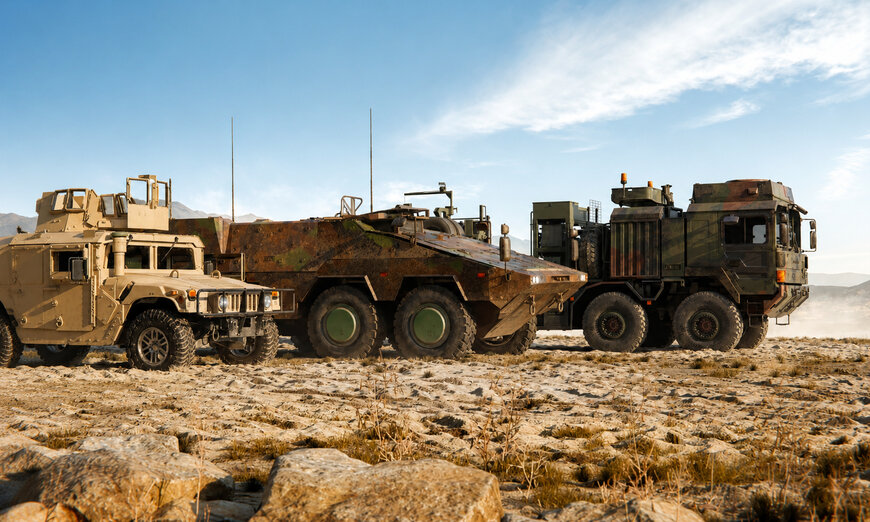
Continental has announced the expansion of its tactical vehicle tire portfolio engineered to optimize structural integrity across low-traction terrain. This hardware deployment introduces advanced tread patterns and high-density carcass architectures developed to sustain heavy logistical trucks, light utility platforms, and tactical deployment vehicles operating under severe-duty mechanical stress. To demonstrate these field capabilities in a live operational environment, the complete portfolio is being showcased at the Eurosatory exhibition held from June 15 to 19, 2026, in Paris, France.
Off-road traction mechanics and structural casing reinforcement
The severe mechanical demands of tactical transport necessitate heavy-duty tire construction capable of resisting stone drilling, sidewall puncture, and extreme carcass deflection. Operating under high cargo loads and sustained travel speeds, the structural engineering incorporates thick under-tread rubber matrices and multi-ply steel cord belts. These structural boundaries prevent premature casing separation and footprint distortion during rapid torque changes on loose gravel, deep mud, and sand matrices.
In heavy tactical vehicle configurations, such as those utilizing the SOT Traction product line, the deep-groove block kinematics provide self-cleaning properties that prevent mud packing in the interstitial voids of the tread. The specialized high-durability rubber compounds minimize heat buildup under full weight ratings, yielding a stable footprint that distributes contact pressure evenly. This uniform pressure distribution limits tread wear and maximizes torque conversion efficiency across low-traction surfaces without forcing vehicles to sacrifice speed ceilings during critical supply-chain maneuvers.
Terrain-specific profile tuning and system-level load optimization
The architecture introduces custom profile cross-sections to match specific field-level deployment categories, separating medium logistical requirements from light multi-terrain maneuvers. By integrating high-stiffness shoulder blocks and stone-ejector ridges within the tread grooves, the HCS variants for medium tactical and logistical vehicles optimize directional stability across uneven surfaces. This design isolates localized lateral shear stress, stopping lateral slip from disrupting heavy convoy steering paths, while the Grabber X3 profiles handle the high agility needs of light off-road platforms.
When synchronized with central tire inflation systems, the flexible yet robust bead construction achieves uniform sealing tension at reduced inflation pressures. This mechanical compliance allows the tire to widen its contact patch significantly over soft sand or silt, increasing total flotation metrics. This decentralized load optimization cuts down rolling resistance in deep terrain, decreasing fuel consumption while preserving the mechanical life of drivetrain links.
Additional Context: This section details technical specifications and competitive benchmarking not included in the original product announcement
Within the high-performance military and tactical tire market, this expanded portfolio competes directly with established lines such as the Michelin X Force series or the Goodyear MV/T tactical tire family. Objective technical benchmarking indicates that while conventional standard-duty utility tires require external run-flat inserts that add unsprung mass and complicate field replacement, Continental's smart rubber compounding integrates defensive boundaries close to the tyre carcass. This design minimizes wheel assembly imbalance and stabilizes total rotation cycles under severe-duty cross-country processing loads.
Additionally, a dense global supply-chain footprint underlines substantial market traction alongside legacy industrial fleet implementations. However, achieving maximum traction gains across mixed tarmac and gravel surfaces demands precise synchronization with modern electronic stability control systems; improper inflation tuning in multi-axle heavy transport trucks can introduce high heat generation at the crown, reducing total tread life advantages compared to specialized highway blocks equipped with passive rigid sipes.
Edited by Sucithra Mani, Induportals editor – adapted by AI.
www.continental.com
