
www.aero-defence.tech
12
'26
Written on Modified on
Integrating multi-modal earth observation networks into open software frameworks
Rheinmetall and ICEYE are coordinating an alliance of technology partners to build a unified space-based reconnaissance architecture.
www.rheinmetall.com
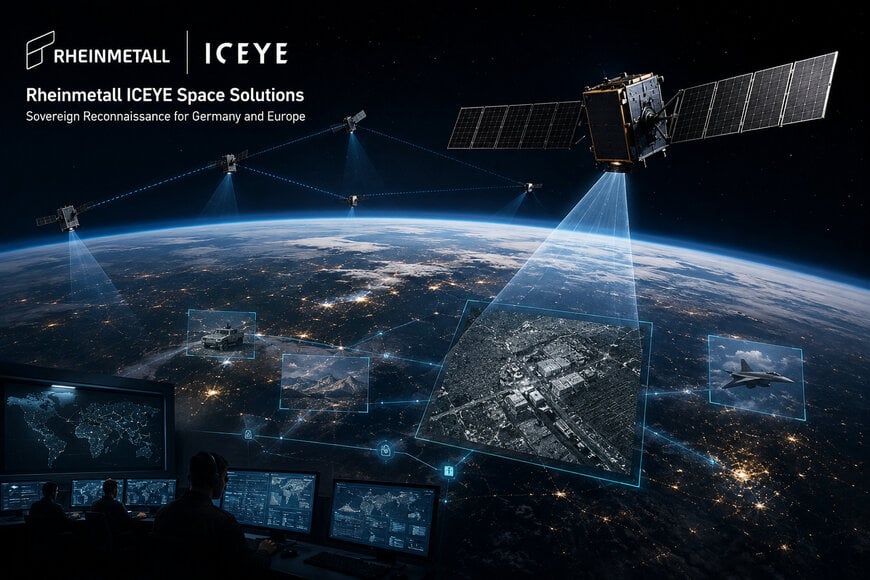
Rheinmetall and ICEYE, operating through their joint venture Rheinmetall ICEYE Space Solutions, have established a technical cooperation to integrate satellite telemetry with tactical data networks. The open architecture aggregates multi-modal Earth observation streams into decentralized military command channels, targeting real-time intelligence infrastructure across space, air, land, sea, and cyber domains.
Operational fragmentation in high-frequency data pipelines
Modern defense networks depend on rapid situational awareness, yet telemetry from independent orbital platforms remains highly siloed. Traditional imagery networks require isolated terrestrial processing gateways, which creates substantial bottlenecks when converting raw sensor data into actionable information.
Without automated processing loops, manual data aggregation between thermal imagery, optical snapshots, and synthetic aperture radar (SAR) feeds increases latency. This processing lag impedes localized tactical decision-making when monitoring highly dynamic environments across varied operational areas.
Open architecture mechanics and technical division of responsibilities
The joint initiative establishes an interoperable intelligence, surveillance, and reconnaissance (ISR) platform using an open software framework. This architecture integrates specialized aerospace sensor technologies from multiple German partner companies, including Reflex Aerospace, OroraTech, ConstellR, and LiveEO.
The responsibilities within the technical system are partitioned across specific core capabilities:
- Rheinmetall and ICEYE components: Host the operational processing framework, manage tactical ground station interfaces, and execute the high-speed data pipelines that unify incoming raw feeds.
- Partner subsystems: Integrate specialized thermal data sensors, multi-spectral imaging payloads, automated orbital analytics software, and rapid deployment small-satellite bus architectures into the common baseline platform.
The open system relies on artificial intelligence algorithms embedded directly at the data layer to normalize and cross-reference diverse sensor parameters automatically, accelerating target detection and verification routines.
Scalable deployment and cross-domain data integration
The technical deployment focuses on integrating the unified software architecture with existing field-level command and control systems. The operational framework routes processed satellite data directly to cross-domain tactical interfaces.
The implementation methodology relies on a parallel integration protocol. High-altitude and orbital sensor arrays transmit multi-modal telemetry to secure cloud frameworks, where data filtering occurs before distribution to ground units. This approach allows defense operators to scale information access across different network domains without modifying verified tactical equipment layers, enabling immediate testing of multi-sensor fusion.
Measurable benefits and structural impact
Consolidating disparate orbital intelligence pipelines into a single open-architecture framework reduces the latency between initial sensor capture and localized data delivery. The inclusion of automated processing layers optimizes bandwidth across satellite links by transmitting analyzed metadata instead of uncompressed raw telemetry. Furthermore, the interoperable software interface enables engineering teams to scale the system by incorporating new sensor types over time, reinforcing long-term data security and processing stability across continuous monitoring networks.
Edited by Sucithra Mani, Induportals editor – adapted by AI.
www.rheinmetall.com
Scalable deployment and cross-domain data integration
The technical deployment focuses on integrating the unified software architecture with existing field-level command and control systems. The operational framework routes processed satellite data directly to cross-domain tactical interfaces.
The implementation methodology relies on a parallel integration protocol. High-altitude and orbital sensor arrays transmit multi-modal telemetry to secure cloud frameworks, where data filtering occurs before distribution to ground units. This approach allows defense operators to scale information access across different network domains without modifying verified tactical equipment layers, enabling immediate testing of multi-sensor fusion.
Measurable benefits and structural impact
Consolidating disparate orbital intelligence pipelines into a single open-architecture framework reduces the latency between initial sensor capture and localized data delivery. The inclusion of automated processing layers optimizes bandwidth across satellite links by transmitting analyzed metadata instead of uncompressed raw telemetry. Furthermore, the interoperable software interface enables engineering teams to scale the system by incorporating new sensor types over time, reinforcing long-term data security and processing stability across continuous monitoring networks.
Edited by Sucithra Mani, Induportals editor – adapted by AI.
www.rheinmetall.com
