
www.aero-defence.tech
05
'26
Written on Modified on
Advanced Propulsion Validation for Long-Range Strike Missiles
Lockheed Martin, L3Harris and the U.S. Army advance a ramjet-powered missile configuration for extended-range precision strike applications.
www.lockheedmartin.com
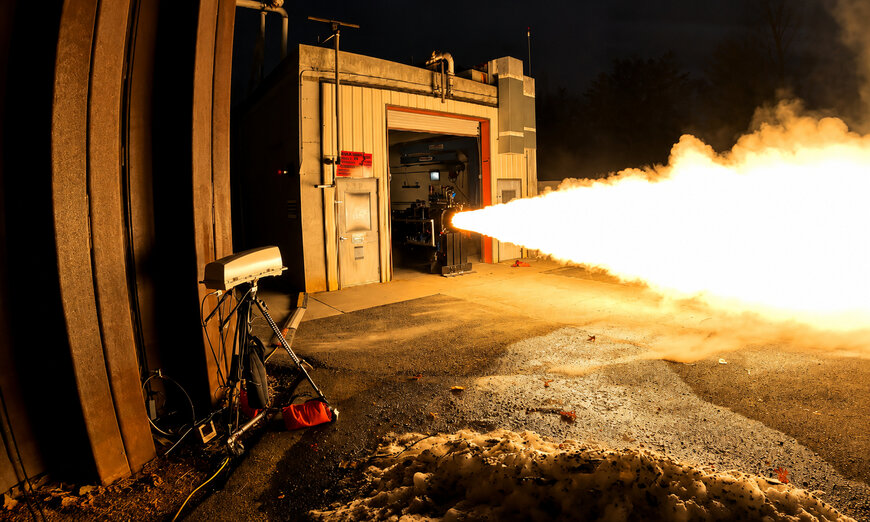
Lockheed Martin, L3Harris and the U.S. Army have completed a propulsion validation milestone for the Precision Strike Missile (PrSM) Increment 4 program. The test verified a booster-to-ramjet transition sequence intended to support long-range precision strike missions while maintaining compatibility with existing launcher and logistics infrastructure.
Targeted at land and maritime strike operations, the system is being developed to extend engagement ranges beyond current PrSM configurations without requiring new launch platforms.
Partner Roles and Program Objectives
The cooperation combines missile system development, propulsion engineering and military operational requirements. Lockheed Martin is responsible for the PrSM Increment 4 missile design and system integration. L3Harris provides the ramjet propulsion technology and testing infrastructure, while the U.S. Army defines operational requirements and supports program development.
The primary objective is to increase missile range while preserving compatibility with existing launchers and support systems. Achieving this goal requires integration of advanced air-breathing propulsion with a missile architecture suitable for current operational environments.
Technical Solution and Responsibilities
The recently completed Direct Connect Transition Test was conducted at an L3Harris facility specializing in high-speed air-breathing propulsion systems. The test demonstrated the transition from a booster propulsion phase to sustained ramjet operation, a critical requirement for the missile’s extended-range configuration.
The propulsion architecture is designed to support engagement ranges exceeding 1,000 kilometres. According to the program information, the ramjet-powered configuration is expected to provide approximately twice the range of the baseline PrSM while retaining compatibility with existing M142 HIMARS and M270 launcher systems.
Lockheed Martin and L3Harris have jointly invested more than $300 million in additive manufacturing and production automation technologies. These investments support rapid hardware production and are intended to accelerate transition from development to operational deployment.
Deployment and Integration
Completion of the transition test removes a major technical risk before flight testing. The next phase of the program includes missile flight trials intended to validate propulsion performance under operational conditions.
The missile maintains the same transport container dimensions as earlier PrSM variants and can be transported using existing C-130 aircraft logistics networks. This approach allows integration into current military infrastructure without modifications to launch platforms, transport systems or supply-chain processes.
Applications and Operational Impact
The missile is intended for long-range precision strike missions against relocatable land targets and moving maritime targets. The combination of extended range, sustained ramjet propulsion and compatibility with existing launch systems enables deployment without significant infrastructure changes.
By combining advanced propulsion technology with established launch and logistics systems, the program aims to increase operational reach while reducing the integration challenges typically associated with new missile capabilities.
Edited by Sucithra Mani, Induportals editor – adapted by AI.
www.lockheedmartin.com
