
www.aero-defence.tech
29
'26
Written on Modified on
Air Flow-Through Chassis Seal for Embedded Computing Systems
Parker Chomerics has developed an isolation sealing mechanism to comply with ANSI/VITA 48.5-2026 standards in aerospace and defense thermal management architectures.
www.parker.com
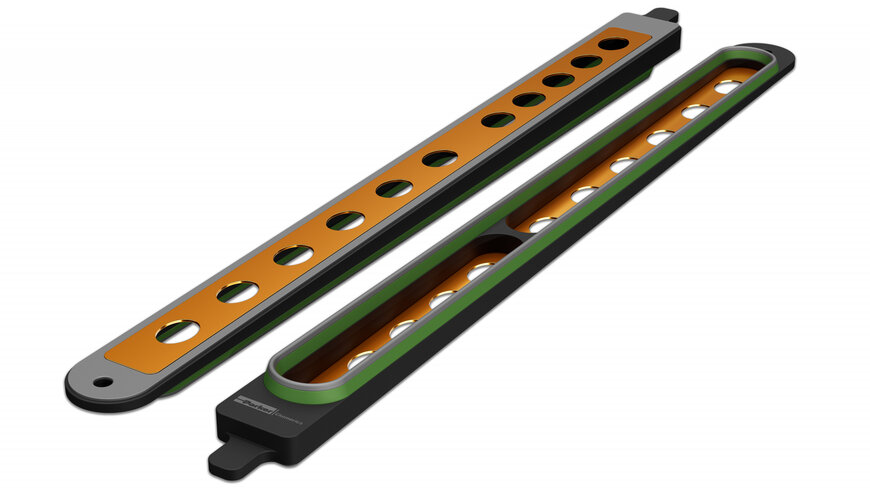
The Chomerics Division of Parker Hannifin Corporation has introduced a VITA 48.5 chassis seal, functioning as an air flow-through isolation mechanism. The component meets the mechanical and interface specifications defined in ANSI/VITA 48.5-2026. This sealing mechanism is engineered for embedded computing architectures within defense and aerospace sectors, establishing a secure interface between the chassis plenum and the module heat exchanger. By isolating the cooling airflow path, the seal prevents external air from contacting sensitive electronic components.
Operational Principles and Material Specifications
The sealing component functions by preventing contaminated airflow from reaching electronic assemblies, protecting systems deployed in environments characterized by moisture, particulate matter, and salt. The seal integrates into forced-air thermal management configurations utilized in avionics, radar arrays, surveillance equipment, command electronics, and ground vehicle platforms.
The architecture utilizes a dual-durometer elastomer construction featuring a 1-degree taper. This geometry yields uniform compression and sealing functionality within a predefined deflection range of 0.2 millimeters to 0.76 millimeters. The elastomer configuration maintains isolation integrity across pressure and temperature variations, isolating the cooling path under operational parameters. The silicone elastomers comply with the A-A-59588 specification, aligning with military and aerospace material requirements.
Structural Integration and Compliance
The structural frame of the seal is manufactured from aluminum and is anodized according to MIL-PRF-8625 Type III, Class 1 standards. A fluorinated ethylene propylene (FEP) coating is applied to the frame to reduce friction coefficients during the insertion and extraction of modules. This surface treatment ensures mechanical repeatability in ruggedized embedded computing platforms. The seal is listed as a suggested source within the ANSI/VITA 48.5-2026 standard.
According to Jesse Hagar, Product Manager at Parker Chomerics, maintaining a controlled airflow path in defense and aerospace electronics is necessary to ensure functional forced-air thermal management. Hagar noted that the seal allows engineers to isolate computing hardware while facilitating installation and maintenance procedures.
System Compatibility and Configurations
The seals are manufactured in 4.45-millimeter and 9.53-millimeter widths, accommodating both inlet and exhaust module designs. Complementary structural components, such as air seal retainer blocks, blanks, and orifice plates, are utilized to complete system integration. The hardware is specifically engineered to align with ANSI/VITA 48.5-2026 parameters and does not maintain backward compatibility with legacy ANSI/VITA 48.5-2010 configurations.
Additional Context: This section details technical specifications and competitive benchmarking not included in the original product announcement.
The VITA 48.5 standard defines Air Flow-Through (AFT) cooling protocols for VPX and other embedded systems. Compared to VITA 48.2 conduction cooling standards, which rely on heat transfer through metal rails and face limitations in dissipating high thermal loads, AFT architectures channel cooling air directly through the center of the module's heat sink. This approach increases the thermal dissipation capacity necessary for high-density processors without exposing the printed circuit boards to environmental contaminants. Alternative thermal management frameworks, such as VITA 48.4 liquid flow-through cooling, provide higher cooling capacities but require complex fluid loop infrastructures and mechanical pumps. The VITA 48.5 AFT standard balances high thermal dissipation with simpler pneumatic systems, making precise elastomeric sealing mechanisms critical to maintaining internal atmospheric separation.
Edited by an industrial journalist, Lekshman Ramdas, with AI assistance.
www.parker.com
