
www.aero-defence.tech
29
'26
Written on Modified on
Autonomous Military Vehicle Development Partnership
American Rheinmetall and Harbinger are collaborating to develop unmanned ground vehicles for U.S. military applications.
www.rheinmetall.com
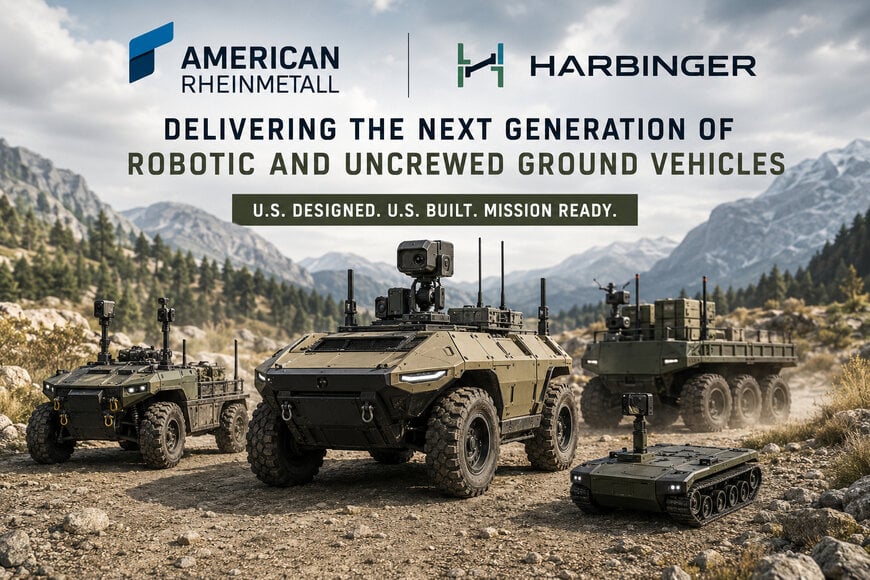
American Rheinmetall and Harbinger have entered into a partnership to develop a family of robotic and unmanned ground vehicles (UGVs) for military logistics, sustainment, and combat-related applications. The cooperation combines vehicle integration and mission systems expertise with an autonomy-ready hybrid vehicle platform to address requirements for military automation and autonomous mobility.
Background of the Cooperation
The increasing use of autonomous systems in military operations is driving demand for platforms that can be both technically scalable and economically produced. Unmanned vehicles are intended to reduce personnel exposure in hazardous environments, support resupply missions, and enhance operational flexibility. Developing such systems requires the integration of vehicle engineering, mission systems, control architectures, and autonomous technologies.
American Rheinmetall contributes expertise in military vehicle integration, mission equipment, and modular vehicle architectures. Harbinger complements the partnership with a commercially derived hybrid-electric platform designed for autonomous operation and drive-by-wire functionality.
Technical Solution and Responsibilities
Under the agreement, American Rheinmetall is responsible for integrating mission systems, vehicle architectures, and application-specific payloads. The company brings experience in ground combat vehicle integration as well as established production and support facilities in the United States.
Harbinger provides the underlying vehicle platform. The system is based on a hybrid-electric powertrain featuring scalable battery technology and a combustion-engine range extender. The platform supports fully electronic drive-by-wire controls, a prerequisite for autonomous operation and teleoperation.
Key technical characteristics include reduced thermal and acoustic signatures, extended operational endurance through hybrid propulsion, and compatibility with autonomous control and remote-operation systems. The architecture is designed to support multiple vehicle configurations and mission profiles.
Deployment and Implementation
The initial focus of the cooperation includes autonomous tactical wheeled vehicles, unmanned resupply systems for contested environments, and robotic platforms supporting manned-unmanned teaming concepts. These application areas align with ongoing U.S. Army modernization efforts in military automation and autonomous systems.
The partners plan to leverage commercially derived vehicle architectures and pursue development opportunities through Commercial Solutions Openings (CSOs), Other Transaction Authorities (OTAs), and conventional procurement programs. Joint technology demonstrations are expected to support the next phase of evaluation and prototyping.
Applications and Use Cases
Potential applications include battlefield logistics, contested-environment resupply, reconnaissance support, and autonomous transport missions. By integrating autonomous mobility with mission-specific payloads, the vehicles can perform operational tasks while reducing the need for personnel exposure in high-risk areas.
The modular architecture also enables adaptation for different vehicle classes and mission requirements, supporting future expansion across a range of military ground platforms.
Expected Impact
The partnership aims to shorten development timelines for autonomous military vehicles by combining commercially available vehicle technologies with military integration expertise. Using a production-oriented hybrid platform alongside established mission-system integration capabilities may help reduce development risks and accelerate manufacturing scalability.
In addition, autonomous and remotely operated vehicles can undertake transport and sustainment missions without placing operators directly in harm’s way. The modular design approach further supports long-term maintainability, system upgrades, and integration of future autonomous capabilities.
Edited by Sucithra Mani, Induportals editor – adapted by AI.
www.rheinmetall.com
