
www.aero-defence.tech
28
'26
Written on Modified on
Autonomy Test Advances Collaborative Air Combat
General Atomics Aeronautical Systems and the U.S. Air Force demonstrated manned-unmanned teaming between an MQ-20 Avenger and an F-35 during a joint autonomy exercise.
www.ga.com
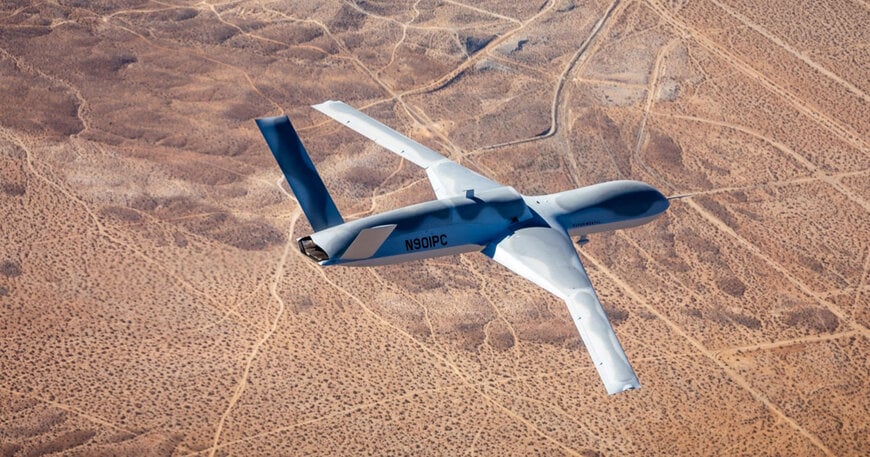
General Atomics Aeronautical Systems, Inc. (GA-ASI), together with the F-35 Joint Program Office, U.S. Air Force test units, Lockheed Martin and Autonodyne, conducted a flight test focused on collaborative combat aircraft operations and autonomous mission coordination. The exercise paired an F-35 Lightning II fighter aircraft with an MQ-20 Avenger unmanned jet configured as a Collaborative Combat Aircraft (CCA) surrogate.
The project was intended to validate communication, autonomy and command systems required for future manned-unmanned teaming operations in combat environments.
Integration of Autonomous Air Combat Systems
The demonstration focused on enabling coordinated interaction between a piloted fighter aircraft and an autonomous unmanned platform. The MQ-20 Avenger was equipped with GA-ASI’s TacACE tactical autonomy software, based on the U.S. government’s reference autonomy architecture.
The system was designed to support rapid integration between autonomous mission software, aircraft control systems and military communication networks. During the exercise, the MQ-20 and F-35 exchanged operational data using a tactical proliferated low Earth orbit communication link.
The test also demonstrated Beyond Line of Sight communication between an airborne MQ-20 and an F-35 located on the ground. This configuration enabled the F-35 pilot to transmit tactical autonomy commands through a cockpit tablet interface connected to the unmanned aircraft.
Tactical Command and Autonomous Maneuvering
The autonomy exercise evaluated how pilots could direct unmanned systems during operational missions while reducing manual control requirements. Commands transmitted from the F-35 were processed by the MQ-20’s TacACE autonomy software using capabilities developed under the Autonomy Government Reference Architecture.
During the demonstration, the pilot directed the MQ-20 to perform tactical maneuvers, modify waypoints and transfer ADS-B track information back to the fighter aircraft. The test validated interoperability between onboard autonomy systems, communication networks and mission-management interfaces.
According to GA-ASI, the objective was to verify that autonomous aircraft can respond to tactical commands while maintaining coordinated mission execution with manned aircraft.
Michael Atwood, vice president of Advanced Programs at GA-ASI, stated that the exercise represented a milestone toward operational readiness for collaborative combat aircraft and demonstrated near-term opportunities for force integration.
Validation of Manned-Unmanned Teaming Concepts
Manned-unmanned teaming is being developed to allow fighter aircraft to operate alongside multiple highly autonomous support aircraft capable of surveillance, sensing and tactical mission execution.
The recent exercise validated several technical elements required for this operational concept, including autonomy software integration, low Earth orbit communications, mission command interfaces and data exchange between aircraft platforms.
GA-ASI has used the MQ-20 Avenger as a surrogate collaborative combat aircraft platform for more than five years. The aircraft has supported testing activities both before and after the development of the company’s purpose-built XQ-67A Off-Board Sensing Station and YFQ-42A unmanned combat aircraft.
The demonstration forms part of broader efforts within the defense aerospace sector to develop scalable autonomous systems capable of operating alongside crewed combat aircraft in future air operations.
Edited by Sucithra Mani, Induportals editor – adapted by AI.
www.ga.com
