
www.aero-defence.tech
28
'26
Written on Modified on
Laser-Light Module Integration For Modern Small Arms Systems
Rheinmetall will supply an additional six-figure quantity of targeting modules to the German armed forces to enhance multi-spectral combat operations.
www.rheinmetall.com
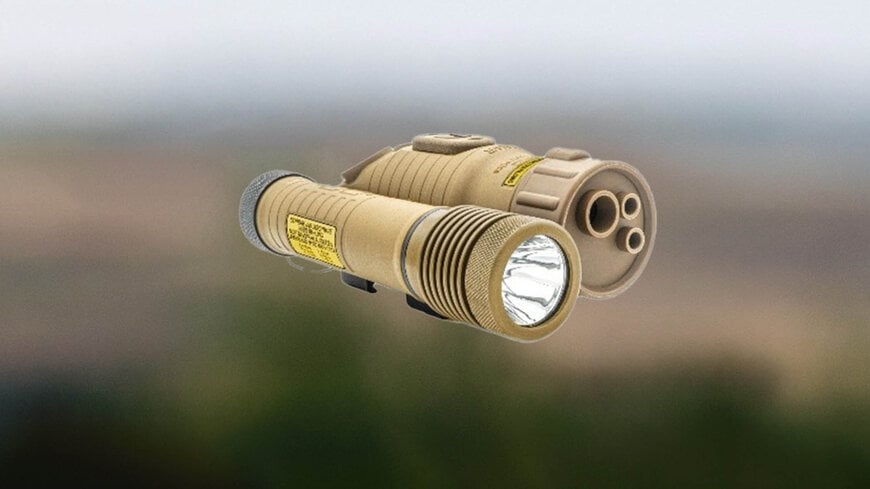
The integration of specialized laser-light modules onto infantry small arms provides essential target detection, identification, and marking capabilities. Rheinmetall has secured an order to deliver an additional six-figure quantity of LLM-VarioRay modules to the German Bundeswehr between 2026 and 2032. Following budget approval by the German Bundestag’s Budget Committee in December 2025, this procurement extends a framework agreement originally established in June 2021. The devices are manufactured at the Rheinmetall Soldier Electronics facility in Stockach, Germany, supported by a network of domestic suppliers.
Operating Principles and System Architecture
The LLM-VarioRay laser-light module functions as an integrated optical aiming system for dismounted infantry forces. Weighing approximately 250 grams including its mounting hardware, the device attaches directly to standard assault rifles utilizing either a MIL-STD 1913 or STANAG 4694 rail interface. Operators control the module via a dedicated trigger cable connected to the weapon system. The optical array integrates four distinct illumination and targeting mechanisms: a high-output white light LED, a red-light laser marker, an infrared laser marker, and an electrically focusable infrared illuminator. Module functions are managed through a rotary switch that enables stepless selection and adjustment of the active light source.
Optical Alignment and Tactical Application
To maintain zero and optimize accuracy, the module is constructed with a fully integrated, factory-aligned laser block. This internal configuration simplifies the bore-sighting process and the overall optical alignment between the weapon system and the aiming visor. When operated in conjunction with separate night vision goggles or thermal imaging optics, the infrared components of the module allow operators to identify and mark targets without emitting visible light. This multi-spectral capability ensures operational effectiveness regardless of ambient lighting or weather conditions.
Dr. Timo Haas, Head of Rheinmetall’s Digital Systems division, noted that the module operates as a "tactical combat enhancer for dismounted soldiers," stating that the procurement scale reflects the "constructive cooperation between industry, procurement authorities and the armed forces."
Cross-Platform Deployment and Integration
The implementation of the LLM-VarioRay extends beyond standard infantry rifles, serving as a core component of the German military's "Future Soldier – Extended System (IdZ-ES)." The hardware architecture has also been standardized across other European armed forces, currently operating within the British Army under the designation Laser-Light-Module MK3, and within the Swiss Army as the Laser-Light-Module 19. The manufacturer's broader portfolio of illumination hardware includes the LM-VTAL (Laser Module - Variable Tactical Aiming Laser), which features specific adaptations for special operations units.
Additional Context: This section details technical specifications and competitive benchmarking not included in the original product announcement.
In the global defense market, multi-spectral laser aiming devices are evaluated based on weight, rail footprint, and integrated functions. The LLM-VarioRay (approximately 250g) competes directly with systems such as the L3Harris AN/PEQ-15 (ATPIAL), which weighs roughly 212g, and the Steiner DBAL-A3, which weighs 227g. While the AN/PEQ-15 requires operators to mount a separate white-light source—such as a SureFire Scout light—consuming additional rail space and increasing overall system weight, the LLM-VarioRay natively integrates the white-light LED alongside its infrared and visible lasers into a single housing. This integration provides a lower total footprint on the MIL-STD 1913 rail, optimizing weapon balance and ergonomics for standard infantry units.
Edited by an industrial journalist, Lekshman Ramdas, with AI assistance.
www.rheinmetall.com
