
www.aero-defence.tech
27
'26
Written on Modified on
Long-Range Rocket Launcher Advances French Deep-Strike Capability
Thales and its industrial partners are developing a modular long-range land strike system to support sovereign defence capability and replace ageing rocket artillery infrastructure.
www.thalesgroup.com
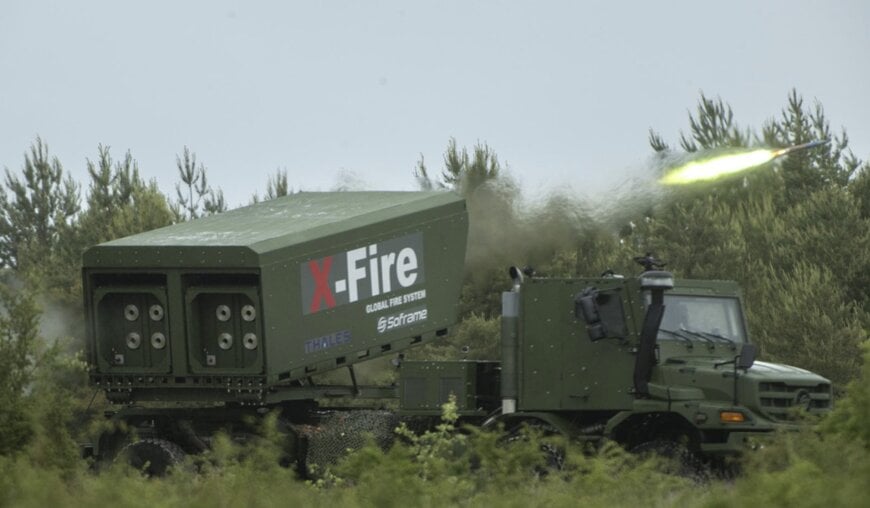
The versatile X-Fire launcher © Thales
Thales has completed the first live firings of its X-Fire ground launcher, a long-range land strike platform developed with Soframe, as part of France’s effort to modernise deep-strike artillery capabilities. The system combines a mobile launcher architecture, resilient navigation technologies, and compatibility with both domestic and allied munitions for land warfare applications.
Deep-Strike Modernisation for Ground Forces
The live firings conducted on 20 May 2026 marked a technical milestone for France’s long-range precision fires programme. The X-Fire launcher is being positioned as a replacement pathway for the French Army’s LRU (Unitary Rocket Launcher) system, which is approaching end-of-life.
The programme addresses two parallel requirements in modern artillery procurement: maintaining uninterrupted operational capability while building sovereign strike capacity. To support this transition, the launcher is designed to deploy both French-developed and foreign munitions, allowing armed forces to preserve combat readiness while indigenous systems complete development.
This dual-path approach reflects a broader defence procurement trend in Europe, where operational continuity increasingly competes with strategic autonomy requirements.
Modular Launcher Architecture and Mobility Design
X-Fire has been developed as a mobile 8x8 launcher platform intended for rapid deployment and compatibility with the French Army’s broader logistics fleet. Vehicle commonality is relevant because it can reduce training complexity, simplify maintenance support, and improve fleet interoperability.
The launcher is designed for deep-strike missions at ranges of 150 km and beyond, depending on munition selection. Its modular architecture allows integration with multiple ammunition types rather than restricting the platform to a single proprietary missile family.
For modern land warfare, launcher flexibility has become a critical system parameter because artillery forces increasingly require adaptable firing platforms capable of responding to supply constraints, coalition interoperability demands, and evolving battlefield missions.
Sovereign Ballistic Munition Development
The X-Fire platform forms part of a broader long-range strike ecosystem being developed with ArianeGroup.
On 5 May 2026, Thales and ArianeGroup conducted demonstration firings of the FLP-T 150 ballistic munition, a sovereign long-range strike munition intended to enter service before the end of the decade. This munition is being positioned as the long-term domestic precision fires solution for French forces.
Until that capability becomes operational, X-Fire’s compatibility with foreign munitions provides a bridging mechanism.
This approach reduces capability gaps that might otherwise emerge as existing launcher inventories retire before sovereign replacement systems are fielded.
Navigation Resilience in Contested Electromagnetic Environments
One of the system’s more technically relevant characteristics is its navigation architecture.
The launcher integrates Thales’ TopStar Smart Receiver GNSS anti-jamming receiver alongside the TopAxyz inertial measurement unit. These systems support positioning, navigation, and timing continuity in electronically contested operating conditions where GNSS disruption or spoofing may degrade targeting accuracy.
In long-range precision strike missions, navigation resilience directly affects firing precision, mission reliability, and survivability. Inertial backup systems are particularly important when satellite navigation denial is expected.
This positions the launcher within the wider military electronics trend toward hardened battlefield navigation systems.
Training and Operational Transition Mechanisms
The 20 May firing campaign also included the Thales 68 mm X-Fum training rocket.
This training munition has previously been tested on platforms including the Tiger combat helicopter and is intended to support operator familiarisation during transition to the new launcher architecture.
Training compatibility matters because artillery modernisation programmes often face delayed operational readiness when crews must adapt to unfamiliar fire control systems, loading procedures, and targeting workflows.
By incorporating a dedicated training munition into the transition strategy, the programme aims to shorten the gap between equipment delivery and deployable operational competence.
Strategic Relevance for European Land Defence
Long-range rocket artillery has regained strategic importance due to evolving battlefield requirements for distributed fires, rapid counter-battery response, and deep logistical disruption.
Systems capable of precision engagement beyond 150 km extend operational reach against logistics hubs, command infrastructure, and support assets beyond traditional artillery envelopes.
For France, the X-Fire programme represents both an artillery replacement initiative and an industrial sovereignty project, particularly as European governments reassess dependence on externally sourced missile systems.
Edited by Aishwarya Mambet, Induportals Editor, with AI assistance.
www.thalesgroup.com
Thales has completed the first live firings of its X-Fire ground launcher, a long-range land strike platform developed with Soframe, as part of France’s effort to modernise deep-strike artillery capabilities. The system combines a mobile launcher architecture, resilient navigation technologies, and compatibility with both domestic and allied munitions for land warfare applications.
Deep-Strike Modernisation for Ground Forces
The live firings conducted on 20 May 2026 marked a technical milestone for France’s long-range precision fires programme. The X-Fire launcher is being positioned as a replacement pathway for the French Army’s LRU (Unitary Rocket Launcher) system, which is approaching end-of-life.
The programme addresses two parallel requirements in modern artillery procurement: maintaining uninterrupted operational capability while building sovereign strike capacity. To support this transition, the launcher is designed to deploy both French-developed and foreign munitions, allowing armed forces to preserve combat readiness while indigenous systems complete development.
This dual-path approach reflects a broader defence procurement trend in Europe, where operational continuity increasingly competes with strategic autonomy requirements.
Modular Launcher Architecture and Mobility Design
X-Fire has been developed as a mobile 8x8 launcher platform intended for rapid deployment and compatibility with the French Army’s broader logistics fleet. Vehicle commonality is relevant because it can reduce training complexity, simplify maintenance support, and improve fleet interoperability.
The launcher is designed for deep-strike missions at ranges of 150 km and beyond, depending on munition selection. Its modular architecture allows integration with multiple ammunition types rather than restricting the platform to a single proprietary missile family.
For modern land warfare, launcher flexibility has become a critical system parameter because artillery forces increasingly require adaptable firing platforms capable of responding to supply constraints, coalition interoperability demands, and evolving battlefield missions.
Sovereign Ballistic Munition Development
The X-Fire platform forms part of a broader long-range strike ecosystem being developed with ArianeGroup.
On 5 May 2026, Thales and ArianeGroup conducted demonstration firings of the FLP-T 150 ballistic munition, a sovereign long-range strike munition intended to enter service before the end of the decade. This munition is being positioned as the long-term domestic precision fires solution for French forces.
Until that capability becomes operational, X-Fire’s compatibility with foreign munitions provides a bridging mechanism.
This approach reduces capability gaps that might otherwise emerge as existing launcher inventories retire before sovereign replacement systems are fielded.
Navigation Resilience in Contested Electromagnetic Environments
One of the system’s more technically relevant characteristics is its navigation architecture.
The launcher integrates Thales’ TopStar Smart Receiver GNSS anti-jamming receiver alongside the TopAxyz inertial measurement unit. These systems support positioning, navigation, and timing continuity in electronically contested operating conditions where GNSS disruption or spoofing may degrade targeting accuracy.
In long-range precision strike missions, navigation resilience directly affects firing precision, mission reliability, and survivability. Inertial backup systems are particularly important when satellite navigation denial is expected.
This positions the launcher within the wider military electronics trend toward hardened battlefield navigation systems.
Training and Operational Transition Mechanisms
The 20 May firing campaign also included the Thales 68 mm X-Fum training rocket.
This training munition has previously been tested on platforms including the Tiger combat helicopter and is intended to support operator familiarisation during transition to the new launcher architecture.
Training compatibility matters because artillery modernisation programmes often face delayed operational readiness when crews must adapt to unfamiliar fire control systems, loading procedures, and targeting workflows.
By incorporating a dedicated training munition into the transition strategy, the programme aims to shorten the gap between equipment delivery and deployable operational competence.
Strategic Relevance for European Land Defence
Long-range rocket artillery has regained strategic importance due to evolving battlefield requirements for distributed fires, rapid counter-battery response, and deep logistical disruption.
Systems capable of precision engagement beyond 150 km extend operational reach against logistics hubs, command infrastructure, and support assets beyond traditional artillery envelopes.
For France, the X-Fire programme represents both an artillery replacement initiative and an industrial sovereignty project, particularly as European governments reassess dependence on externally sourced missile systems.
Edited by Aishwarya Mambet, Induportals Editor, with AI assistance.
www.thalesgroup.com
