
www.aero-defence.tech
21
'26
Written on Modified on
Resilient Communications for Agile Combat Employment
RTX BBN Technologies developed a self-healing communication architecture funded by the Air Force Research Laboratory to ensure continuous data flow across contested digital infrastructure.
www.rtx.com
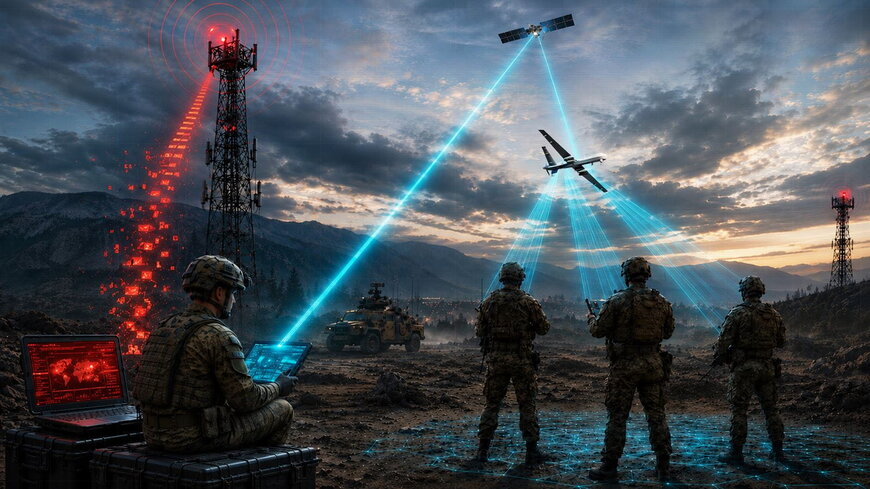
The Air Force Research Laboratory and RTX BBN Technologies have cooperated to develop and demonstrate a self-healing system designed for combat air support environments. The technology ensures continuous, secure data transmission across fragmented, jammed, or low-power communication networks.
Infrastructure Challenges and Partner Roles
Modern industrial and defense networks require constant synchronization across highly dispersed environments. When high-capacity primary links face interference or jamming, data flow typically drops, forcing operators to manually troubleshoot connections.
To address this complexity, the Air Force Research Laboratory provided funding and oversight, while RTX BBN Technologies engineered the software architecture. Collins Aerospace, an RTX business based in Ottawa, Canada, integrated high-frequency radio support, and the Institute for Human and Machine Cognition in Pensacola, Florida, supplied the necessary long-range radio hardware.
Technical Architecture and System Responsibilities
The system relies on the Primary, Alternate, Contingency, and Emergency for Agile Combat Employment (PACE4ACE) architecture. PACE4ACE functions at the network layer to automatically monitor link quality across diverse communication pathways, including satellite links and tactical radios.
The software uses dynamic, real-time routing protocols to assess channel performance. If a high-capacity link encounters degradation or active jamming, the system automatically selects the next viable waveform and reroutes traffic. This self-healing process occurs without human operator intervention, preventing data loss in Open Mission Systems and Team Awareness Kit applications.
The design utilizes a compact architecture with optimized size, weight, and power (SWaP) parameters. This allows the system to integrate into power-constrained edge devices and legacy hardware interfaces via plug-and-play integration frameworks.
Implementation and Operational Impact
The architecture underwent deployment testing across four geographically dispersed sites to validate the Agile Combat Employment concept. During the technical demonstration, when primary communication lines were intentionally obstructed, the multi-band routing system shifted traffic to alternative low-power waveforms.
The automated switch successfully maintained synchronization between the distributed nodes, ensuring continuous operational data flow. The technical results confirm that the system preserves network stability and maintainability under severe data-link constraints.
"The network self-heals, so crews can focus on the mission instead of troubleshooting communications."
— Dr. Sam Nelson, principal investigator at RTX BBN Technologies.
The engineering work on PACE4ACE continues in Cambridge, Massachusetts, focusing on broader multi-band compatibility and integration with existing tactical digital infrastructure.
Edited by Evgeny Churilov, Induportals Media - Adapted by AI.
www.rtx.com
