
www.aero-defence.tech
20
'26
Written on Modified on
Integrating Microsatellites for High-Frequency Earth Observation
Axelspace Corporation and Exolaunch are partnering to deploy seven next-generation microsatellites to expand digital infrastructure for global optical remote sensing.
www.axelspace.com
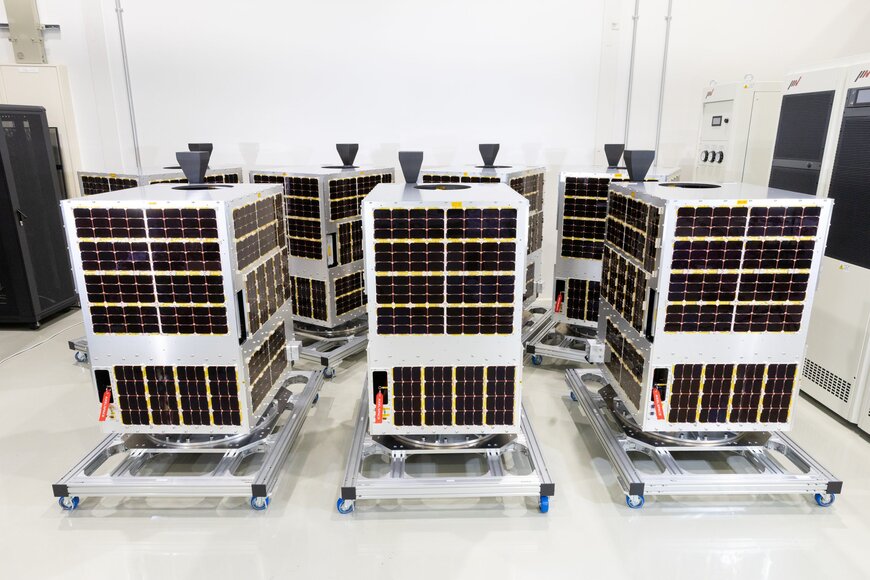
Axelspace Corporation is expanding its existing AxelGlobe Earth observation constellation by deploying seven next-generation GRUS-3 optical microsatellites. Within this cooperative framework, Exolaunch serves as the launch integrator, managing mission logistics, satellite integration, and deployment services. The deployment utilizes a Falcon 9 rocket via the SpaceX Transporter-17 rideshare mission. This cooperation combines Axelspace’s satellite manufacturing and constellation management expertise with the deployment systems and integration capabilities of Exolaunch to scale low-Earth orbit infrastructure.
Technical Specifications and Orbital Logistics
The GRUS-3 microsatellites will operate in a sun-synchronous orbit at an altitude of 585 kilometers. The primary technical objective of this deployment is to establish wide-area, high-frequency data collection. For geographical locations north of 25 degrees latitude, the expanded constellation achieves a revisit rate of once per day.
Each GRUS-3 unit features a spatial resolution, measured as Ground Sample Distance (GSD), of 2.2 meters. The instruments provide an effective swath width of 28.3 kilometers and a maximum continuous capture length of 1,356 kilometers. Operating in unison, the seven new satellites yield a combined daily imaging capacity of 2.3 million square kilometers.
Data Acquisition and Industrial Application
The upgraded digital infrastructure introduces a specialized coastal blue spectral band alongside standard true-color and vegetation-analysis sensors. This technical modification allows the sensor payload to penetrate shallow water surfaces to map seabed topography and monitor seagrass beds.
Axelspace integrates this sensor data with proprietary satellite attitude control technology to support on-demand imaging tasks. The resulting high-frequency data streams provide measurable parameters for precision agriculture, forest management, topographic map creation, and environmental monitoring.
Implementation Timeline
The integration process and final orbital deployment are scheduled to take place no earlier than July 2026 at the Vandenberg Space Force Base in California, USA. The seven new units will join the five active GRUS-1 microsatellites currently in operation, bringing the total operational constellation to 12 active spacecraft.
Edited by Evgeny Churilov, Induportals Media - Adapted by AI.
www.axelspace.com
