
www.aero-defence.tech
13
'26
Written on Modified on
Rheinmetall Showcases Multi-Domain Defense Systems
Presentation at BSDA 2026 includes land, air, naval, soldier systems, and ammunition production capabilities for NATO-aligned defense programs.
www.rheinmetall.com
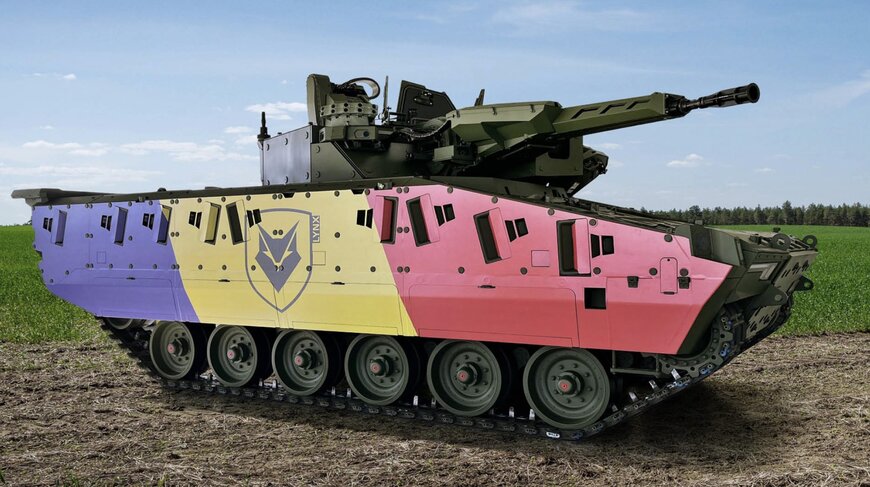
Defense procurement programs increasingly prioritize integrated multi-domain capability, local industrial participation, and scalable ammunition supply as NATO members expand modernization and readiness efforts. In this context, Rheinmetall presented a broad cross-section of its defense systems portfolio at the Black Sea Defense & Aerospace (BSDA) exhibition, held in Bucharest from May 13–15, 2026.
The company’s display covered armored vehicles, air defense, tactical logistics, digital soldier systems, ammunition manufacturing, and naval systems, reflecting a strategy centered on vertically integrated defense manufacturing and lifecycle support.
Land combat systems and tactical mobility
Among the featured platforms was the Lynx KF41 infantry fighting vehicle, configured with the Lance turret, MK30-2/ABM 30 mm automatic cannon, and the Main Sensor Slaved Armament (MSSA) weapon station.
The platform was presented as part of Rheinmetall’s offering for mechanized land forces, with emphasis on adaptable industrial participation models including localized manufacturing and technology transfer.
The company also displayed an HX 3 logistics vehicle from its tactical transport portfolio. The HX vehicle family is intended for military logistics and specialized battlefield support applications, combining off-road mobility with configurable protection levels.
Air defense and digitized soldier systems
Ground-based air defense remains a major procurement priority across Europe as armed forces expand layered protection against aerial threats. Rheinmetall showcased the 35 mm Oerlikon Revolver Gun Mk3, integrated as part of the Oerlikon Skynex air defense system.
The modular system can be mounted on multiple truck platforms, supporting mobile deployment and flexible force structure integration.
In the soldier systems segment, Rheinmetall presented Gladius 2.0, its latest digital soldier system designed to connect dismounted personnel into networked battlefield management environments through end-to-end digital integration.
Such systems are increasingly relevant in modern command-and-control architectures where situational awareness, communications integration, and digital mission coordination are critical.
Ammunition production expansion
Ammunition supply capacity remains a strategic concern across NATO and allied defense industries. Rheinmetall outlined planned production increases across multiple ammunition categories.
For 155 mm artillery ammunition, annual production capacity is targeted at 1.1 million rounds by 2027, increasing to 1.5 million by 2030. Tank ammunition production is planned to reach 240,000 cartridges annually from 2027.
Medium-caliber ammunition output is projected to rise to 3.4 million cartridges by 2027 and 4 million by 2030.
These expansions reflect broader efforts to strengthen sovereign defense manufacturing capacity and reduce supply constraints in long-duration procurement and replenishment cycles.
Naval systems after portfolio expansion
Rheinmetall also highlighted its expanded maritime capabilities following the acquisition of NVL, which established its Naval Systems division.
The division includes shipyards at Blohm+Voss and Norderwerft in Hamburg, Peene-Werft in Wolgast, and Neue Jadewerft in Wilhelmshaven, alongside international engineering and operational activities in Egypt, Brunei, Bulgaria, Croatia, and Singapore.
The naval business supports procurement programs for the German Navy and other NATO naval operators, with capabilities focused on technologically complex naval and coast guard vessel development.
Edited by Aishwarya Mambet, Induportals Editor, with AI assistance.
www.rheinmetall.com
