
www.aero-defence.tech
13
'26
Written on Modified on
Short-Range Interceptor Seeker Validation Completed
Lockheed Martin demonstrated seeker tracking and onboard processing capabilities for the U.S. Army’s next-generation short-range air defence interceptor program.
www.lockheedmartin.com
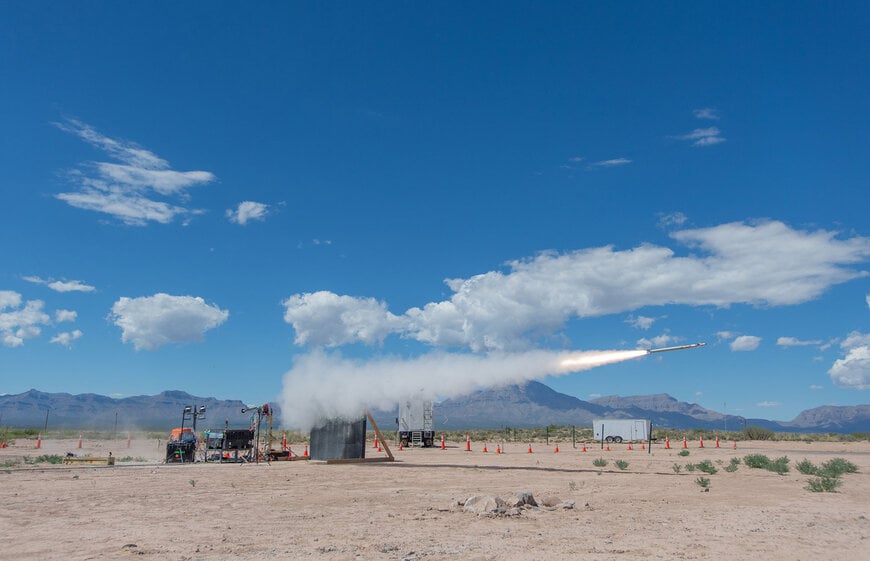
Lockheed Martin has completed a seeker characterization flight test for its QuadStar missile under the U.S. Army’s Next-Generation Short-Range Interceptor (NGSRI) competition. Conducted at White Sands Missile Range in New Mexico on 11 May 2026, the trial evaluated seeker sensing, onboard signal processing and target-tracking functions intended for a future replacement of the legacy Stinger missile system.
Seeker Characterization Flight Test
The test involved launching the QuadStar interceptor from a Command Launch Assembly (CLA) along a tactical flight trajectory. According to the company, the missile demonstrated seeker operation at engagement distances exceeding the capability of the current Stinger-based system.
The primary objective of the Seeker Characterization Flight Test (SCFT) was to verify the seeker’s ability to capture imagery, process signals onboard and maintain continuous target tracking throughout the engagement profile. Lockheed Martin stated that the test also validated CLA functionality and confirmed integration between the seeker, guidance and interceptor subsystems.
The company reported a 100% target acquisition and tracking success rate during the evaluation.
Air Defence and Counter-UAS Applications
The NGSRI programme is intended to address evolving short-range air-defence requirements against unmanned aerial systems, rotary-wing aircraft and fixed-wing threats. Modern interceptor systems increasingly require improved seeker discrimination and faster processing capability to engage low-signature and highly manoeuvrable targets.
Lockheed Martin stated that the QuadStar seeker incorporates AI-enabled signal processing and an open-systems architecture designed to support modular upgrades and faster software integration cycles. Open-system approaches are being adopted across defence and digital supply chain environments to simplify interoperability between sensors, launch systems and mission software.
The company also described the seeker design as intended to support affordability and manufacturability while enabling future capability updates without extensive hardware redesign.
Accelerated Development Timeline
According to Lockheed Martin, the seeker characterization test followed approximately three months after the programme’s first flight event. The compressed development timeline reflects broader defence industry efforts to shorten qualification cycles for short-range air-defence systems responding to rapidly changing aerial threat profiles.
Randy Crites, vice president of Advanced Programs at Lockheed Martin, said the milestone demonstrated continued progress toward delivering a next-generation interceptor for U.S. Army operational requirements.
Chris Murphy, business development lead for Lockheed Martin’s NGSRI activities, stated that completing seeker characterization in under six months highlighted the programme’s focus on manufacturability, affordability and rapid system delivery.
Replacement for the Stinger System
The U.S. Army’s Next-Generation Short-Range Interceptor initiative is intended to replace the FIM-92 Stinger, a shoulder-fired air-defence missile system introduced during the Cold War period. Current replacement programmes are focused on extended engagement range, improved seeker performance and increased effectiveness against unmanned and low-altitude aerial threats.
White Sands Missile Range in New Mexico remains a primary U.S. Army facility for missile testing, seeker validation and integrated air-defence system evaluation.
Edited by an industrial journalist Sucithra Mani with AI assistance.
www.lockheedmartin.com
