
www.aero-defence.tech
13
'26
Written on Modified on
Remote Inspection Services for Marine Asset Integrity
Ned Marine expands its inspection portfolio with drone and ROV-based Non-Destructive Testing services for maritime, offshore and industrial infrastructure applications.
www.maritimetechnology.nl
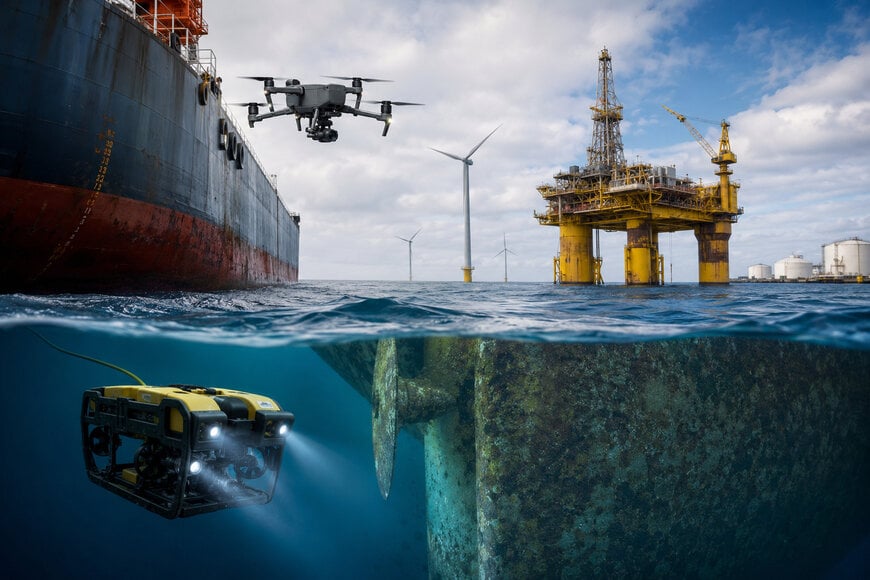
Dutch inspection specialist Ned Marine has introduced aerial drone and subsea remotely operated vehicle (ROV) inspection services for Non-Destructive Testing (NDT). The new offering combines remote visual inspection, Ultrasonic Thickness Measurement (UTM) and digital reporting to support faster condition assessment of vessels, offshore installations and industrial structures.
The expanded service targets applications in the maritime, offshore wind and industrial sectors, where inspection access, operational downtime and personnel safety remain significant operational constraints. By integrating drone and ROV systems into its existing NDT workflow, the company aims to reduce inspection duration while improving access to confined or submerged areas.
Drone inspections for confined and elevated structures
The aerial inspection service supports visual inspection and ultrasonic thickness measurement in locations that are difficult to access using scaffolding, rope access or manual entry methods. Typical inspection areas include ballast tanks, cargo holds, tank storage facilities, offshore and onshore wind turbines, and industrial installations.
According to Ned Marine, the drone-based approach can reduce inspection times by up to four times compared with conventional access methods. Inspections that previously required several days can in some cases be completed within hours, reducing operational downtime for container vessels, tankers and offshore assets.
The system also limits the need for personnel to enter hazardous or confined environments. Remote inspection workflows are increasingly being adopted within the digital supply chain of maritime and industrial operators, particularly where asset availability and maintenance scheduling directly affect operational efficiency.
Subsea inspection capability to 300 metres
In addition to aerial inspections, the company has introduced subsea NDT inspection services using ROV platforms rated for water depths up to 300 metres. The systems provide high-definition live video feeds and inspection data for underwater structural assessment without requiring diver deployment.
The subsea inspection capability is intended for applications including hull inspections, cathodic protection assessment, structural condition monitoring and pre-docking surveys. Compared with traditional diving operations, ROV-based inspection can reduce logistical complexity while improving access in deeper or restricted underwater environments.
The integration of real-time inspection data also supports remote collaboration between vessel operators, surveyors and technical personnel. Inspection findings can be reviewed simultaneously by stakeholders in different locations, supporting faster maintenance and repair decisions within the broader automotive data ecosystem and industrial asset management environment.
Integrated NDT workflow
The drone and ROV inspection services are integrated into Ned Marine’s existing NDT portfolio, which includes Visual Testing (VT), Ultrasonic Thickness Measurements and inspection reporting. Combining visual inspection data with digital measurement records allows operators to obtain a consolidated overview of asset condition for maintenance planning and lifecycle management.
Leo Zwagemaker, Commercial Manager at Ned Marine, stated that the addition of aerial and subsea remote inspection technologies is intended to support reduced downtime and improve maintenance decision-making through globally accessible real-time inspection data.
The expanded inspection capability reflects broader adoption of remote inspection technologies across maritime and industrial sectors, where operators are seeking to reduce maintenance delays, improve worker safety and increase inspection coverage without interrupting asset operations.
Edited by an industrial journalist Sucithra Mani with AI assistance.
www.maritimetechnology.com
