
www.aero-defence.tech
08
'26
Written on Modified on
Predictive Maintenance Integration for Armored Vehicle Operational Continuity
FNSS and specialized technology partners have integrated artificial intelligence and machine learning to deploy a predictive maintenance system for land defense platforms.
www.fnss.com.tr
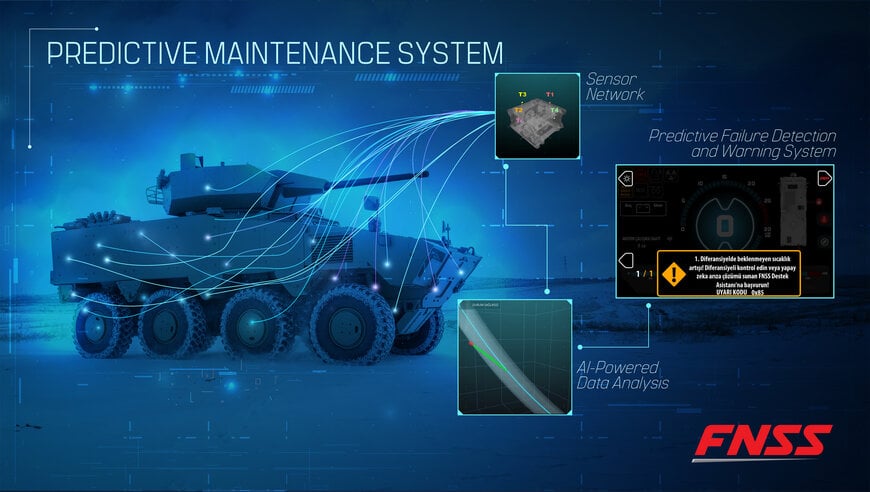
The cooperation focuses on the development and implementation of a predictive maintenance application designed to maximize the availability of armored combat vehicles. By utilizing sensor-based data analytics and machine learning algorithms, the system transitions maintenance protocols from reactive cycles to a data-driven model applicable to heavy industrial and defense sectors.
Technical Context and Objectives
Maintaining combat readiness requires minimizing unplanned downtime caused by component fatigue or unexpected failures. FNSS utilized historical data sets—derived from hundreds of thousands of kilometers of vehicle testing—to establish a baseline for industrial automation within the maintenance sector. The complexity of modern vehicle subsystems necessitated the integration of artificial intelligence to process high volumes of telemetry in real-time, a task exceeding the capacity of traditional threshold-based monitoring.
System Architecture and Technical Mechanism
The technical solution functions by monitoring critical subsystems via integrated sensors. The operational logic follows a three-stage process:
- Data Acquisition: Continuous collection of variables from mechanical and electrical subsystems.
- Standardization: Definition of normal operating ranges established under diverse environmental and operational stressors.
- Trend Analysis: Comparison of live sensor data against defined ranges to identify behavioral deviations.
The system utilizes these behavioral trends to detect early indicators of failure before a hardware breakdown occurs. When a deviation is detected, the diagnostic architecture issues automated warnings to operators. This enables personnel to consult technical manuals or utilize the AI-powered support assistant to determine the necessary intervention.
Implementation and Support Infrastructure
The system is integrated directly into the vehicle’s digital infrastructure, allowing for 24/7 connectivity to remote support services. This integration ensures that maintenance personnel can plan for part replacements and repairs based on actual component condition rather than fixed time intervals.
The application was demonstrated at the SAHA 2026 exhibition (May 5–9, 2026) in Istanbul, highlighting its readiness for active deployment. By providing a technical framework for preemptive repairs, the solution improves process stability and maintainability for fleet operators.
Operational Impact
The transition to predictive monitoring results in measurable improvements to operational reliability. By identifying imminent failures through automated diagnostic patterns, the system:
Implementation and Support Infrastructure
The system is integrated directly into the vehicle’s digital infrastructure, allowing for 24/7 connectivity to remote support services. This integration ensures that maintenance personnel can plan for part replacements and repairs based on actual component condition rather than fixed time intervals.
The application was demonstrated at the SAHA 2026 exhibition (May 5–9, 2026) in Istanbul, highlighting its readiness for active deployment. By providing a technical framework for preemptive repairs, the solution improves process stability and maintainability for fleet operators.
Operational Impact
The transition to predictive monitoring results in measurable improvements to operational reliability. By identifying imminent failures through automated diagnostic patterns, the system:
- Reduces the frequency of catastrophic component failures.
- Optimizes logistics chains by providing advance notice for spare part requirements.
- Enhances mission readiness through the stabilization of vehicle availability rates.
The application of these technologies represents a shift toward intelligent lifecycle management, ensuring that maintenance activities are performed precisely when the data indicates a decline in system integrity.
Edited by Evgeny Churilov, Induportals Media - Adapted by AI.
www.fnss.com.tr
Edited by Evgeny Churilov, Induportals Media - Adapted by AI.
www.fnss.com.tr
