
www.aero-defence.tech
21
'26
Written on Modified on
Unmanned surface vessel enters scaled naval production
Rheinmetall establishes Hamburg-based production with Kraken Technology Group to deliver modular maritime platforms for defence and civilian applications.
www.rheinmetall.com
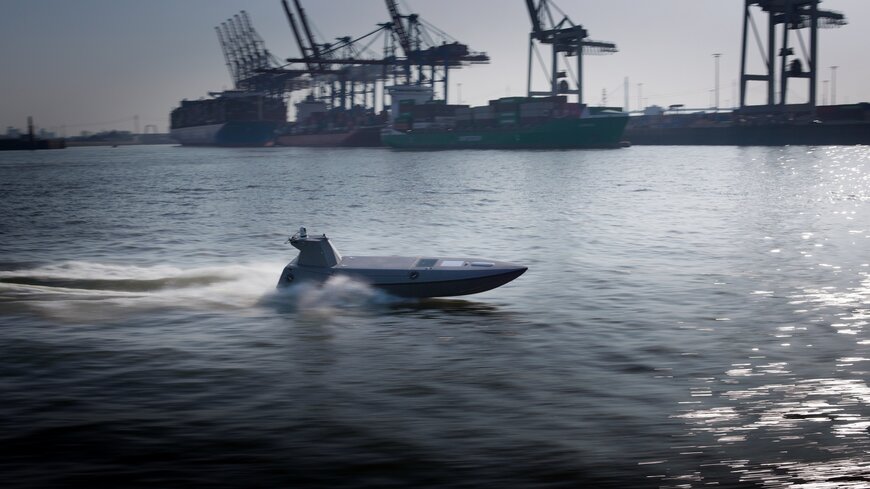
A new production programme for unmanned surface vessels (USVs) has been initiated in Hamburg, targeting scalable manufacturing of modular maritime systems for surveillance, infrastructure protection, and defence missions.
Transition from prototype to series production
Series production of the Kraken K3 Scout has commenced at Rheinmetall’s Blohm+Voss shipyard in Hamburg, marking a transition from development to industrial-scale manufacturing of unmanned maritime systems. The platform is designed as a market-ready USV capable of both civilian and military deployment.
The system supports multiple operational configurations, including maritime surveillance, protection of critical infrastructure such as offshore assets, and deployment as a weapons carrier in naval operations. This flexibility reflects growing demand for adaptable platforms within a digitally integrated maritime security environment.
Technical characteristics and modular design
The Kraken K3 Scout measures 8.4 metres in length and achieves speeds of up to 55 knots, positioning it within the high-speed USV category. Its modular architecture enables mission-specific configuration, allowing integration of sensors, communication systems, or payload modules depending on operational requirements.
Such configurability is central to the evolving autonomous maritime systems landscape, where platforms are expected to operate across multiple mission profiles without requiring significant redesign.
Industrial scaling and production capacity
Initial production capacity is set at approximately 200 units per year, with the capability to scale up to 1,000 units annually depending on demand. This level of scalability indicates a shift toward serial manufacturing in the unmanned naval sector, traditionally characterised by low-volume, specialised builds.
The Hamburg site is being developed as a test and technology centre for unmanned and autonomous marine systems, integrating production with validation and system testing. This approach supports faster iteration cycles and reduces deployment timelines.
Joint venture structure and technology integration
The programme is managed through Rheinmetall Kraken GmbH, a joint venture between Rheinmetall Naval Systems and the UK-based Kraken Technology Group. The collaboration combines large-scale shipbuilding and integration capabilities with specialised expertise in high-performance unmanned platforms.
Kraken Technology Group contributes design and engineering capabilities focused on cost-efficient and high-speed maritime systems, while Rheinmetall provides industrial infrastructure and system integration within broader naval architectures.
Role in modern naval and civilian operations
The introduction of scalable USV production responds to increasing operational requirements for persistent maritime monitoring and rapid-response capabilities. In defence applications, unmanned systems can extend surveillance coverage and reduce crew exposure in contested environments.
In civilian contexts, such platforms are relevant for offshore asset monitoring, environmental data collection, and port security. The ability to produce these systems at scale supports wider adoption across both public and private maritime sectors.
Competitive context
The Kraken K3 Scout operates within a growing global market for USVs, where performance is typically benchmarked by speed, payload flexibility, and endurance. With a top speed of 55 knots and modular configuration, the platform aligns with high-speed tactical USVs, though its distinguishing feature lies in its planned production scale.
The move toward industrialised manufacturing of unmanned vessels indicates a broader transition in naval procurement, where repeatable platforms and interoperable systems are becoming increasingly important within networked maritime operations.
Edited by an industrial journalist Sucithra Mani with AI assistance.
www.rheinmetall.com
