
www.aero-defence.tech
20
'26
Written on Modified on
HII Revolutionizes Naval Warfare With Next Generation Integrated Mission Framework
HII integrates autonomous systems and open architecture with naval warships to deliver scalable, distributed maritime effects, aligning with the Navy’s strategy for multi-domain joint operations.
hii.com
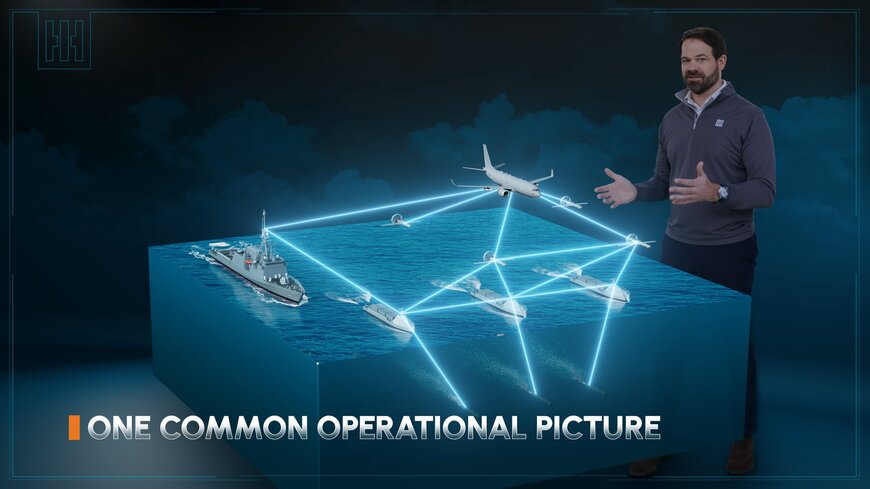
In an era where naval warfare is shifting from concentrated power to distributed networks, HII has distinguished itself from traditional defense contractors by developing a unique "system-of-systems" framework. Unlike rigid, platform-centric models offered by competitors, HII’s approach prioritizes a next-generation integration of naval warships with modular, containerized capabilities and autonomous unmanned systems. This strategy directly operationalizes the U.S. Navy’s "Hedge Strategy," moving away from a linear kill chain toward a networked model where sensing and decision-making are shared across the entire battlespace.
A Domain-Agnostic Approach to Distributed Effects
The primary differentiator of HII’s strategy is its ability to generate combat power and intelligence from anywhere in the environment, spanning maritime, air, space, cyber, and land domains. By focusing on interoperable assets, the framework allows commanders to move beyond the limitations of a single ship. The core of this advantage lies in the fusion of manned fleets with autonomous platforms, ensuring that data collected in one domain can produce immediate kinetic or non-kinetic effects in another. This scalability allows for the delivery of tailored maritime effects at a speed and volume that traditional, siloed naval architectures cannot match.
Seamless Integration Through Open Architecture
To ensure the U.S. Navy and its allies remain adaptable against emerging threats, HII utilizes a government-owned, open-architecture command platform known as the Minotaur Mission Management System. This system acts as the operational backbone, fusing data from various sensors into a unified operational picture. By pairing Minotaur with the Odyssey Autonomous Control System, HII enables a single operator to manage multiple unmanned platforms simultaneously. This integration shortens the sensor-to-shooter timeline and increases lethality in contested environments, providing a level of plug-and-play flexibility that eliminates the industry’s typical dependency on proprietary, single-platform software.
Modular Speed and the Future of Naval Presence
HII further separates itself from the competition through its emphasis on containerized, mission-ready payloads. This modularity allows for the rapid reconfiguration of forces without the high costs and long timelines associated with traditional ship overhauls. While aircraft carrier strike groups remain the centerpiece of power projection, HII’s distributed, unmanned-enabled forces serve as a force multiplier that extends the carrier's reach and creates complex dilemmas for adversaries. By embracing commercial acquisition models and continuous iteration at the operational edge, HII is driving a fundamental shift toward a more agile, mission-focused era of maritime power.
Edited by Evgeny Churilov, Induportals Media - Adapted by AI.
www.hii.com
