
www.aero-defence.tech
15
'26
Written on Modified on
General Atomics advances EO/IR weather payload for space missions
EWS payload enhances real-time environmental intelligence with expanded spectral imaging for improved military weather monitoring and mission planning.
www.ga.com
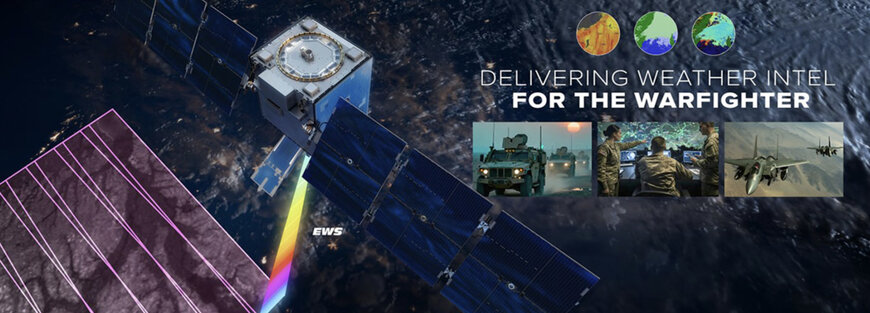
Space-based environmental monitoring, defense systems, and satellite imaging are increasingly critical for real-time decision-making in complex operational environments. General Atomics Electromagnetic Systems (GA-EMS) has advanced its electro-optical/infrared (EO/IR) payload for the U.S. Space Force’s EO/IR Weather System (EWS) program, completing the pre-ship review (PSR) and clearing the system for spacecraft integration.
The payload is designed to address key capability gaps in space-based weather intelligence, including cloud characterization and theater-level weather imaging. It will replace legacy systems from the Defense Meteorological Satellite Program (DMSP), supporting modernization efforts aimed at improving cost efficiency and operational performance.
Enhanced spectral imaging for environmental intelligence
The EO/IR payload incorporates 16 spectral bands, a significant increase compared to the two primary bands available in previous DMSP systems. This expanded spectral range enables more detailed atmospheric and surface observations, improving the accuracy of weather forecasting and environmental analysis.
A high-resolution ultra-low-light sensor supports both day and night imaging, allowing continuous monitoring under varying illumination conditions. These capabilities are essential for applications such as flight planning, surveillance, and mission coordination across multiple operational domains.
Compact architecture for scalable deployment
The system combines advanced optical performance with a compact, modular design. This reduces size and cost compared to earlier satellite payloads while supporting scalable production, aligning with the U.S. Space Force’s strategy of deploying distributed satellite constellations.
From an engineering perspective, the reduced form factor enables more flexible satellite integration and deployment options, while maintaining the performance required for high-resolution environmental sensing.
Validation and preparation for integration
Completion of the pre-ship review confirms that the payload has successfully passed functional and environmental qualification testing, including calibration processes. The system will be transferred for integration with the GA-500 spacecraft bus, forming part of the complete satellite platform.
As the prime contractor, GA-EMS is responsible for the full mission lifecycle, including payload development, spacecraft integration, and operational data delivery. After launch, the system will undergo on-orbit calibration and begin generating environmental data products.
Supporting modern military operations
The EWS mission is intended to provide real-time weather intelligence to support mission planning and execution. Accurate environmental data can improve operational efficiency, enhance situational awareness, and reduce risks associated with adverse weather conditions.
Compared to legacy satellite systems, modern EO/IR payloads with higher spectral resolution and improved sensitivity offer more detailed and timely information. These advancements are particularly relevant for defense applications where environmental conditions directly impact mission success.
Edited by Natania Lyngdoh, Induportals Editor — Adapted by AI.
www.ga.com
