
www.aero-defence.tech
18
'26
Written on Modified on
GA-ASI and USAF Demonstrate IR-Based Autonomous Targeting
Flight test validates passive infrared sensing and autonomous coordination for collaborative combat aircraft in contested electromagnetic environments.
www.ga.com
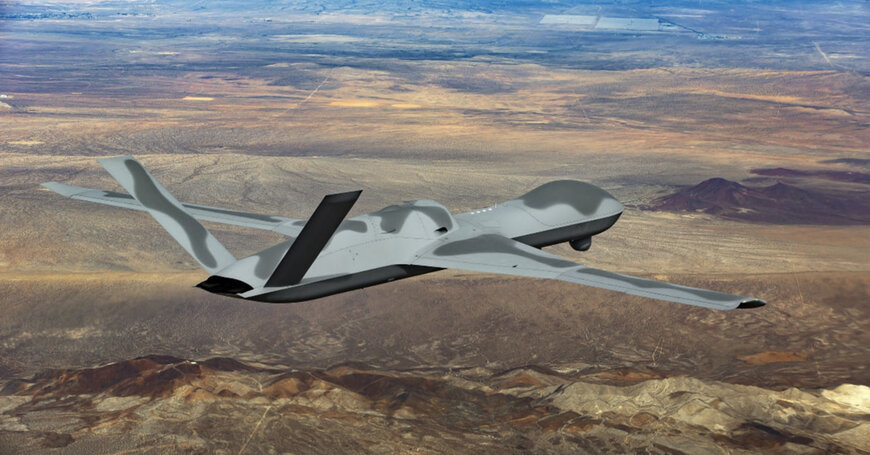
Defense, aerospace, and autonomous systems development increasingly focus on autonomous mission execution and resilient sensing in contested environments. General Atomics Aeronautical Systems, Inc. (GA-ASI), in collaboration with the U.S. Air Force, demonstrated infrared-based autonomous targeting during a flight exercise on February 24, using an uncrewed jet as a surrogate Collaborative Combat Aircraft (CCA).
The demonstration, conducted as part of a large force exercise, validated the integration of autonomy software, infrared sensing, and secure data links to support coordinated operations without reliance on active radar systems.
Passive infrared sensing for stealth operations
The test utilized an MQ-20 Avenger uncrewed jet equipped with an Infrared Search and Track (IRST) sensor to perform passive target detection and tracking. Through Single Ship Ranging (SSR), the system estimated target distance and trajectory without emitting detectable signals.
This approach enables aircraft to identify and track airborne threats while remaining undetected, a key requirement in denied or contested electromagnetic environments where radar use may expose platform positions.
By relying on infrared signatures rather than active emissions, the system supports stealthy sensor-to-shooter workflows, allowing autonomous platforms to contribute to engagement chains without compromising survivability.
Integration of autonomy software and mission systems
The exercise incorporated the government-developed Autonomy Starter Kit (ASK) alongside GA-ASI’s TacACE (Tactical Autonomy Ecosystem), which provides a modular framework for autonomous behaviors. Within this architecture, SSR was integrated as part of a broader skills library supporting mission execution and cooperative targeting.
The MQ-20 also operated using a proliferated low-earth orbit (LEO) data link, enabling real-time communication and coordination between autonomous systems during the exercise. This connectivity supports distributed operations, where multiple platforms share data and coordinate actions across a networked battlespace.
The TacPad Pilot Vehicle Interface (PVI) was used to manage mission interaction, bridging autonomous decision-making with operator oversight when required.
Application in collaborative combat aircraft operations
The demonstrated capabilities are directly relevant to future CCA concepts, where uncrewed aircraft operate alongside crewed platforms to extend sensing, targeting, and operational reach. Passive sensing and autonomous coordination allow these systems to function as distributed nodes within a larger combat network.
Such systems can support tasks including target detection, tracking, and engagement coordination, reducing workload on crewed aircraft and enabling more flexible mission planning.
Technology positioning in autonomous air combat
Compared with traditional systems relying heavily on active radar and centralized control, the demonstrated approach emphasizes distributed autonomy, passive sensing, and resilient communication. This combination supports operations in environments where electronic warfare and signal denial are significant challenges.
The use of a modular autonomy framework also enables incremental capability development, allowing new sensing or decision-making functions to be integrated without redesigning the entire system.
The MQ-20 Avenger continues to serve as a test platform for these developments, supporting the evolution of purpose-built autonomous aircraft designed for collaborative combat roles.
Edited by Industrial Journalist, Natania Lyngdoh — Adapted by AI.
www.ga.com
