
www.aero-defence.tech
18
'26
Written on Modified on
High-Voltage Electrical Architecture for Hybrid Aircraft
Collins Aerospace and Safran Electrical & Power validate a 500 kW-class hybrid-electric distribution system under the Clean Aviation HECATE program.
www.rtx.com
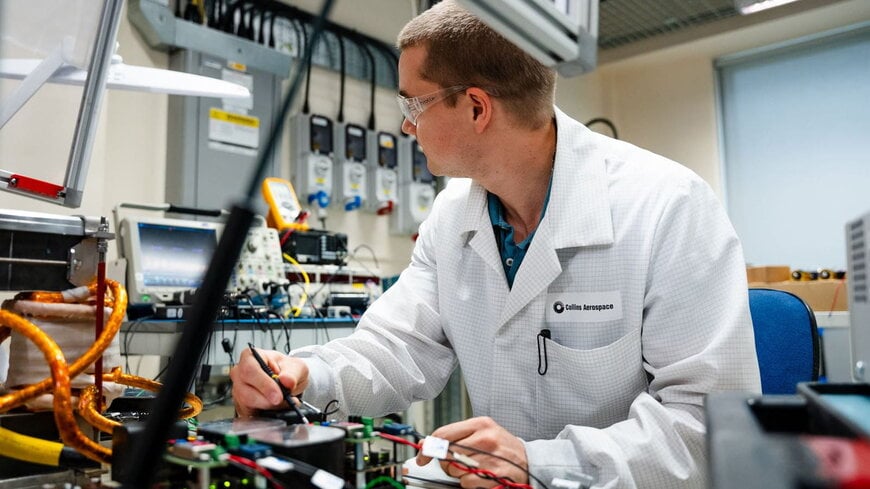
Collins Aerospace and Safran Electrical & Power have completed a joint development program to validate high-voltage electrical power systems for hybrid-electric aircraft. The project focuses on electrical generation and distribution architectures for future regional aviation platforms.
Context of the Cooperation
The HECATE project was conducted under the European Clean Aviation Joint Undertaking, involving 38 entities across 11 countries. Collins Aerospace led the project steering activities through its Applied Research & Technology and Power & Controls divisions, while Safran Electrical & Power acted as technical coordinator.
The cooperation addresses a key challenge in hybrid-electric propulsion: the need for reliable, high-power electrical architectures capable of supporting propulsion and onboard systems. Achieving this requires integration of multiple subsystems, compliance with aviation safety standards, and validation under representative operating conditions.
Technical Solution and Responsibilities
The project developed an Electrical Power Generation and Distribution System (EPGDS) designed for hybrid-electric regional aircraft. The system exceeds 500 kW power output and operates under high-voltage conditions to improve transmission efficiency and reduce conductor weight critical parameters in aerospace engineering.
Collins Aerospace contributed system architecture design, power electronics, and control strategies. Safran Electrical & Power provided system integration and coordinated validation using its test infrastructure. The solution incorporates digital infrastructure elements such as digital twin models to simulate operational scenarios and optimize system behavior before physical testing.
The architecture was designed to meet electromagnetic compatibility (EMC) requirements, ensuring stable operation without interference across onboard systems, in line with aviation certification constraints.
Deployment and Implementation
System validation was performed on Safran’s “Copper Bird” test platform in Niort, France. This ground-based integration facility enables full-scale testing of electrical systems in a controlled environment.
The project progressed through simulation, subsystem validation, and full system integration. Digital twin simulations reduced physical testing cycles by replicating real-world operating conditions, including load variations and electromagnetic environments.
Testing, verification, and validation activities confirmed system performance at Technology Readiness Level 5 (TRL5), demonstrating functionality in representative conditions.
Applications and Use Cases
The developed architecture targets:
- Hybrid-electric regional aircraft
- More-electric aircraft systems
- Future short- to medium-range aviation platforms
Key use cases include propulsion support, onboard power distribution, and integration of electrically driven subsystems. The system supports industrial automation principles in aerospace through modular design and scalable power management.
Results and Expected Impact
Achieving TRL5 confirms that high-voltage electrical distribution systems can operate reliably under simulated flight conditions. The use of higher voltage levels enables reduced current, leading to lighter cabling and improved system efficiency.
The project establishes a validated baseline for subsequent Clean Aviation Phase 2 programs, including OSYRYS and LEIA, which will further mature hybrid-electric architectures toward certification and entry into service by 2035.
The cooperation demonstrates that integrated system validation, supported by digital simulation and coordinated engineering roles, is essential for scaling hybrid-electric propulsion technologies in commercial aviation.
Edited by an industrial journalist, Sucithra Mani, with AI assistance.
www.rtx.com
