
www.aero-defence.tech
28
'26
Written on Modified on
Active Phased Array Naval Radar System Integration
Raytheon and the U.S. Navy deploy the scalable SPY-6 radar to resolve maritime multi-threat defense challenges on Arleigh Burke-class destroyers.
www.rtx.com
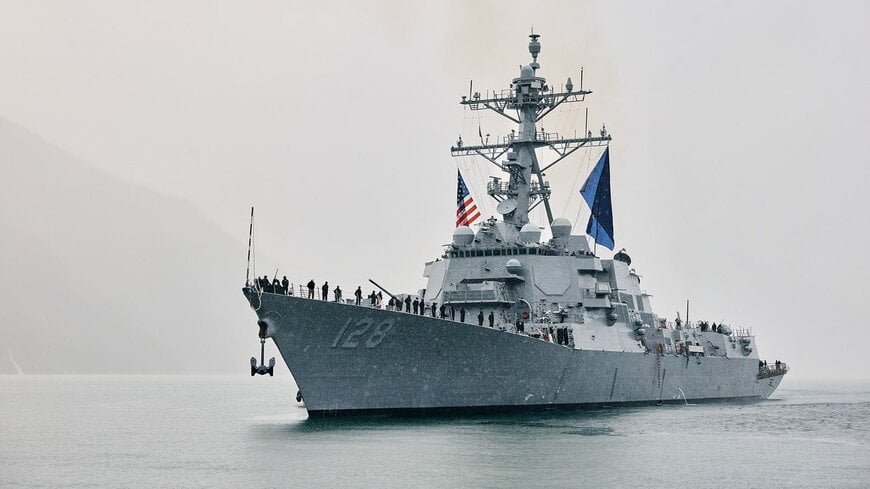
The U.S. Navy and Raytheon have collaborated to integrate the AN/SPY-6 active electronically scanned array radar family into active surface combatants, addressing modern defense needs across naval defence systems. The initial deployment on the newly commissioned Flight III Arleigh Burke-class destroyer USS Ted Stevens expands integrated air and missile defense coverage against simultaneous ballistic missiles, cruise missiles, unmanned aerial vehicles, and electronic warfare attacks.
Operational Challenges in Naval Air Defense
Naval operations contend with saturation threats originating from asymmetric platforms and diverse vectors. Traditional maritime sensors often lack the resolution, processing capacity, and power efficiency required to track and classify concurrent high-velocity threats. Addressing this operational challenge requires active phased array architectures capable of extended detection ranges, concurrent tracking, and integration with established combat management systems.
Modular Architecture and Engineering Responsibilities
The SPY-6 radar family relies on discrete Radar Modular Assemblies (RMAs), each functioning as an autonomous active phased array radar element. Multiple RMAs stack to form distinct antenna apertures suited to specific ship classes without altering underlying signal processing components:
Raytheon oversees core hardware manufacturing, automation, software compilation, and aperture testing at its vertically integrated production facility in Andover, Massachusetts.
The U.S. Navy manages program integration, combat management system synchronization, operational validation, and fleetwide sustainment.
The software-defined architecture allows functional updates without hardware substitution. Gallium nitride (GaN) semiconductor technology enhances RF output efficiency, thermal management, and power distribution across the array face, significantly increasing radar sensitivity compared to legacy passive systems.
Production Infrastructure and Deployment Scope
USS Ted Stevens marks the fourth commissioned surface vessel operating with a SPY-6 configuration, part of a wider procurement program projecting installations across more than 50 hulls. Validation protocols have included live-fire tracking events on USS Jack H. Lucas (DDG 125), with 60 live-fire exercises scheduled through operational testing in 2027.
To meet production volume requirements, Raytheon invested over $800 million to establish automated fabrication, assembly, and testing lines. This manufacturing framework supports ongoing full-rate production, targeting a doubled output rate by 2028.
"The investment we’ve made in automation allows us to build at high rates," said Jason Rathbone, executive director of Naval Radars at Raytheon. "It reduces the cost of these products and improves quality and reliability. Most importantly, it allows us to scale capacity very easily."
Fleet Standardisation and Strategic Impact
Deploying standard RMA building blocks across diverse hull types establishes cross-fleet component commonality. Shared logistical pipelines, standardized operator training courses, and centralized depot-level repair workflows reduce lifecycle ownership costs. Furthermore, networked SPY-6 units share target track data across the operating environment, establishing a synchronized common operational picture that enhances joint fleet interception timelines.
Edited by Evgeny Churilov, Induportals Media - Adapted by AI.
www.rtx.com
