
www.aero-defence.tech
18
'26
Written on Modified on
AI Mission Autonomy Integration for UAV Systems
Mitsubishi Heavy Industries and Shield AI collaborate to develop and deploy AI-based mission autonomy for unmanned aerial vehicles using a unified development environment.
www.mhi.com
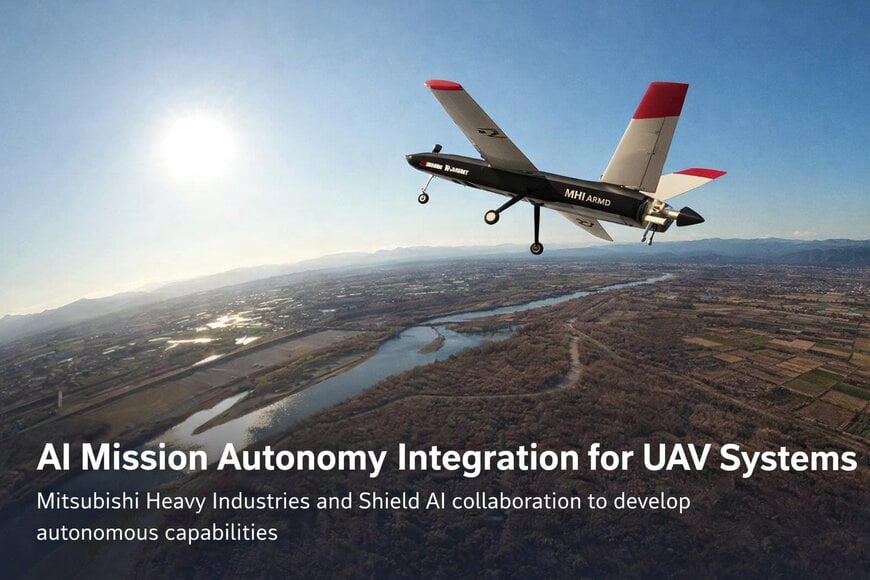
Mitsubishi Heavy Industries (MHI) and Shield AI have jointly demonstrated an AI-enabled mission autonomy system for unmanned aerial vehicles (UAVs), using an integrated development platform to accelerate deployment in aerospace and defence applications.
Context of the Cooperation
MHI, a Japanese industrial and aerospace manufacturer, partnered with US-based Shield AI to address the complexity and time requirements associated with developing autonomous UAV capabilities. Mission autonomy defined as the ability of UAVs to independently execute tasks based on onboard decision-making is a key enabler in modern aerospace systems and defence operations.
Previously, MHI relied on a distributed development setup combining multiple open-source tools for coding, AI model training, simulation, and Hardware-in-the-Loop (HIL) validation. This approach increased integration overhead and limited development efficiency. The cooperation with Shield AI was established to consolidate these processes within a unified AI development environment, reducing system fragmentation and improving development speed.
Technical Solution and Responsibilities
The collaboration centres on the use of Shield AI’s Hivemind Enterprise platform, which provides an integrated environment for AI model development, simulation testing, and deployment. The platform supports closed-loop workflows, including training, validation, and real-time system integration, enabling faster iteration cycles.
MHI was responsible for designing and integrating the mission autonomy algorithms into its UAV platform, while Shield AI provided the development infrastructure and associated tools for simulation and validation. The system architecture incorporates AI-driven decision-making models validated through simulation and HIL testing, ensuring functional reliability prior to flight deployment.
The UAV platform used was the ARMD (Affordable Rapid-prototyping Mitsubishi-Drone), with a wingspan of 2.5 metres, a total weight of 20 kg, and an engine-based propulsion system. The autonomy system was embedded onboard following validation.
Deployment and Implementation
Development activities began in September 2025, followed by staged validation processes including simulation and HIL testing. Flight demonstrations were conducted in November and December 2025 at test sites in Ibaraki and Gunma prefectures in Japan.
The implementation followed a structured workflow: AI model training, simulation-based evaluation, hardware validation through HIL, and final system integration into the UAV. This end-to-end process was completed within eight weeks, demonstrating reduced development time compared to previous approaches.
Applications and Use Cases
The system is designed for aerospace and defence applications requiring autonomous navigation and decision-making in dynamic environments. Potential use cases include surveillance, reconnaissance, and mission-critical operations where real-time autonomy improves operational resilience.
The integration of AI-based autonomy into UAV platforms aligns with broader trends in industrial automation and digital infrastructure, particularly in systems requiring distributed intelligence and reduced operator dependency.
Results and Expected Impact
The cooperation enabled a significant reduction in development time by consolidating previously fragmented workflows into a single platform. The use of an integrated environment reduced engineering overhead associated with toolchain management and system interoperability.
From a technical perspective, the approach improves repeatability in testing, accelerates validation cycles, and enhances system reliability through structured simulation and HIL processes. The collaboration also supports the localisation of mission autonomy capabilities, contributing to domestic development capacity in Japan’s UAV sector.
Edited by an industrial journalist, Sucithra Mani, with AI assistance.
www.mhi.com
