
www.aero-defence.tech
25
'26
Written on Modified on
European GaN Electronics for Q–V Band Satellites
Sener is leading the SGAN-Next project with key European partners to develop space-qualified high-frequency GaN technology under Horizon Europe.
www.sener-group.com
SGAN-Next is a European research and industrial cooperation project focused on developing gallium nitride (GaN)–based electronic equipment for satellite communication payloads operating at very high frequencies, particularly in the Q–V band. The initiative targets next-generation systems in low Earth orbit (LEO) and geostationary orbit (GEO).
Context of the Cooperation
The project is coordinated by Sener and funded by the European Commission under the Horizon Europe Space Research and Innovation programme (Grant No. 101082611).
The consortium includes United Monolithic Semiconductors, SweGaN, Airbus, Ferdinand Braun Institute, University of Bologna, Autonomous University of Barcelona and Thales Alenia Space.
The cooperation addresses a strategic challenge in the European space sector: securing a competitive, space-qualified supply chain for high-frequency radio-frequency (RF) components. Operation in the Q–V band (33–75 GHz) increases available bandwidth but requires semiconductor technologies capable of high power density, thermal stability and radiation tolerance. No single organization covers the full chain from wafer growth to satellite payload integration, making coordinated development necessary.
Technical Solution and Responsibilities
SGAN-Next focuses on GaN-on-SiC (silicon carbide) technology, selected for its high breakdown voltage, electron mobility and thermal conductivity compared with conventional GaAs or silicon solutions. These properties support higher power density and efficiency in compact RF modules, which is critical for active electronically steered antennas and high-throughput satellite payloads.
- The consortium develops three core building blocks:
- Solid-state power amplifiers (SSPAs)
- Low-noise amplifiers (LNAs)
- High-frequency RF switches
SweGaN contributes epitaxial GaN-on-SiC wafer growth, while United Monolithic Semiconductors supports monolithic microwave integrated circuit (MMIC) design and fabrication. Research partners, including the Ferdinand Braun Institute and the universities, address device modeling, reliability analysis and high-frequency characterization. Airbus and Thales Alenia Space provide system-level requirements and payload integration expertise. Sener coordinates system engineering, qualification planning and overall project management.
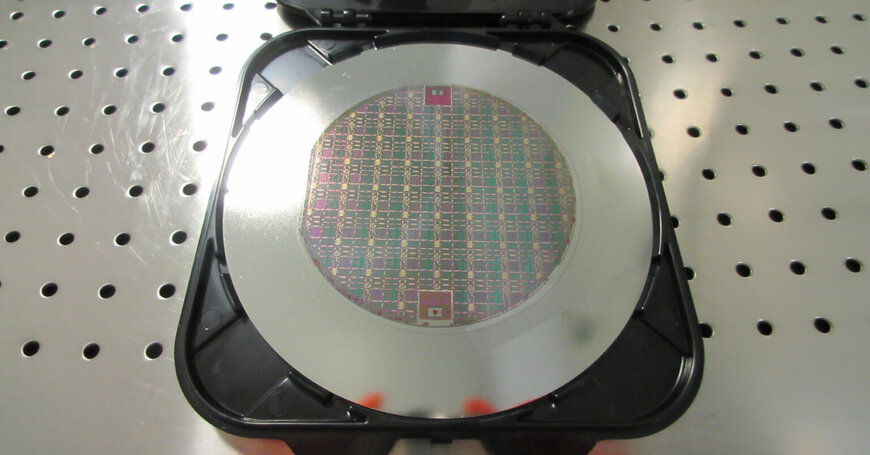
A first wafer containing functional prototypes has already been manufactured, enabling initial electrical and RF validation.
Qualification and Deployment Path
A central objective is qualification under the European Space Components Coordination (ESCC) framework. This involves reliability testing, radiation assessment and process control validation to meet space-grade standards.
The components are intended for integration into satellite communication payloads in both LEO constellations and GEO platforms. Their higher frequency operation enables increased data throughput while reducing amplifier size and mass, contributing to more compact payload architectures.
Applications and Expected Impact
The primary applications are high-capacity satellite communications and advanced active antenna systems. By improving power efficiency and reducing module footprint, GaN-based components can lower thermal management requirements and support higher spectral efficiency in Q–V band links.
Beyond individual components, the project establishes a coordinated European digital infrastructure for semiconductor design, manufacturing and qualification. This approach strengthens technological autonomy by aligning wafer production, MMIC fabrication and satellite integration within a European industrial framework.
www.group.sener.com
A first wafer containing functional prototypes has already been manufactured, enabling initial electrical and RF validation.
Qualification and Deployment Path
A central objective is qualification under the European Space Components Coordination (ESCC) framework. This involves reliability testing, radiation assessment and process control validation to meet space-grade standards.
The components are intended for integration into satellite communication payloads in both LEO constellations and GEO platforms. Their higher frequency operation enables increased data throughput while reducing amplifier size and mass, contributing to more compact payload architectures.
Applications and Expected Impact
The primary applications are high-capacity satellite communications and advanced active antenna systems. By improving power efficiency and reducing module footprint, GaN-based components can lower thermal management requirements and support higher spectral efficiency in Q–V band links.
Beyond individual components, the project establishes a coordinated European digital infrastructure for semiconductor design, manufacturing and qualification. This approach strengthens technological autonomy by aligning wafer production, MMIC fabrication and satellite integration within a European industrial framework.
www.group.sener.com
