
www.aero-defence.tech
25
'26
Written on Modified on
Long-Range Standoff Integration for MQ-9B UAS
General Atomics Aeronautical Systems advances MQ-9B multi-role capability by integrating extended-range precision strike weapons for maritime and joint operations.
www.ga.com
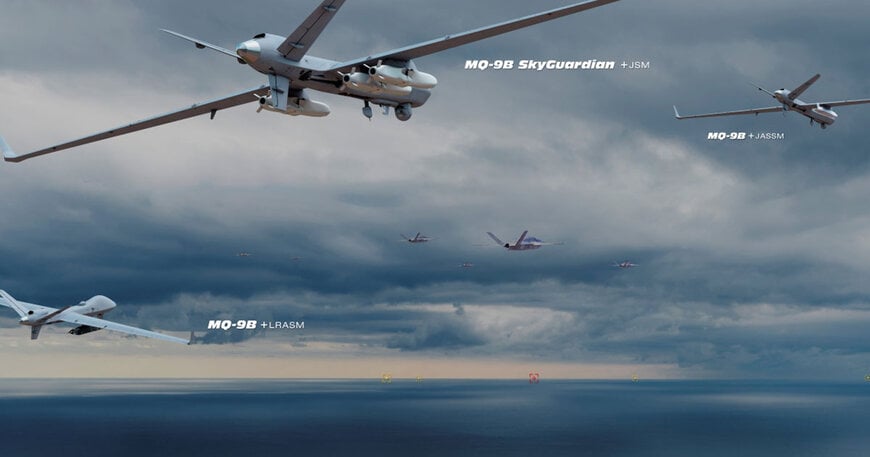
General Atomics Aeronautical Systems, Inc. (GA-ASI) is developing long-range standoff strike capabilities for its MQ-9B unmanned aircraft system (UAS), expanding the platform’s mission profile beyond intelligence, surveillance, and reconnaissance (ISR) to include naval and deep-strike operations.
Expanding Mission Sets in Maritime and Pacific Theaters
The MQ-9B family comprising SkyGuardian, SeaGuardian, and the Protector RG Mk1 operated by the United Kingdom’s Royal Air Force has primarily been fielded for long-endurance ISR missions. The current development effort focuses on adapting the aircraft to deploy extended-range precision weapons, responding to operational requirements for platforms capable of holding high-value targets at risk across large maritime and littoral environments, including the Western Pacific.
According to GA-ASI, engineering teams have completed performance analytics assessing payload integration, aerodynamic stability, range impact, and endurance trade-offs associated with heavier standoff munitions. The MQ-9B’s payload capacity and long-endurance design are central to this effort, as the aircraft is engineered for persistent operations over extended distances.
Technical Integration of Standoff Weapons
The integration program evaluates compatibility with several established long-range air-launched weapons, including:
- Lockheed Martin’s Joint Air-to-Surface Standoff Missile (JASSM)
- Lockheed Martin’s Long-Range Anti-Ship Missile (LRASM)
- Kongsberg Defence & Aerospace / Raytheon Joint Strike Missile (JSM)
These weapons are designed for extended-range precision strike, typically operating at stand-off distances that allow launch platforms to remain outside adversary air-defense engagement zones. Their integration requires structural reinforcement assessments, power and data interface validation, flight-control law adjustments, and mission-system software updates to ensure stable carriage and safe release.
GA-ASI has indicated that at least one of these weapons is planned for flight testing as early as 2026. Such testing will validate aerodynamic performance, release envelopes, and command-and-control integration within joint operational frameworks.
Concept of Operations and Operational Implications
A representative mission profile envisions MQ-9B aircraft deploying from dispersed bases in the Western or Southern Pacific, transiting to a forward holding point beyond hostile weapons engagement zones. From this position, the UAS could loiter for extended periods, leveraging its endurance to provide persistence before executing coordinated strike missions alongside U.S. or allied forces.
This concept leverages two defining characteristics of the MQ-9B platform: endurance and range. By combining these attributes with long-range munitions, the aircraft shifts from a surveillance-centric role toward a distributed strike node within a broader networked battlespace.
Platform Adoption and Operational Track Record
The MQ-9B is under procurement or contract by Belgium, Canada, Denmark, Germany, India, Japan, Poland, Taiwan, and the United States Air Force in support of Special Operations Command. The Protector RG Mk1 variant is being delivered to the United Kingdom.
The platform has participated in major U.S. Navy exercises, including Northern Edge, RIMPAC, Integrated Battle Problem, and Group Sail, demonstrating interoperability in maritime and joint-force scenarios.
Strategic and Competitive Context
Medium-altitude long-endurance (MALE) UAS platforms have traditionally focused on ISR, with limited integration of heavy, long-range cruise missiles due to payload, certification, and mission-system constraints. By pursuing compatibility with established standoff weapons such as JASSM and LRASM typically deployed from crewed combat aircraft GA-ASI positions the MQ-9B within a narrower category of armed UAS capable of contributing to distributed maritime strike operations.
If validated through flight testing, this development would represent a measurable shift in the operational role of MALE UAS platforms, expanding their contribution from persistent surveillance to integrated, long-range precision strike within joint and allied force structures.
www.ga.com
GA-ASI has indicated that at least one of these weapons is planned for flight testing as early as 2026. Such testing will validate aerodynamic performance, release envelopes, and command-and-control integration within joint operational frameworks.
Concept of Operations and Operational Implications
A representative mission profile envisions MQ-9B aircraft deploying from dispersed bases in the Western or Southern Pacific, transiting to a forward holding point beyond hostile weapons engagement zones. From this position, the UAS could loiter for extended periods, leveraging its endurance to provide persistence before executing coordinated strike missions alongside U.S. or allied forces.
This concept leverages two defining characteristics of the MQ-9B platform: endurance and range. By combining these attributes with long-range munitions, the aircraft shifts from a surveillance-centric role toward a distributed strike node within a broader networked battlespace.
Platform Adoption and Operational Track Record
The MQ-9B is under procurement or contract by Belgium, Canada, Denmark, Germany, India, Japan, Poland, Taiwan, and the United States Air Force in support of Special Operations Command. The Protector RG Mk1 variant is being delivered to the United Kingdom.
The platform has participated in major U.S. Navy exercises, including Northern Edge, RIMPAC, Integrated Battle Problem, and Group Sail, demonstrating interoperability in maritime and joint-force scenarios.
Strategic and Competitive Context
Medium-altitude long-endurance (MALE) UAS platforms have traditionally focused on ISR, with limited integration of heavy, long-range cruise missiles due to payload, certification, and mission-system constraints. By pursuing compatibility with established standoff weapons such as JASSM and LRASM typically deployed from crewed combat aircraft GA-ASI positions the MQ-9B within a narrower category of armed UAS capable of contributing to distributed maritime strike operations.
If validated through flight testing, this development would represent a measurable shift in the operational role of MALE UAS platforms, expanding their contribution from persistent surveillance to integrated, long-range precision strike within joint and allied force structures.
www.ga.com
