
www.aero-defence.tech
21
'26
Written on Modified on
Secure mission systems support joint all-domain operations
General Dynamics Mission Systems provides processing, radios and satellite payloads to U.S. defense programs to accelerate deployment, improve interoperability and secure data sharing.
www.gd.com
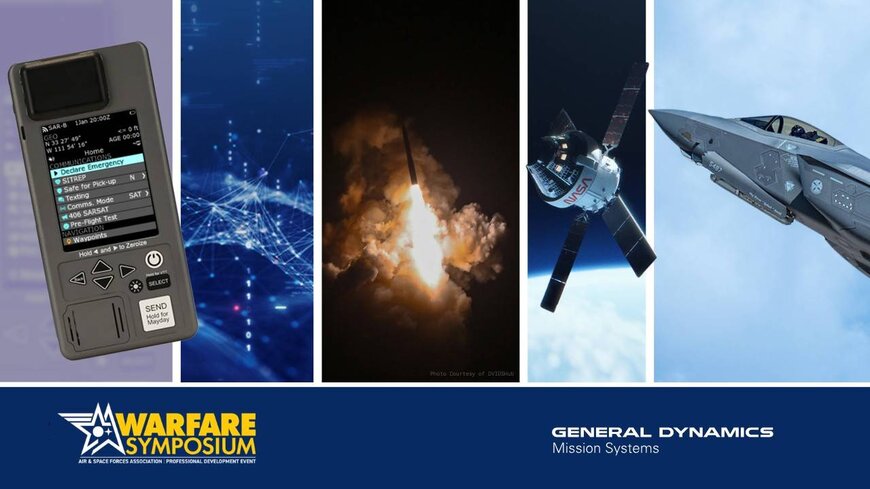
Armed forces are restructuring their command, control and communications architectures to operate across air, land, sea, cyber and space. This transition requires mission computing, secure communications systems and satellite payloads that can be deployed faster, operate in contested electromagnetic environments and exchange classified data between different security levels without multiplying hardware and networks.
Legacy equipment typically involves separate processing units, radios and storage platforms for each mission function. This increases size, weight and power consumption, complicates aircraft and spacecraft integration, and slows capability upgrades. It also limits the speed at which new operational functions can be fielded.
U.S. defense programs therefore seek modular, open and security-certified architectures that reduce integration time while maintaining cryptographic protection and resilience to interference.
Solution: Open, secure and SWaP-optimized mission architecture
General Dynamics Mission Systems developed a portfolio combining mission processors, software-defined radios, cross-domain solutions and satellite network payloads. The approach is based on open standards, multi-level security and reduced size, weight and power (SWaP), allowing the same core technologies to be used across aircraft, ground systems, weapons and small satellites.
The mission processing environment integrates computing, storage and encryption in a single infrastructure. This enables new capabilities to be inserted without redesigning the full platform and supports joint all-domain data exchange.
For space applications, the secure network processor consolidates networking and data transport into a single radiation-tolerant unit. This simplifies integration into proliferated low Earth orbit constellations and shortens deployment cycles for small satellites.
Enabling rapid rescue and contested communications
For combat search and rescue missions, the next-generation survival radio provides encrypted identification, location and situation reporting. Its reduced size and improved power efficiency allow aircrews and isolated personnel to carry it without adding significant load, while over-the-horizon data links accelerate detection and authentication by rescue teams.
In congested radio-frequency environments, multi-waveform tactical transceivers maintain simultaneous communications without the physical separation previously required between radios. This supports rapid multi-channel deployment during emergency or expeditionary operations.
Software-defined radio technology with high processing capacity also enables collaborative unmanned systems, resilient positioning and electronic warfare functions from remote locations, reducing exposure of personnel.
Cross-domain data sharing without network multiplication
Operational units increasingly need to move information between classification levels in the field. Tactical cross-domain systems and centralized multi-level security platforms address this by allowing controlled data exchange through a single access point rather than parallel networks.
This architecture reduces hardware footprint and IT administration while maintaining accredited separation between security domains. The result is faster decision-making based on a common operational picture.
Integration into strategic and precision-strike programs
The same secure electronics and cryptographic technologies are used in strategic deterrence modernization and precision-guided munitions. In these applications, assured positioning, navigation and timing, anti-tamper protection and guidance electronics are combined to maintain accuracy and system integrity in contested environments.
Deployment model and industrial support
The systems are designed as modular building blocks that can be integrated by prime contractors or directly into existing platforms. Open interfaces and compliance with military standards allow incremental upgrades rather than full platform replacement, which shortens qualification cycles and reduces lifecycle risk for program operators.
Operational benefits
Although program-level performance figures are not publicly disclosed, the technical architecture delivers measurable effects at system level:
- Faster capability insertion through open mission systems and integrated processing
- Reduced SWaP for airborne and space platforms
- Improved spectrum efficiency and resistance to interference
- Simplified IT infrastructure for multi-level information sharing
- Accelerated integration of small satellites into proliferated constellations
These factors directly support higher mission availability, quicker deployment timelines and lower integration complexity for defense operators.
Industrial and program context
The technologies are being presented at the Air & Space Forces Warfare Symposium, held February 23–25, 2026, in Aurora, Colorado, where discussions on rapid spacecraft manufacturing and digitalized defense production highlight the need for modular, secure and interoperable mission systems across current and future U.S. programs.
www.gdmissionsystems.com
Industrial and program context
The technologies are being presented at the Air & Space Forces Warfare Symposium, held February 23–25, 2026, in Aurora, Colorado, where discussions on rapid spacecraft manufacturing and digitalized defense production highlight the need for modular, secure and interoperable mission systems across current and future U.S. programs.
www.gdmissionsystems.com
