
www.aero-defence.tech
21
'26
Written on Modified on
Rheinmetall demonstrates FV-014 loitering munition system
Rheinmetall tests portable 100 km loitering munition for NATO applications, combining reconnaissance and strike capability within a network-enabled digital battlespace environment.
www.rheinmetall.com
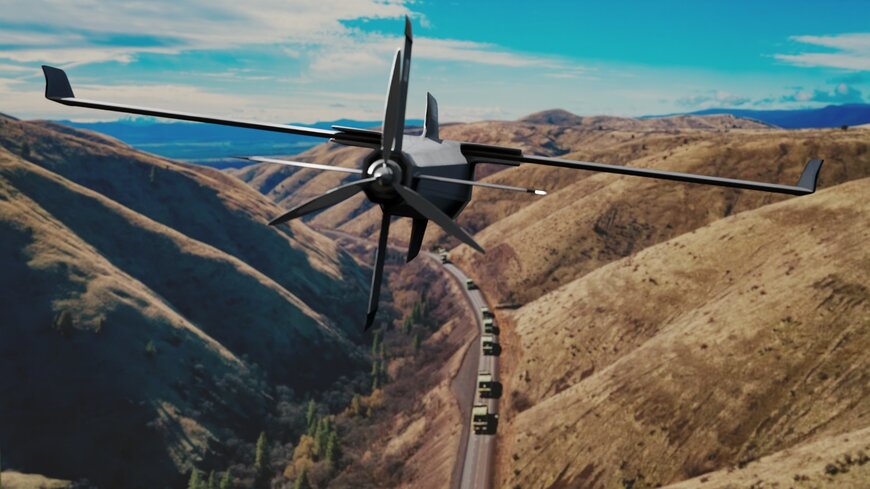
Rheinmetall AG has conducted a live demonstration of its FV-014 loitering munition system (LMS) for a potential NATO customer at the National Test Centre for Unmanned Aerial Systems operated by the German Aerospace Centre (DLR) in Cochstedt, Saxony-Anhalt. The event, held on 18 February 2026, included simulated mission scenarios and representative attack profiles.
The FV-014 is positioned as a portable, troop-level loitering munition designed to combine target reconnaissance and kinetic effect within a single platform. With an operational range of up to 100 km and an endurance of 70 minutes, the system is intended for long-range engagement of high-value point targets beyond line of sight, including armoured vehicles, artillery systems and command platforms.
System architecture and mission profile
The FV-014 has a launch weight of approximately 20 kg, including a payload of around 6 kg. It is deployed from a sealed transport and launch container using a booster-assisted launch, though it can also be integrated into multi-launcher configurations on land vehicles or maritime platforms.
After booster separation, folding wings deploy and the system transitions to sustained aerodynamic flight powered by an electric motor and propeller. The electric propulsion architecture is designed to reduce acoustic and thermal signatures during approach, supporting survivability in contested environments.
The munition carries an approximately 5 kg high-explosive dual-purpose (HEDP) warhead with a stated penetration capability exceeding 600 mm rolled homogeneous armour (RHA). This enables engagement of both armoured and unarmoured targets, as well as selected infrastructure elements. The combination of endurance and data link connectivity allows operators to conduct target observation, identification and engagement decision-making within a single sortie.
Operation and human control
The FV-014 is controlled via a portable ground station providing real-time situational awareness and target assignment through a data link with a range of up to 60 km. The system architecture maintains permanent human-in-the-loop control, allowing operators to confirm targets, execute a precision strike or abort the mission if tactical conditions change.
This operational model aligns with NATO requirements for controlled effects and reduces the risk of unintended engagements in complex operational theatres.
Network capability and GNSS-denied operation
A key design objective is operability in electromagnetically contested airspace. The FV-014 is specified for use in GNSS-jammed environments, indicating the integration of alternative navigation or sensor-based guidance mechanisms to maintain mission effectiveness when satellite navigation signals are degraded or denied.
The platform is also described as network-capable, enabling integration into higher-level command structures and digital battlespace architectures. In this context, loitering munitions such as the FV-014 can act as distributed sensors and effectors within a broader network-enabled force structure.
Swarm deployment and survivability features
The system is designed for individual or swarm-based deployment. In swarm configurations, multiple units can engage separate targets simultaneously or saturate adversary air defence systems. This capability is relevant in scenarios where layered short-range air defence systems require coordinated multi-vector engagement.
From a survivability perspective, the airframe follows a classic wing configuration with faceted structural elements intended to reduce radar signature. Combined with reduced infrared and acoustic emissions, these features aim to lower detection probability during ingress to the target area.
Position within the loitering munition segment
With a 20 kg launch mass, 70-minute endurance and 100 km maximum range, the FV-014 falls within the medium-class loitering munition category. Compared with lighter short-range systems typically below 40 km range, it offers extended operational reach while remaining man-portable at unit level. The declared 600 mm RHA penetration positions it for anti-armour roles beyond soft-target suppression.
The demonstration at the DLR test centre represents a development milestone in Rheinmetall’s expanding portfolio of loitering munition systems, reflecting the growing demand for integrated reconnaissance-strike platforms in European and NATO-aligned armed forces.
www.rheinmetall.com
