
www.aero-defence.tech
18
'26
Written on Modified on
ATLAS Autonomous Combat Vehicle Demonstrator
BAE Systems Australia introduces the ATLAS Collaborative Combat Variant to extend combat mass and reduce soldier exposure through autonomous ground operations.
www.baesystems.com
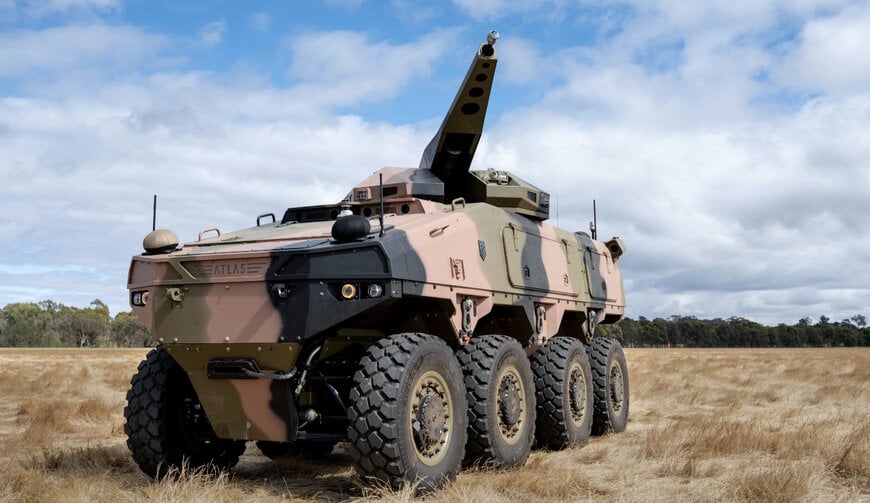
The ATLAS Collaborative Combat Variant (CCV) is an uncrewed ground vehicle prototype designed to operate across multiple autonomy levels, from teleoperation to full sense-and-avoid navigation. Developed by BAE Systems Australia, the platform is positioned for integration into modern land-force structures requiring scalable autonomous combat support.
Development Timeline and Demonstration Context
The ATLAS CCV was launched at the Land Forces 2024 exhibition in September 2024. Within sixteen months, the system progressed from initial unveiling to a fully functional prototype demonstrator undergoing multi-level autonomy trials.
Testing activities have covered:
- Remote teleoperation
- Waypoint-based semi-autonomous navigation
- Full sense-and-avoid autonomous operation
The sense-and-avoid capability relies on onboard sensor fusion and automated obstacle detection to enable independent manoeuvre without continuous operator control. This progression reflects increasing operational maturity within autonomous land systems designed for deployment in contested environments.
Platform Role in the Digital Battlespace
ATLAS is designed as a collaborative combat vehicle intended to operate alongside tracked and wheeled crewed combat platforms. Its primary operational concept is to increase combat mass while reducing direct soldier exposure during high-risk missions.
The vehicle is described as manoeuvrable and capable of operating across varied terrain and environmental conditions, enabling support for mechanised infantry and armoured formations. In practical terms, such systems are typically deployed for:
Platform Role in the Digital Battlespace
ATLAS is designed as a collaborative combat vehicle intended to operate alongside tracked and wheeled crewed combat platforms. Its primary operational concept is to increase combat mass while reducing direct soldier exposure during high-risk missions.
The vehicle is described as manoeuvrable and capable of operating across varied terrain and environmental conditions, enabling support for mechanised infantry and armoured formations. In practical terms, such systems are typically deployed for:
- Forward reconnaissance
- Fire support
- Perimeter security
- Logistics resupply in contested zones
By assigning “dull, dirty and dangerous” tasks to an uncrewed platform, operational forces can reduce personnel risk while sustaining operational tempo.
Modular Payload Architecture
The ATLAS CCV supports multiple payload configurations. In its assault configuration, it integrates a lightweight medium-calibre turret system known as VANTAGE, engineered specifically for uncrewed platforms.
The turret incorporates BAE Systems’ passive Multi-Spectral Automatic Target Detection, Tracking and Classification System (ATTCS). This system performs automated detection and classification across multiple spectral bands, reducing reliance on active emissions. Passive sensing contributes to a lower probability of detection in contested electromagnetic environments.
ATTCS is designed to:
Modular Payload Architecture
The ATLAS CCV supports multiple payload configurations. In its assault configuration, it integrates a lightweight medium-calibre turret system known as VANTAGE, engineered specifically for uncrewed platforms.
The turret incorporates BAE Systems’ passive Multi-Spectral Automatic Target Detection, Tracking and Classification System (ATTCS). This system performs automated detection and classification across multiple spectral bands, reducing reliance on active emissions. Passive sensing contributes to a lower probability of detection in contested electromagnetic environments.
ATTCS is designed to:
- Automate target detection and tracking
- Support classification across sensor modalities
- Reduce operator cognitive load
- Enable one-to-many vehicle supervision
One-to-many control architectures are increasingly central to autonomous land warfare concepts, allowing a single operator to supervise multiple uncrewed systems simultaneously. This model supports scalable deployment within a broader digital battlespace framework.
Operational Relevance and Industry Positioning
The ATLAS CCV enters a defence market where uncrewed ground vehicles are being evaluated as force multipliers. Benchmark criteria in this segment typically include autonomy level, payload flexibility, sensor integration, and interoperability with existing armoured fleets.
By demonstrating multi-tier autonomy and integrated automated targeting in a prototype platform, ATLAS addresses core technical requirements for next-generation collaborative land systems.
According to Andrew Gresham, Managing Director – Defence Delivery at BAE Systems Australia, the system has progressed from exhibition launch to operational prototype status within sixteen months, reflecting accelerated development cycles in autonomous defence platforms.
The company is conducting customer engagement activities in international markets, indicating positioning for export and broader program integration.
www.baesystems.com
