
www.aero-defence.tech
05
'26
Written on Modified on
Sea trials test Ford-class carrier performance
HII’s Newport News Shipbuilding completed the builder’s sea trials of the USS John F. Kennedy (CVN-79) to evaluate key systems and readiness ahead of delivery to the U.S. Navy.
hii.com
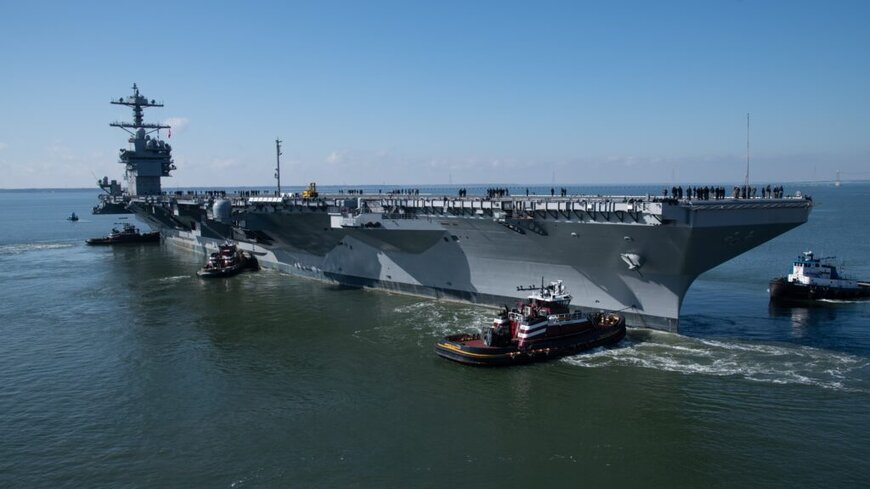
Newport News Shipbuilding deployed the solution to validate ship systems and performance before handover. The carrier returned to port after operating at sea, where critical components were exercised under real-world conditions.
Client and operational context
Huntington Ingalls Industries’ Newport News Shipbuilding division is the U.S. Navy’s primary builder of nuclear-powered aircraft carriers. The company has been constructing the USS John F. Kennedy (CVN-79), the second ship in the Gerald R. Ford-class of carriers, at its Virginia facility. The Ford-class design incorporates modern naval systems intended to improve operational efficiency and electrical power capacity over previous carrier classes.
Before the ship can be delivered to the Navy, the builder must verify that systems and components perform as designed in open waters. These builder’s sea trials address that requirement, moving beyond dockside tests to assess propulsion, navigation, and other core capabilities in operational conditions.
Technical challenges and goals
Aircraft carriers are complex vessels with integrated systems that must operate reliably together. Newport News Shipbuilding needed to confirm that propulsion, control systems, electrical generation, and newly incorporated technologies function correctly at sea. For the Ford class, this includes validating enhancements such as a new nuclear power plant and increased electrical capacity intended to reduce crew workload and support future weapons and sensors.
The goal of the sea trials was to demonstrate stable performance of these systems, identify any adjustments needed before formal Navy acceptance testing, and reduce risks associated with later phases of testing and deployment.
Deployment and support
On January 28, 2026, the Kennedy departed Newport News under its own power for the first time to begin the builder’s sea trials, marking a transition from shore-based construction and dock testing to open-water evaluation. Tugboats guided the carrier as it left the shipyard and entered sea lanes where trials were conducted under the supervision of shipbuilder personnel, sailors assigned to the pre-commissioning unit, and Navy representatives.
According to company and industry accounts, the sea trial program is structured to gather data on system performance, enabling engineers and technicians to verify operation and make required adjustments before the vessel enters the Navy’s acceptance phase.
Measurable results and technical outcomes
Upon completion of the builder’s sea trials, the carrier returned to Newport News Shipbuilding, having successfully tested important ship systems and components at sea for the first time. This milestone demonstrates the ship’s readiness for the next stage of verification toward delivery, currently projected for March 2027 after a series of construction and outfitting phases.
The trials contribute to risk mitigation by validating integration of core technical systems and providing empirical data to inform any required refinements before official Navy acceptance.
Industry impact
For HII and the U.S. Navy, completing the sea trial phase represents a key benchmark in the life cycle of a carrier development program. It provides confidence that the vessel’s major systems function together in real-world maritime conditions and supports planning for subsequent operational testing and deployment to the fleet.
www.hii.com
