
www.aero-defence.tech
03
'26
Written on Modified on
Maritime Defense Sensing System for USV Threats
Raytheon and DARPA collaborate on advanced situational-awareness and targeting capability for commercial and naval logistics vessels.
www.rtx.com
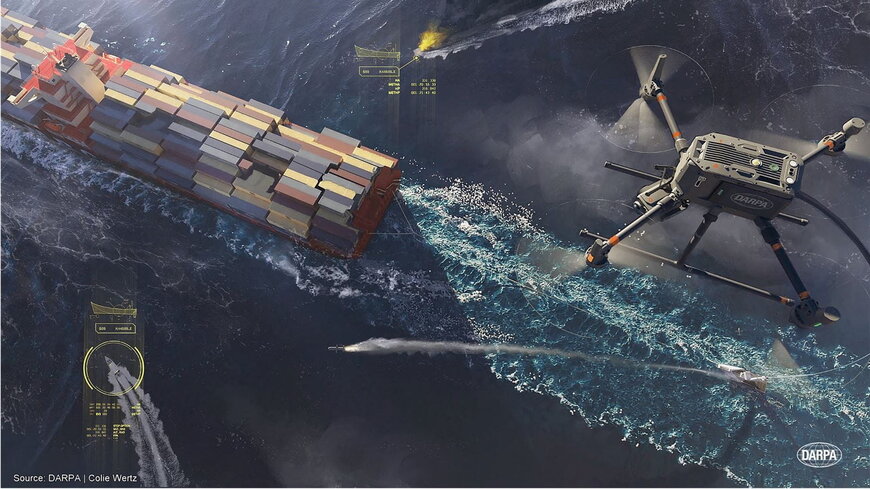
Raytheon, a business unit of the aerospace and defense firm RTX, is working with the U.S. Defense Advanced Research Projects Agency (DARPA) to develop a technical system for maritime threat detection and response under DARPA’s Pulling Guard program. The cooperation focuses on an integrated sensing and targeting solution intended to enhance situational awareness and remote decision support for vulnerable commercial shipping and naval logistics platforms facing emerging unmanned surface vehicle (USV) threats.
Context of the Cooperation
DARPA, a U.S. defense research agency responsible for high-risk/high-reward technologies, awarded the contract to Raytheon’s Advanced Technology team to address growing risks posed by unattended and potentially hostile unmanned surface vehicles at sea. USVs represent a class of robotic platforms capable of long-endurance surface operations and can challenge conventional maritime defense due to limited onboard detection and engagement systems on non-combatant vessels.
Raytheon brings systems engineering expertise in electro-optical/infrared (EO/IR) sensing, detection software, and command and control (C2) integration, while DARPA provides program direction and performance requirements for prototyping and demonstration stages. The collaboration responds to operational needs where distributed sensing, rapid data processing, and remote engagement decision support are critical for safe maritime logistics and commercial operations.
Technical Solution and Responsibilities
The core technical solution integrates:
- Sensors: High-resolution EO/IR units for wide-area detection and tracking of surface contacts.
- Detection Software: Algorithms for target recognition, behaviour classification, and tracking parameter fusion.
- Command and Control: Interfaces for remote monitoring and threat response coordination.
These components are hosted on a tethered drone system connected to a semi-autonomous unmanned platform towed by the host vessel, extending the sensor horizon beyond ship-mounted limitations and enabling line-of-sight elevation above the sea surface. Sensor telemetry and tracking data are relayed in real time to remote operators, supporting threat evaluation and rapid response decisions.
Raytheon is responsible for end-to-end system design, integration of sensors with C2 software, and demonstration of performance against defined benchmarks. DARPA oversees phased testing and evaluation metrics tied to operational objectives.
Deployment and Implementation
The program is structured in two phases:
Raytheon is responsible for end-to-end system design, integration of sensors with C2 software, and demonstration of performance against defined benchmarks. DARPA oversees phased testing and evaluation metrics tied to operational objectives.
Deployment and Implementation
The program is structured in two phases:
- Simulation and Interface Evaluation: System performance and operator workflows are tested in controlled scenarios to verify detection accuracy, latency, and integration of C2 tools.
- Live Operations Integration: The solution advances to incorporate operational launchers and effectors, evaluating the full sensor-to-decision-to-actuation chain in representative maritime environments.
Integration with existing ship platforms emphasises modular interfaces and standards-compliant communication protocols, ensuring the new system can complement legacy navigation and bridge systems without extensive retrofit.
Applications and Expected Impact
Target industries include commercial shipping logistics, naval supply operations, and maritime security sectors where unattended surface threats pose safety and operational continuity risks. Use cases encompass overwatch of supply convoys in contested waters, extended watch duties for logistics vessels, and layered situational awareness supporting risk mitigation strategies.
The collaboration is expected to improve detection range, situational awareness, and remote decision support, reducing operator cognitive load and enhancing response timing. Quantifiable performance outcomes include real-time target tracking and C2 interoperability metrics measured during phased demonstrations, although specific figures remain internal to program data.
Strategic Rationale
By combining Raytheon’s sensing and C2 integration capabilities with DARPA’s structured development framework and test methodology, the cooperation aims to deliver a technically scalable defense solution for evolving maritime operational environments.
www.rtx.com
Applications and Expected Impact
Target industries include commercial shipping logistics, naval supply operations, and maritime security sectors where unattended surface threats pose safety and operational continuity risks. Use cases encompass overwatch of supply convoys in contested waters, extended watch duties for logistics vessels, and layered situational awareness supporting risk mitigation strategies.
The collaboration is expected to improve detection range, situational awareness, and remote decision support, reducing operator cognitive load and enhancing response timing. Quantifiable performance outcomes include real-time target tracking and C2 interoperability metrics measured during phased demonstrations, although specific figures remain internal to program data.
Strategic Rationale
By combining Raytheon’s sensing and C2 integration capabilities with DARPA’s structured development framework and test methodology, the cooperation aims to deliver a technically scalable defense solution for evolving maritime operational environments.
www.rtx.com
