
www.aero-defence.tech
15
'26
Written on Modified on
BAE Systems Expands Amphibious Combat Vehicle Production
Contract supports production of ACV-30 variants with integration of Kongsberg turret systems for Marine expeditionary operations.
www.baesystems.com
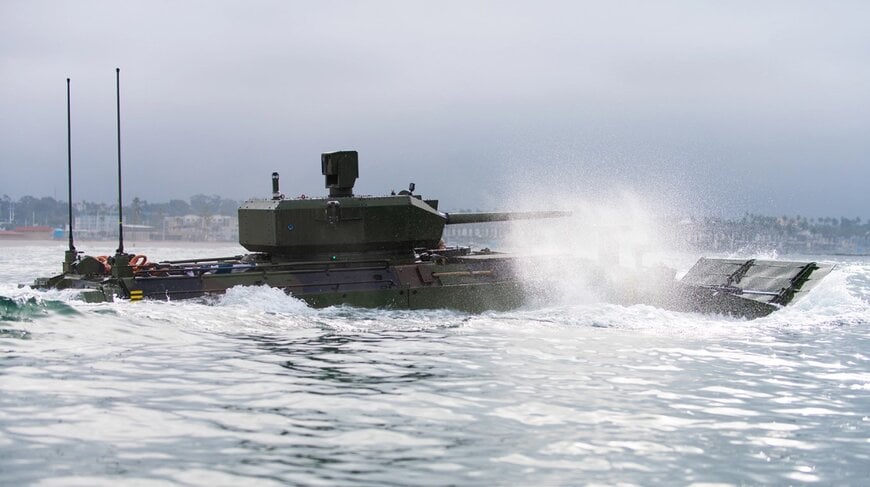
BAE Systems has been awarded a $184 million full-rate production contract by the U.S. Marine Corps for the manufacture of 30 additional Amphibious Combat Vehicles (ACVs) configured with 30 mm medium-caliber weapon systems. This award, designated as part of the full-rate production (FRP) Lot 5/6 contract under the FRP 6A designation, increases the total number of ACV-30 variants ordered by the Marine Corps to more than 100 units. The ACV program is the Marine Corps’ principal effort to replace legacy tracked amphibious assault vehicles with a modern, wheeled family of combat vehicles optimized for expeditionary operations.
ACV Family and Operational Capability
The ACV family comprises multiple mission role variants designed to operate across maritime and land domains with enhanced mobility, protection, and growth potential. The ACV-30 is the lethality-enhanced variant of the family, combining an 8×8 amphibious chassis with an integrated remote-controlled medium-caliber turret system. This configuration enables transport of Marines, mission-critical equipment, and other payloads while delivering direct fire support and protection in littoral and inland environments. The turret and main weapon system (a stabilised 30 mm cannon with coaxial machine gun) are procured separately by the government and integrated through dedicated naval and industrial facilities.
Manufacturing and integration work for the ACV-30 vehicles under this contract occurs in Pennsylvania (York and Johnstown) and at the U.S. Navy’s Naval Warfare Information Center in Charleston, South Carolina, where turret integration takes place.
Differentiation Within the ACV Program and Versus Competitors
The ACV family differs from prior amphibious platforms and competitor systems by unifying mobility, protection, and modular mission role variants on a common wheeled chassis. Unlike traditional tracked assault amphibians, the ACV series is designed to sustain higher operational tempo and strategic reach, with rapid transition from ship-to-shore operations to inland maneuver. The ACV-30, specifically, adds a medium-caliber direct-fire capability that enhances infantry support in contested littoral and expeditionary environments. This capability distinguishes the ACV-30 within U.S. Marine Corps ground combat vehicles and relative to similar amphibious combat systems fielded by other nations, which often prioritize either transport utility or heavier armour at the cost of strategic mobility and modularity.
BAE Systems also holds production contracts for other ACV variants, including the personnel carrier (ACV-P) and command variant (ACV-C), and has developed recovery variants (ACV-R) to support field maintenance and sustainment across Marine Corps assault amphibian units.
Industrial and Strategic Implications
This contract continues the transition of the ACV program into sustained full-rate production, reinforcing the industrial base for amphibious combat vehicles and enabling long-term manufacturing planning. The cumulative production awards underscore Marine Corps commitment to fielding a multi-role amphibious combat fleet capable of meeting evolving strategic requirements. As a single vendor selected for the ACV family under the U.S. acquisition process, BAE Systems’ role extends beyond vehicle fabrication to encompass integration of advanced systems and coordination with suppliers of weapon and sensor subsystems.
The $184 million production contract for additional ACV-30 vehicles represents a continuation of the U.S. Marine Corps’ effort to modernise its amphibious combat capabilities with a versatile, modular wheeled platform. The ACV-30’s combination of mobility, protection, and medium-caliber firepower marks a departure from legacy amphibious vehicles and positions it distinctively among comparable systems, while BAE Systems’ expanding production footprint supports long-term sustainment and operational readiness.
www.baesystems.com
