
www.aero-defence.tech
19
'25
Written on Modified on
Multi-Class UAS Command and Control Integration
Lockheed Martin Skunk Works integrates XTEND’s operating system into its autonomy platform to enable single-operator control of heterogeneous unmanned aircraft.
www.lockheedmartin.com
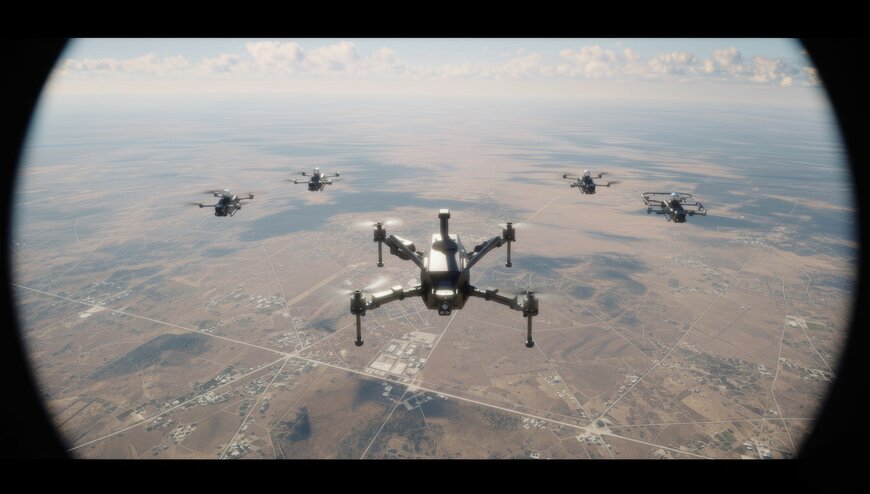
Lockheed Martin Skunk Works and XTEND have demonstrated an integrated command-and-control capability that allows a single operator to manage multiple classes of unmanned aircraft systems within joint all-domain C2 scenarios, reducing mission complexity and manpower requirements.
Integrating autonomy and multi-class drone control
Lockheed Martin Skunk Works has integrated XTEND’s Operating System (XOS) into its MDCX autonomy platform to enable simultaneous command and control of different UAS classes. The combined solution supports coordinated operation of larger unmanned platforms alongside smaller Class 1 and Class 2 drones, extending situational awareness and decision-making at lower mission echelons.
The integration is positioned within the context of joint all-domain command and control (JADC2), where data fusion, rapid decision loops, and cross-domain interoperability are required to manage complex, distributed operations.
Demonstration of marsupial drone operations
In November, the companies demonstrated a multi-class MDCX (MC-MDCX) workstation during a marsupial drone mission scenario. In this demonstration, a larger UAS deployed a smaller Class 1 drone to execute a close-in task, such as localized inspection or reconnaissance.
Traditionally, such missions require a handoff from the operator controlling the larger platform to a separate operator trained on lower-level drone controls. These controls typically include first-person video, mark-and-fly commands, and immersive interfaces needed to navigate confined or high-precision environments.
With the integration of XOS into MC-MDCX, a single operator conducted both the launch and close-in mission phases, eliminating the need for handoffs between operators.
Impact on manpower and situational awareness
According to the demonstration results, the integrated workstation reduced the total number of personnel required to execute complex, multi-drone missions. Removing operator handoffs simplifies command structures and reduces latency between mission phases.
Maintaining control within a single operator environment also improved situational awareness across the mission space, as the operator retained continuous context of both the carrier platform and deployed drones. This continuity is particularly relevant in time-sensitive operations where delays or miscommunication between operators can affect outcomes.
XTEND operating system capabilities
XTEND’s XOS is designed for combat-proven drone command and control and is deployed by multiple military users. The system provides layered control modes and operational step-down processes that allow missions to continue under degraded conditions, including GPS denial or radio-frequency jamming.
XOS is intended to reduce operator training burden by enabling near expert-level mission execution through assisted controls and intuitive interfaces. This approach shortens training cycles while supporting consistent mission performance across varying operator experience levels.
Relevance to JADC2 and autonomous systems
The collaboration reflects ongoing efforts to align autonomy platforms with JADC2 requirements, where operators must manage multiple assets across domains with minimal cognitive and manpower overhead. Integrating toolsets that unify control of heterogeneous systems supports faster decision loops and more resilient operations.
Lockheed Martin Skunk Works and XTEND are now evaluating how the demonstrated techniques can be extended to broader JADC2 missions, including integration into larger autonomous system architectures and decision-support frameworks.
Within the evolving defense technology landscape, the integration illustrates how multi-class UAS control and autonomy software are converging to support scalable, operator-efficient mission execution in contested environments.
www.lockheedmartin.com
