
www.aero-defence.tech
20
'25
Written on Modified on
Bell Flight MV-75 FLRAA Adopts Modular Open Systems
The U.S. Army's MV-75 Future Long Range Assault Aircraft is adopting a Modular Open Systems Approach to enable rapid, cost-effective upgrades and ensure the aircraft remains adaptable against evolving threats.
www.bellflight.com
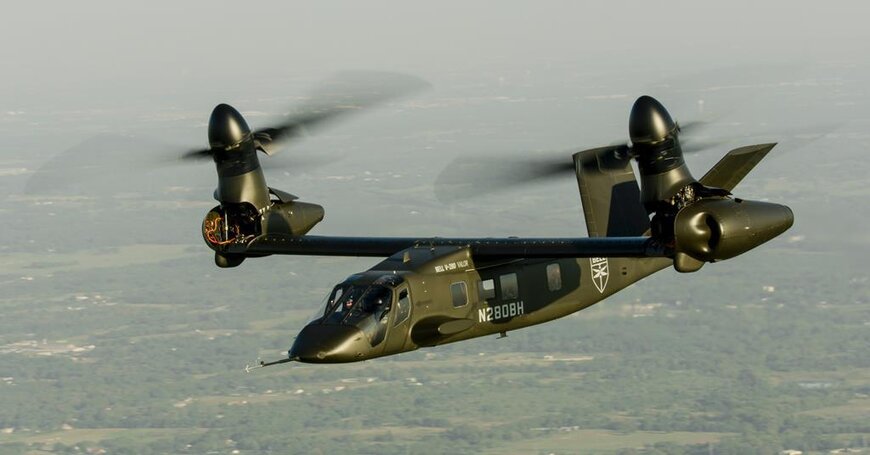
The U.S. Army's MV-75 Future Long Range Assault Aircraft (FLRAA) is ushering in a new era of military aviation through its adoption of a Modular Open Systems Approach (MOSA). This architectural framework allows for rapid, cost-effective upgrades to essential aircraft systems, ensuring adaptability and relevance against evolving threats. The MV-75 FLRAA breaks away from traditional, tightly coupled systems, allowing individual components to be upgraded or replaced without extensive system-wide redesign.
By the end of 2024, the MV-75 FLRAA program office rigorously evaluated over 1,600 distinct use case attributes within a comprehensive model-based systems engineering (MBSE) framework provided by Bell Textron Inc., a Textron Inc. Company. These assessments validated the MV-75 FLRAA’s ability to seamlessly integrate future upgrades, such as advanced sensors, weapons systems, and communication technologies, securing the Army’s technological advantage while maximizing long-term cost savings and minimizing downtime. This digital modeling approach allows engineers to identify and address integration challenges early in the design process.
MV-75 FLRAA: A Digital-First Aircraft
The MV-75 FLRAA stands out as one of the Army's first "digital-first" weapon systems, leveraging MBSE, digital twins—virtual representations of the physical aircraft—and MOSA. This approach allows the Army to virtually refine the MV-75 FLRAA’s architecture and simulate performance before physical construction, minimizing development risks and maximizing efficiency. This forward-thinking approach prepares FLRAA not just for today's battlefield, but for the anticipated threats of tomorrow.
Understanding MOSA
MOSA, a technical and business strategy for designing adaptable and affordable systems, is the Department of Defense's (DoD) preferred method for implementing open systems and is mandated by law (Title 10 U.S.C. 4401(b)) for all major defense acquisition programs. It enables "plug-and-play" integration of upgrades, allowing military equipment to evolve quickly and affordably by leveraging competition among vendors and fostering innovation. This contrasts with traditional procurement processes, which often involve costly and time-consuming custom integration efforts. MOSA fosters competition and drives down costs, ensuring the Army gets the best technology at the best price.
Implementing MOSA in MV-75 FLRAA
A critical aspect of the MV-75 FLRAA's MOSA implementation is defining specific, measurable technical and operational goals. While designed for high-speed, long-range missions, MV-75 FLRAA must also accommodate rapid system upgrades to remain relevant in a dynamic threat environment. MOSA use cases—real-world scenario testing—help assess how well the MV-75 FLRAA meets these requirements. For example, integrating a new secure communication radio becomes a more streamlined process, ensuring compatibility with existing cockpit controls, displays, and network architectures.
Critically, MOSA helps the Army acquire intellectual property and data rights necessary to control future upgrades and avoid vendor lock-in. This provides flexibility in sustaining and evolving the MV-75 FLRAA throughout its projected service life, further reducing costs and fostering innovation.
As the Army finalizes the MV-75 FLRAA’s design, verifying the effectiveness of its MOSA framework to meet long-term operational needs is paramount. Early identification and mitigation of potential architectural challenges avoids costly and time-consuming redesigns later. Continuous collaboration with industry partners and rigorous design evaluations ensure the MV-75 FLRAA delivers on its demanding mission requirements.
www.bellflight.com
