
www.aero-defence.tech
11
'24
Written on Modified on
Siemens & PhysicsX collaborate to build AI-based deep physics simulation
PhysicsX is building its latest pre-trained deep physics model for aerodynamics on high-fidelity simulation data generated with the Siemens Xcelerator portfolio.
www.sw.siemens.com
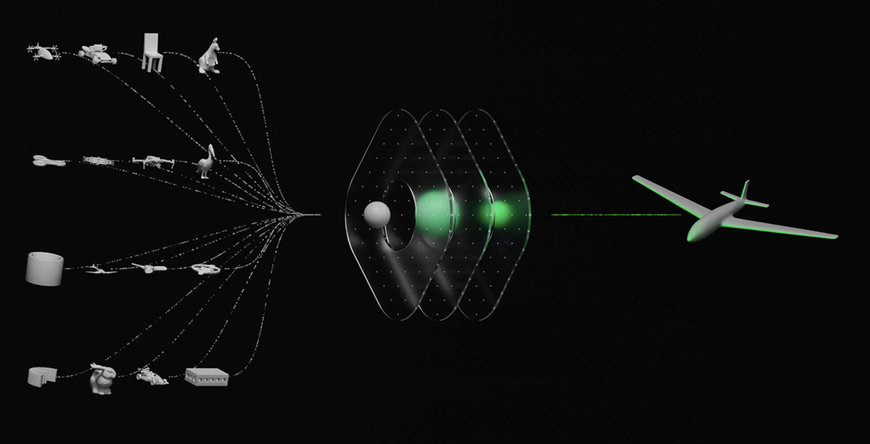
PhysicsX is building its latest pre-trained Large Physics Model (LPM) for aerodynamics on high-fidelity simulation data generated with Siemens’ Simcenter simulation software (image credit: PhysicsX)
Siemens Digital Industries Software announced its ongoing collaboration with PhysicsX, a startup leveraging generative AI to enable breakthrough engineering in advanced industries. Together, they aim to create the next generation of AI-based deep physics simulation to accelerate performance prediction and optimization.
Large Geometry Model (LGM) release
Much of the promise of AI in industrial applications starts with the dramatic acceleration that AI can bring to simulation. PhysicsX’s LGM-Aero is trained on a corpus of more than 25 million geometries and associated physics simulation. The training data contains tens of billions of mesh elements and tens of thousands of Computational Fluid Dynamics (CFD) and Finite Element Analysis (FEA) simulations using high-quality Simcenter™ STAR-CCM+™ software and Simcenter™ Nastran software. It allows users to fine-tune deep learning models for their own applications with as little as a few tens of simulations.
Technology demonstrator goes live
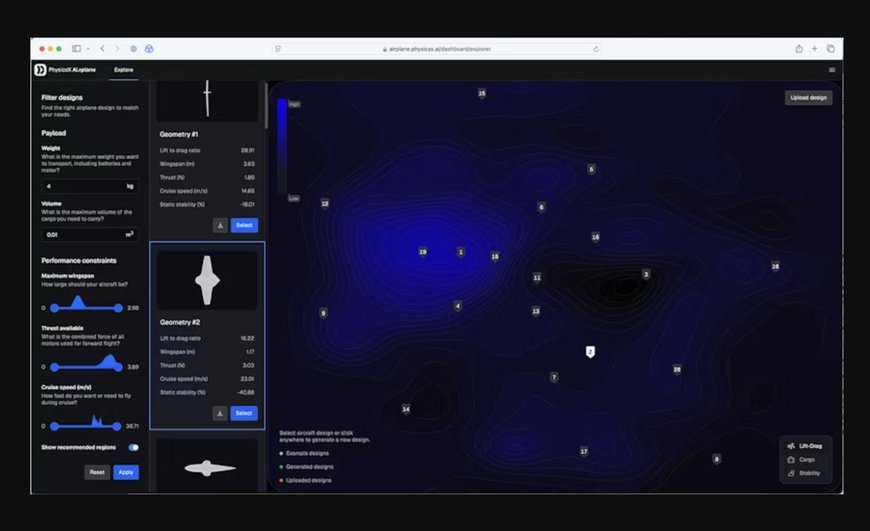
PhysicsX has released Ai.rplane, a free-to-use public-access technology demonstrator offering a set of exploratory tools focused on aerodynamics and aircraft structures with unique AI-shape generation – built on training data created using Siemens’ Simcenter Nastran and STAR-CCM+ software. (Image credit: PhysicsX)
PhysicsX has also released Ai.rplane, a free-to-use public-access technology demonstrator offering a set of exploratory tools focused on aerodynamics and aircraft structures with unique AI-shape generation. Ai.rplane is the world’s first Large Physics Model (LPM) for flight, a fully trained model that generalizes to a broad set of aeroelastic applications. Ai.rplane can infer aero performance, flight stability and structural stress for any flying shape and is a true zero-shot model. This technology creates geometry and delivers results in less than a second, compared to the several hours required for traditional numerical simulations.
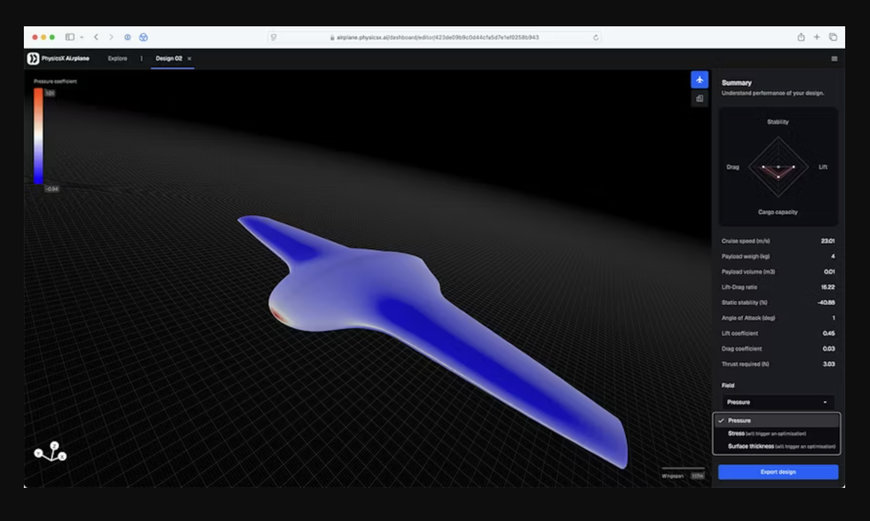
PhysicsX’s Ai.rplane is the world’s first Large Physics Model (LPM) for flight, a fully trained model that generalizes to a broad set of aeroelastic applications. (Image credit: PhysicsX)
Starting with a basic set of instructions, users can explore the full generative design space offered by Ai.rplane, then modify or optimize for a desired performance characteristic in seconds. Over time, PhysicsX aims to add new features, including cargo packaging, selection of commercial powertrains, and controls.
Ai.rplane was developed using an extensive set of simulation technologies from Siemens to automate the generation of high-quality training data. Both LGM-Aero and Ai.rplane are available on the PhysicsX AI engineering platform.
Siemens Digital Industries Software announced its ongoing collaboration with PhysicsX, a startup leveraging generative AI to enable breakthrough engineering in advanced industries. Together, they aim to create the next generation of AI-based deep physics simulation to accelerate performance prediction and optimization.
Large Geometry Model (LGM) release
Much of the promise of AI in industrial applications starts with the dramatic acceleration that AI can bring to simulation. PhysicsX’s LGM-Aero is trained on a corpus of more than 25 million geometries and associated physics simulation. The training data contains tens of billions of mesh elements and tens of thousands of Computational Fluid Dynamics (CFD) and Finite Element Analysis (FEA) simulations using high-quality Simcenter™ STAR-CCM+™ software and Simcenter™ Nastran software. It allows users to fine-tune deep learning models for their own applications with as little as a few tens of simulations.
Technology demonstrator goes live
PhysicsX has released Ai.rplane, a free-to-use public-access technology demonstrator offering a set of exploratory tools focused on aerodynamics and aircraft structures with unique AI-shape generation – built on training data created using Siemens’ Simcenter Nastran and STAR-CCM+ software. (Image credit: PhysicsX)
PhysicsX has also released Ai.rplane, a free-to-use public-access technology demonstrator offering a set of exploratory tools focused on aerodynamics and aircraft structures with unique AI-shape generation. Ai.rplane is the world’s first Large Physics Model (LPM) for flight, a fully trained model that generalizes to a broad set of aeroelastic applications. Ai.rplane can infer aero performance, flight stability and structural stress for any flying shape and is a true zero-shot model. This technology creates geometry and delivers results in less than a second, compared to the several hours required for traditional numerical simulations.
PhysicsX’s Ai.rplane is the world’s first Large Physics Model (LPM) for flight, a fully trained model that generalizes to a broad set of aeroelastic applications. (Image credit: PhysicsX)
Starting with a basic set of instructions, users can explore the full generative design space offered by Ai.rplane, then modify or optimize for a desired performance characteristic in seconds. Over time, PhysicsX aims to add new features, including cargo packaging, selection of commercial powertrains, and controls.
Ai.rplane was developed using an extensive set of simulation technologies from Siemens to automate the generation of high-quality training data. Both LGM-Aero and Ai.rplane are available on the PhysicsX AI engineering platform.
www.sw.siemens.com
