
www.aero-defence.tech
20
'23
Written on Modified on
PRATT & WHITNEY AND VIRGINIA TECH PIONEER NEW TECHNOLOGY FOR GAS TURBINES
The Filtered Rayleigh Scattering for Thrust measurement (FRST) was successfully demonstrated on a test engine at Pratt Whitney Center of Excellence at Virginia Tech.
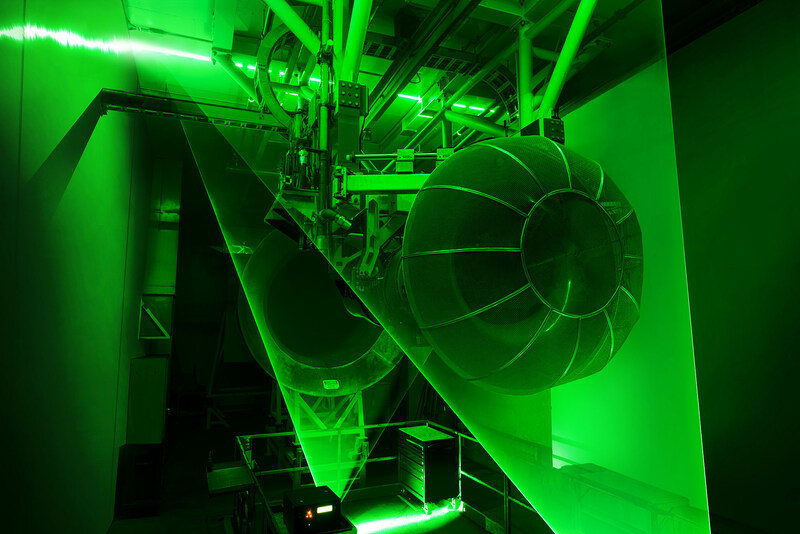
Pratt & Whitney and Virginia Tech announced a pioneering new technology for calculating thrust using lasers to enable high-fidelity measurement of key gas turbine engine parameters including velocity, temperature, and density.
Known as Filtered Rayleigh Scattering for Thrust measurement (FRST), this new optical instrumentation technique offers significant advantages compared to traditional sensors and probes, which will support the development of more efficient engine core technologies and could enable the measurement of non-CO2 particulate emissions in flight.
A patent-pending technology, FRST makes use of the ultraviolet light spectrum and relies on the principle that light scattering back from air molecules passing over a laser-illuminated area can provide information about the gas flow field, from which thrust can be derived. Applied to a turbofan engine, the light is provided by a laser beam directed across the turbine's gas path, while the resulting scatter is recorded by a high-performance camera and "filtered" for corruptions in the signal.
FRST optical instrumentation potentially eliminates the need for traditional sensors and probes, which can be difficult to install and cause flow blockage, particularly on smaller engine cores where space is limited. FRST also presents opportunities to measure non-CO2 particulate emissions, which could contribute to industry-wide efforts to understand and mitigate the environmental impact of those emissions, particularly with regard to contrail formation.
Pratt & Whitney and Virginia Tech's joint research team successfully measured engine thrust using FRST optical techniques on a research engine in a test stand at Virginia Tech recording similar accuracy to that of traditional sensors and probes. The teams are working towards flight testing the technology.
www.prattwhitney.com
