
www.aero-defence.tech
10
'23
Written on Modified on
TOSHIBA'S SUPERCONDUCTING MOTORS TO CHANGE THE FUTURE OF AIRCRAFT
The light, compact, high-output superconducting motor developed by Toshiba will contribute to carbon neutrality.
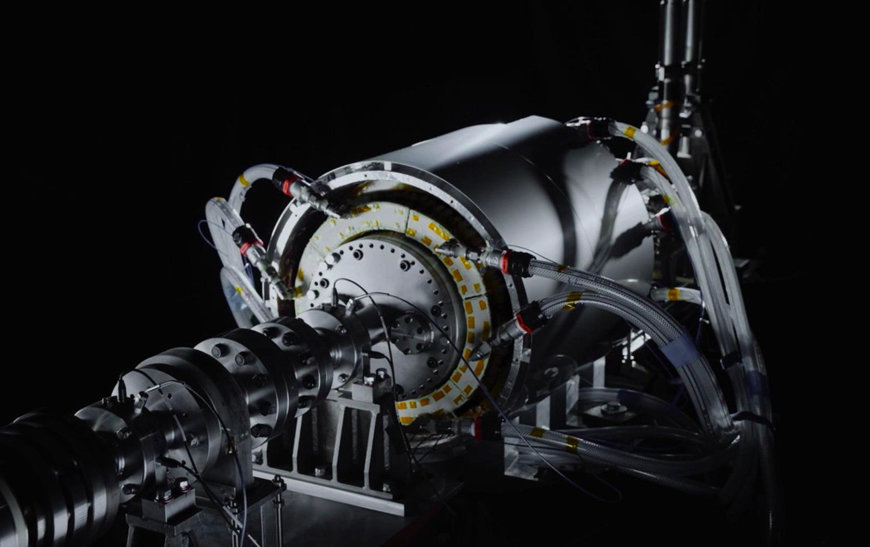
In October 2022, the International Civil Aviation Organization set new targets for reducing CO₂ emissions from international flights: a 15% cut from 2024 on, against 2019, and the achievement of net zero by 2050. The mobility industry is being transformed as electric vehicles replace gasoline-powered cars and grow in popularity, and now aircraft are also expected to replace fossil-fuel-powered jet engines with electric motors. However, it is currently very difficult to do that.
The solution to this global challenge can be found in Toshiba’s superconducting motor, a breakthrough that combines deep know-how with advanced technologies.
A world’s first in superconducting motors in the face of fierce global competition
Superconducting motors make it possible to simultaneously achieve the lightness required for mounting on aircraft and the high output needed to replace jet engines. That is why research institutes, universities, venture companies, and large corporations in countries around the world have started to develop them.
As competition grew, Toshiba began development work in November 2019, starting with a worldwide survey of development status and a study of technical concepts based on the survey.
Toshiba manufactures turbine generators and has many technologies for the manufacture of high-speed rotating machines. It also has the superconductivity technology necessary for light, compact, high-power motors. In March 2022, Toshiba achieved a breakthrough by producing the world’s first superconducting motor that was one-tenth of the size and weight of a conventional motor with equivalent output.
The advantages offered by superconductivity
Ryo Fuchimoto, the design leader for the motor’s rotor and its overall assembly, explains what a superconducting motor is, and how it differs from an ordinary motor.
“How can superconducting motors, which are small and light, generate high output power?” Fuchimoto asks rhetorically. “The reason is simply explained from the principle of the motor. It has a part that turns, the rotor, which is fitted with permanent magnets and housed in the stator, which is stationary and contains a coil that surrounds the rotor. Alternating current applied to the coil generates a rotating magnetic field that attracts the rotor’s magnets, causing it to rotate at the same speed. If we want to increase a motor’s output without changing its size, we need to increase the strength of the magnets in the rotor and of the rotating magnetic field in the stator. As permanent magnets in the rotor have limitations, we replaced them with electromagnets that generate a stronger magnetism when electricity is applied.”
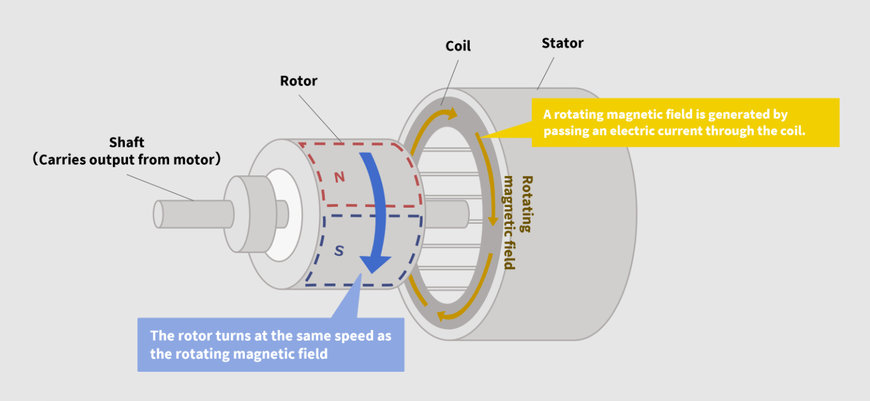
However, there is a problem. When the current is increased, electrical resistance in the coil generates heat; if the temperature gets too high it damages the coil. With ordinary coils, there is a limit to how much output can be increased without changing the size of the motor.
“There is a solution to this,” explains Fuchimoto. “Make the electromagnet coils superconductive. Superconductivity is the point of zero electrical resistance, and it is achieved by replacing normal coils, usually made with copper wire, with coils made from a superconducting material. When resistance in the coil is zero, even the application of a large current does not generate heat, and a strong magnetic field can be obtained. Making the electromagnetic coil of a motor a superconductor is the key to increasing the motor’s output to the maximum while maintaining a small size.”
Toshiba’s superconducting motor takes on a global problem. It promises a carbon-neutral solution no one has achieved before, and it could well change the future of aircraft.
www.toshiba-clip.com
