
www.aero-defence.tech
23
'26
Written on Modified on
Radiation-Tolerant Quartz Oscillators for Low Earth Orbit Satellite Systems
Microchip introduces the LX-820 to shorten lead times and mitigate radiation-induced frequency drift in space timing architectures.
www.microchip.com
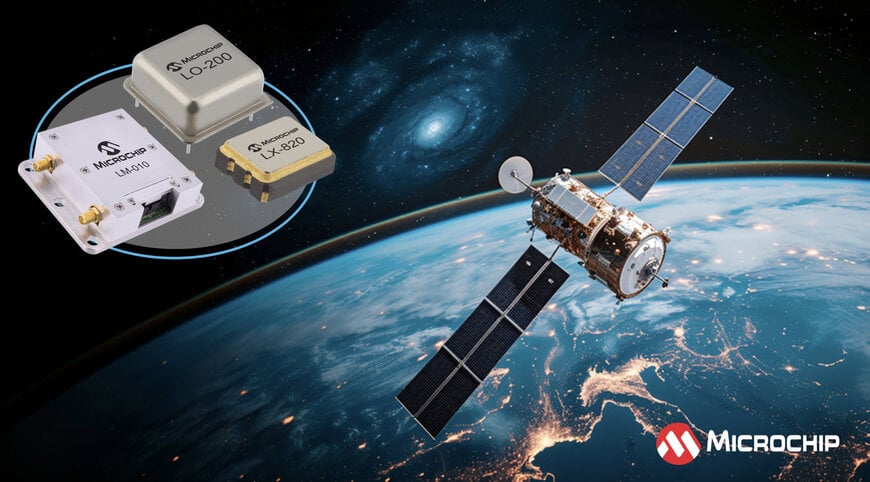
Deploying satellite constellations in Low Earth Orbit requires precision frequency references capable of withstanding ionizing radiation without incurring the protracted procurement cycles of traditional Class S flight hardware. Semiconductor supplier Microchip Technology has expanded its L-Series timing portfolio with the LX-820 radiation-tolerant quartz oscillator, engineered to provide high-reliability clock synchronization across aerospace communications, Earth observation, and orbital navigation payloads.
Mitigating Radiation-Induced Frequency Drift in Orbital Environments
Spacecraft operating in Low Earth Orbit (LEO) experience cumulative exposure to trapped protons and electrons in the Van Allen belts, as well as solar particle events. These environmental factors induce crystal lattice damage in conventional quartz resonators, causing permanent frequency offsets, increased phase jitter, and potential destructive latchup in active driver circuitry. While traditional deep-space missions absorb the financial and schedule overhead of fully customized, radiation-hardened components, commercial satellite operators require balance between radiation resilience and production scalability.
The LX-820 addresses these operational constraints by bridging commercial off-the-shelf (COTS) timing devices and high-reliability aerospace hardware. The complete, functioning oscillator undergoes lot-level screening, incorporating electrical characterization, thermal profile analysis, and hybrid assembly methodologies. The component achieves a Total Ionizing Dose (TID) radiation tolerance rating up to 50 krad and demonstrates Single-Event Latchup (SEL) immunity up to 40 MeV·cm²/mg. To mitigate radiation-induced frequency offsets, the underlying quartz element utilizes an electrolytic sweeping process, which extracts mobile interstitial impurities from the crystalline matrix under high-temperature electrical fields to ensure frequency stability under ionizing flux.
Electro-Mechanical Specifications and Surface-Mount Packaging
Packaged in a 3.2 mm × 2.5 mm hermetic surface-mount footprint, the LX-820 supports high-density board layouts in standardized satellite bus architectures, such as CubeSat and SmallSat platforms. The component is qualified to MIL-PRF-55310 Level B standards and is rated for continuous operational exposure across temperatures ranging from -55°C to 125°C.
The device provides an overall frequency stability performance of ±100 ppm across specified operating parameters. To accommodate varied payload interfaces, the oscillator supports two distinct output signaling configurations: standard CMOS logic across an output frequency span of 1.25 MHz to 135 MHz, and low-voltage differential signaling (LVDS) across an operating range of 100 MHz to 250 MHz for high-speed digital clock distribution.
According to Randy Brudzinski, corporate vice president of Microchip's frequency and time systems business unit, satellite development programs frequently face compounding friction between precision timing performance, procurement lead times, and programmatic budget ceilings, necessitating radiation-tolerant oscillator architectures that mitigate schedule disruption while protecting orbital mission lifespans.
Architectural Scalability Across Space Flight Payloads
The LX-820 serves as a discrete building block within Microchip's broader L-Series ecosystem, which addresses varied RF and processing payloads through tiered oscillator topologies. The family encompasses simple crystal oscillators (XOs) for low-power clock generation, temperature-compensated crystal oscillators (TCXOs) for tighter drift tolerances, oven-controlled crystal oscillators (OCXOs) with four-point crystal mounting designed to survive mechanical launch vibration while providing low phase noise, and pulse-per-second (PPS) disciplined oscillators for onboard holdover synchronization.
Standardizing screening protocols allows standard L-Series configurations to be delivered from inventory or within manufacturing lead times under 20 weeks, avoiding the multi-year qualification schedules frequently required for traditional space-grade frequency control devices.
Additional Context:
This section details technical specifications and competitive benchmarking not included in the original product announcement.
In military and aerospace electronic engineering, quartz oscillators for spaceflight are traditionally procured under MIL-PRF-55310 Class S specifications, which require extensive lot acceptance testing (LAT), destructive physical analysis (DPA), and traceability standards originally formulated for long-duration Geosynchronous Earth Orbit (GEO) missions. For LEO platforms operating at typical orbital altitudes between 400 and 1,200 kilometres with design lives of 3 to 7 years, expected total radiation exposure typically ranges between 10 krad and 30 krad depending on shielding thickness.
Competitors supplying radiation-tolerant quartz references for the New Space sector include Greenray Industries (such as the T1254 and T1276 radiation-hardened TCXO series) and Statek Corporation (such as the CXO-PN and specialized space-qualified surface-mount lines). While legacy Class S oscillators often require lead times between 40 and 65 weeks and guarantee TID tolerance up to 100 to 300 krad(Si), they carry significant cost premiums per unit.
The SWEPT quartz material process cited in the LX-820 design is an industry-standard electrochemical purification procedure governed by standards such as EIA-512. By applying a direct-current electrical field along the optical Z-axis of the quartz crystal at temperatures exceeding 500°C, interstitial alkali ions (such as Li+ and Na+) migrate toward the cathode, where they are substituted by hydrogen ions. This process eliminates defect centers that would otherwise trap radiation-induced holes, reducing both transient and steady-state frequency drift when exposed to space radiation.
Edited by Natania Lyngdoh, Induportals editor, with AI assistance.
www.microchip.com
