
www.aero-defence.tech
22
'26
Written on Modified on
Combat Unmanned Ground Systems Architecture & Autonomous Land Interoperability
Leonardo completes EDA Combat Unmanned Ground System trials validating open modular architectures for heterogeneous uncrewed vehicle combat coordination.
www.leonardo.com
Modern land warfare requires distributed sensory networks and robotic platforms capable of conducting high-risk reconnaissance and kinetic engagements without exposing human crews to direct fire. Achieving synchronized, multi-domain battlefield autonomy across disparate national defense platforms necessitates common open-system architectures that eliminate proprietary communication silos and standardize sensor-to-shooter control chains.
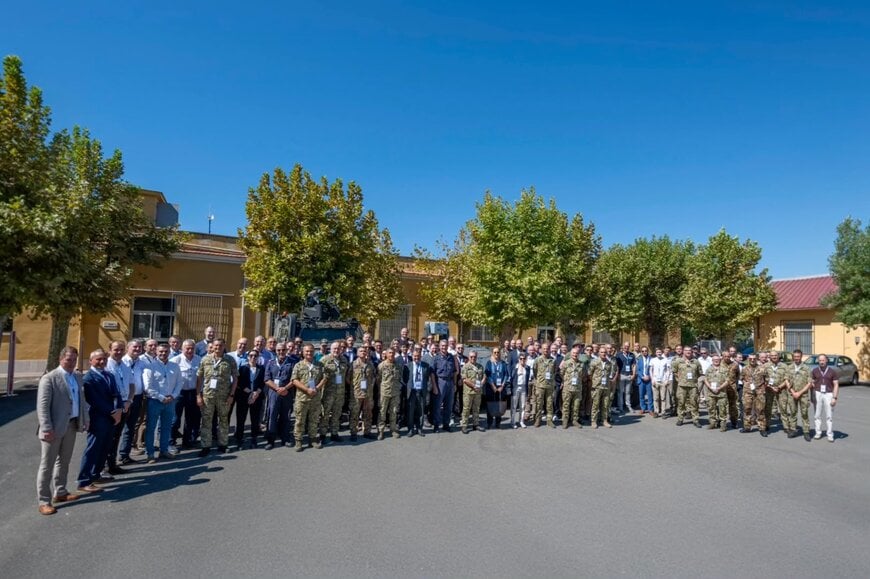
Industrial prime contractor Leonardo, acting as project coordinator on behalf of the European Defence Agency (EDA), concluded the final operational field demonstration for the Combat Unmanned Ground System (CUGS) research initiative. The multi-nation development program validates standardized functional modules designed to transform heterogeneous crewed and uncrewed ground vehicles, unmanned aerial systems, and precision loitering munitions into an interoperable autonomous combat network.
Modular Hardware Architecture and Functional Subsystem Integration
Autonomous ground warfare presents complex mechanical and sensor integration challenges, including dynamic obstacle negotiation, non-line-of-sight electronic warfare environments, and deterministic real-time weapons control. The CUGS architectural approach resolves these operational requirements by decoupling vehicle mobility platforms from mission-specific payloads through standardized combat functional modules.
Rather than developing a single bespoke vehicle, the engineering consortium engineered modular subsystems categorized into autonomous navigation, situational awareness, communications, command and control, cooperation (C3), and kinetic effector management. Onboard perception modules leverage multi-modal sensor arrays, fusing electro-optical, infrared, and telemetry data to enable real-time local environment mapping. Autonomous navigation algorithms process this sensor data at the edge, allowing platforms to calculate routes and identify obstacles independently without constant manual joystick steering.
Cross-Border Interoperability Across Heterogeneous Vehicle Classes
The final operational evaluation demonstrated cross-platform data exchange and distributed engagement chains across light, medium, and heavy land vehicles operating in conjunction with aerial reconnaissance assets. During the simulated tactical scenarios, a remote Command Post positioned several kilometers away from the active operational sector maintained continuous supervision across multi-nation robotic assets.
The exercise integrated diverse armored platforms, weapon stations, and unmanned aerial systems into a synchronized combat group:
- The Lince VTLM-2 light tactical vehicle paired with the Hitrole remote weapon station, developed by Iveco Defence Vehicles (IDV) and Leonardo.
- The THeMIS uncrewed ground vehicle developed by Milrem Robotics, integrated with the Hornet remote weapon station from Arquus.
- The ZSMU 1276 remotely controlled weapon module engineered by Zakłady Mechaniczne Tarnów.
- The Wiesel tracked platform provided by Rheinmetall.
- A dedicated uncrewed Scout Vehicle developed by the Military University of Technology (WAT) and the PIAP research institute.
- The Patria AMV heavy armored multi-role platform.
- The Thales Scout uncrewed aerial vehicle (UAV) providing aerial reconnaissance and localized situational awareness.
- Loitering munition systems supplied by MBDA for beyond-line-of-sight precision strike.
Human-in-the-Loop Target Engagement Mechanics
Dynamic targeting within the CUGS environment relies on artificial intelligence pipelines that process optical and infrared feeds to detect, track, and classify potential battlefield threats automatically. Once targets are acquired, onboard cooperation software calculates ballistic engagement parameters and routes targeting coordinates across the network.
To preserve strict functional safety and adherence to operational rules of engagement, the system enforces a continuous human-in-the-loop operational protocol. Artificial intelligence algorithms handle low-level cognitive burdens—including object detection, terrain categorization, and kinetic route planning—while the authorization to fire or execute tactical transitions remains under the uninterrupted command of operators at the standoff Command Post. Supervisory operators retain the ability to override automated behaviors and take manual control of any vehicle, sensor, or weapon station across the network.
Additional Context:
This section details technical specifications and competitive benchmarking not included in the original product announcement.
The CUGS project operated under an EDA research budget of 35.5 million euros over a 36-month execution cycle, serving as the European Union's largest dedicated research initiative for armed uncrewed ground vehicles. The program builds directly upon standard-based interoperability frameworks developed across European defense modernization roadmaps, specifically complementing the earlier Integrated Modular Unmanned Ground System (iMUGS) project funded by the European Defence Industrial Development Programme (EDIDP).
A primary technical driver of CUGS is compliance with the NATO Generic Vehicle Architecture (STANAG 4754) and STANAG 4586 for unmanned control system interoperability. NGVA defines standardized data buses, power distribution, and software middleware (typically utilizing Data Distribution Service, or DDS), enabling plug-and-play integration of third-party payloads such as remote weapon stations and active protection systems onto legacy hulls.
In comparison with international autonomous combat vehicle programs, the CUGS initiative emphasizes modular payload retrofits across existing military vehicle chassis rather than standardizing on a single purpose-built robotic hull:
The United States Army Robotic Combat Vehicle (RCV) program focuses on procuring specialized robotic vehicle classes divided by weight (RCV-Light, RCV-Medium, and RCV-Heavy). The U.S. approach standardizes vehicle control via the Modular Open Systems Approach (MOSA) and the Ground-system Drivetrain Architecture, deploying autonomy software through programs like the Robotic Technology Kernel (RTK). While the RCV program relies on dedicated ground-up robotic chassis with heavy armor integration, CUGS prioritizes platform-agnostic middleware that accommodates existing NATO-standard wheeled and tracked hulls spanning from 2-ton tracked UGV platforms to 25-ton 8x8 infantry fighting vehicles.
The British Army Robotic Platoon Vehicle (RPV) trials evaluated commercially available light wheeled and tracked UGVs primarily for dismounted infantry logistics, tactical resupply, and lightweight surveillance, utilizing lower-bandwidth tactical radio links. In contrast, CUGS engineers higher-echelon command-and-control architectures capable of managing complex kinetic effectors, vehicle-launched loitering munitions, and multi-sensor target handoffs across multi-kilometer standoff distances.
Edited by Natania Lyngdoh, Induportals editor, with AI assistance.
www.leonardo.com
