
www.aero-defence.tech
19
'26
Written on Modified on
Drone Detection Radar: Performance Analysis at Gardermoen
Kongsberg Demonstrated the DR 100 Drone Detection Radar at the Interpol Counter-UAS Test in October 2026 at Gardermoen Airport.
www.kongsberg.com
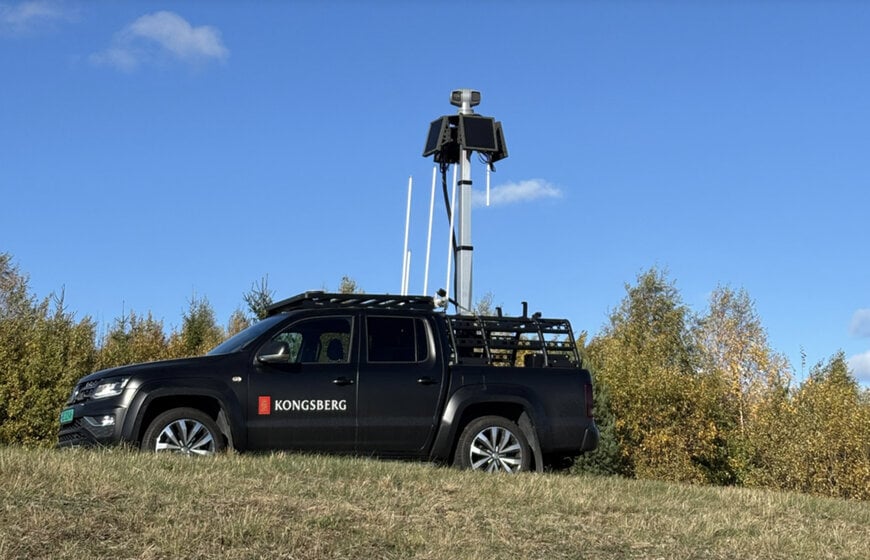
The Interpol Counter-UAS test took place in October 2026 at Gardermoen Airport in Norway, focusing on the evaluation of advanced counter-unmanned aerial systems for security applications. Kongsberg presented the Drone Detection Radar 100, deployed in a quad-radar configuration on a mobile pickup platform, targeting critical infrastructure protection in civilian environments.
Core Technology and System Architecture
The DR 100 utilizes a multi-sensor radar architecture mounted on a deployable vehicle platform, achieving full operational readiness within five minutes of arrival. Sensor data transmission relies on secure 5G cellular connectivity to relay telemetry to a centralized command center. Unlike traditional systems that apply high-pass filters to suppress ground clutter, the radar processes low-altitude returns without filtering out low-flying targets, maintaining detection continuity for small aerial signatures. The software suite classifies airborne targets, vehicles, and personnel simultaneously to establish comprehensive situational awareness.
Deployment and Integration
System deployment involves positioning the quad-radar pickup platform within a designated area of responsibility and establishing encrypted 5G data links to the control facility. The platform supports on-the-move capability, allowing detection and tracking while the vehicle is in motion. Integration pathways connect the radar telemetry output with broader counter-UAS command architectures, interfacing with third-party effectors including radio frequency jammers, small-calibre weapon systems, interceptor drones, and short-range missile solutions via standardized communication protocols.
Industry Applications
Primary deployment sectors include civil aviation airports, critical infrastructure facilities, and perimeter security perimeters where unauthorized drone activity threatens continuous operations. The system addresses the technical challenge of detecting slow, low-flying unmanned aerial vehicles against a background of ground clutter. By providing continuous tracking in civilian airspace, the radar supports security teams in maintaining airspace safety without disrupting normal commercial transport operations.
Operational Impact and Performance Metrics
The five-minute setup duration and on-the-move tracking capability eliminate the deployment delays associated with stationary mast-mounted radars. By avoiding low-altitude filtering, the architecture detects micro-drones that evade conventional surveillance. Decentralized data handling over secure cellular links reduces local processing overhead while delivering real-time track updates to remote operators, minimizing response times for critical infrastructure defense.
Edited by Sucithra Mani, Induportals editor – adapted by AI
www.kongsberg.com
