
www.aero-defence.tech
16
'26
Written on Modified on
Tiltrotor Drive System Testing and Digital Engineering
Bell Textron Inc. advances the MV-75 Cheyenne military aircraft program through structural nacelle integration, accessory gearbox validation, and ground-based avionics testing.
www.bellflight.com
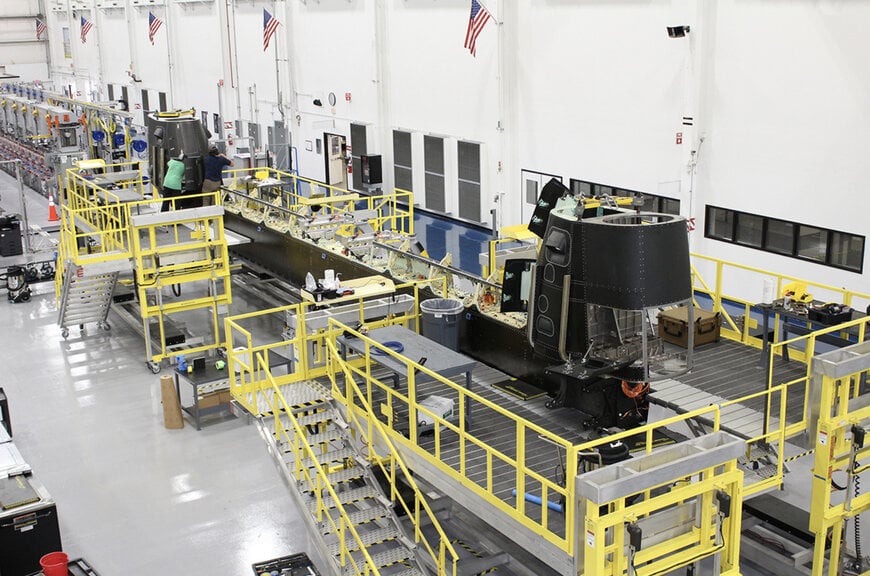
Developing next-generation military vertical lift platforms requires synchronizing complex mechanical drive trains, lightweight airframe structures, and distributed fly-by-wire software architectures before flight testing begins. To address these aeromechanical integration challenges for the United States Army aviation sector, Bell Textron Inc. and Team Cheyenne are executing parallel structural assembly, drive system validation, and digital backbone testing for the MV-75 Cheyenne test aircraft under Army Contracting Command - Redstone Arsenal Contract No. W58RGZ-23-C-0001.
Addressing Airframe and Propulsion Integration Challenges in Tiltrotor Manufacturing
In advanced rotorcraft and tiltrotor engineering, the interface between the wing and the engine nacelle represents a critical load-bearing and aerodynamic junction. Traditional aircraft development often experiences schedule delays during the physical mating of these primary structures due to tolerance stacking, complex tooling transitions, and intricate subsystem routing. Furthermore, verifying high-power drive systems and flight-critical avionics independently on the aircraft during final assembly introduces substantial technical risk prior to initial flight test phases.
To mitigate these manufacturing and integration bottlenecks, aerospace production workflows increasingly rely on end-to-end digital engineering and dedicated ground-based system integration laboratories. Digital thread methodologies connect three-dimensional design directly to tooling, detail part fabrication, and structural assembly, ensuring dimensional accuracy across distributed manufacturing sites. Concurrently, dedicated propulsion and avionics test beds allow engineers to validate mechanical loads, thermal management, and software logic in controlled environments before physical installation on the airframe.
Digital Engineering in Wing and Nacelle Structural Assembly
Applying this model-based engineering workflow, Bell completed the first nacelle structures for the MV-75 Cheyenne test aircraft and transferred the assemblies to its Amarillo Assembly Center in Amarillo, Texas. Following structural completion, manufacturing teams initiated the wing and nacelle assembly phase, executing the physical fit-up between the two primary components.
The transition from engineering design and tooling fabrication to detail part manufacturing and final structural mating demonstrates the operational viability of the digital engineering thread in reducing rework during complex airframe integration.
Drive System Architecture and Accessory Gearbox Validation
Alongside structural airframe assembly, the mechanical propulsion architecture has transitioned into empirical laboratory testing. In tiltrotor configurations, the drive system must reliably transfer mechanical energy from the primary powerplants to the proprotors while simultaneously driving essential aircraft subsystems. The MV-75 gearboxes serve as a vital node in this architecture, providing mechanical power to electrical power generators, hydraulic pumps, and cooling blowers dedicated to the engine and nacelle bays.
Bell maintained internal vertical control over the design, manufacturing, and testing of these drive components. Both the internal precision gears and the structural housings were fabricated at the Bell Manufacturing Technology Center (MTC) in Fort Worth, Texas. Following fabrication, the complete gearbox system was outfitted with test instrumentation and assembled at the MV-75 Drive System Test Lab (DSTL) in Grand Prairie, Texas, a specialized testing facility that began construction in 2023. Validating these instrumented gearboxes on dedicated test rigs allows engineers to verify mechanical efficiency, lubrication flow, thermal dissipation, and structural endurance under simulated operational loads.
Avionics and Digital Backbone Verification in the Weapon System Integration Lab
To ensure that the mechanical and structural systems operate cohesively with the aircraft control laws, parallel verification of the avionics architecture is underway at the Weapon System Integration Lab (WSIL) in Arlington, Texas. Opened two years prior to this testing phase, the WSIL serves as a hardware-in-the-loop environment designed to mature the software and digital backbone of the MV-75 prior to flight testing.
Within the laboratory, engineering teams have integrated key hardware components onto dedicated test benches to evaluate system-level interactions. The active test bench configurations encompass the flight control computers, general purpose computers, actuator drive units, electrical power distribution components, and cockpit large area displays. Conducting closed-loop software and hardware validation in the WSIL reduces technical risk by identifying interface latency, actuator response anomalies, and fault-handling issues on the ground, directly supporting a safer and more predictable flight test campaign in coordination with United States Army program requirements.
Additional Context:
This section details technical specifications and competitive benchmarking not included in the original product announcement.
In the broader military aviation context, the MV-75 program corresponds to the United States Army Future Long-Range Assault Aircraft (FLRAA) initiative, based on the Bell V-280 Valor tiltrotor demonstrator architecture. A primary engineering distinction between this second-generation tiltrotor design and first-generation benchmark platforms, such as the Bell Boeing V-22 Osprey, lies in the mechanical design of the nacelle and drive system.
In legacy V-22 tiltrotor configurations, the entire engine nacelle—housing both the turboshaft engine and the proprotor gearbox—rotates between vertical and horizontal flight modes. While effective, articulating the entire propulsion mass introduces complex mechanical, hydraulic, and thermal routing requirements across the wing-nacelle pivot, alongside high-temperature exhaust impingement on landing surfaces during vertical operations.
Conversely, modern tiltrotor engineering architectures utilize a stationary engine nacelle paired with a rotatable proprotor drive system. By keeping the turboshaft engines fixed horizontally within the nacelles and tilting only the forward proprotor gearboxes and mast assemblies, the mechanical complexity of the wing-to-nacelle interface is substantially reduced. This stationary nacelle approach simplifies structural load paths, improves center-of-gravity stability during transition flight, eliminates downward exhaust heating on unprepared landing zones, and streamlines routine line maintenance access. Furthermore, the digital backbone evaluated in the WSIL aligns with the United States Army Modular Open Systems Approach (MOSA) mandate, an engineering standard designed to decouple hardware from software so that mission computers, sensors, and avionics can be upgraded independently across the service life of the aircraft.
Edited by Sucithra Mani, Induportals editor – adapted by AI.
www.textron.com
