
www.aero-defence.tech
13
'26
Written on Modified on
Robotic Control Interface for Uncrewed Ground Vehicle Autonomy
Textron Systems introduces CoreMotion to bridge high-level autonomy software stacks with mechanical vehicle subsystems on ground fleets.
www.textron.com
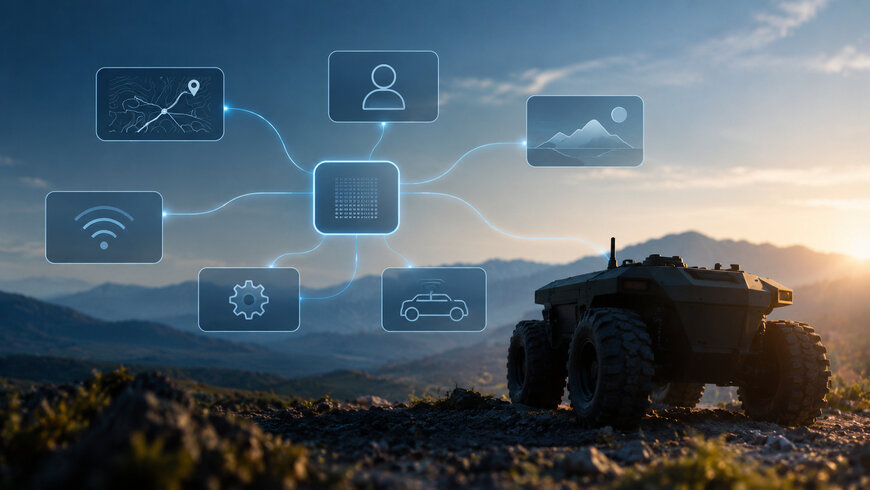
Integrating autonomous navigation stacks into legacy and purpose-built tactical vehicles presents complex electro-mechanical interfacing challenges that often stall modernization programs. To resolve these cross-platform interoperability issues, Textron Systems Corporation, a Textron Inc. business, launched CoreMotion, a robotic control package engineered to act as an execution bridge between high-level autonomy algorithms and low-level ground vehicle drive-by-wire mechanics.
Interoperability Challenges in Tactical Ground Autonomy
Defense organizations and industrial fleet managers modernizing tactical mobility encounter a fragmented automation ecosystem. Higher-tier autonomy architectures, perception sensors, and path-planning algorithms are frequently engineered without direct standardization for mechanical vehicle platforms. Connecting these algorithmic mission planning tools to base-level automotive mechanisms requires substantial translation engineering to manage throttle, steering, active braking, and energy distribution safely.
Without modular, intermediary control interfaces, converting legacy crewed transports or configuring newly fabricated uncrewed platforms demands bespoke hardware adaptations. This custom integration model increases technical risk, prolongs engineering cycles, and limits fleet operators from updating software or switching chassis architectures without completely overhauling their drive-by-wire controls.
Middleware Control Function and System Architecture
The CoreMotion package functions as an execution middleware layer. The platform intercepts, parses, and translates incoming trajectory, speed, and heading directives from autonomy algorithms or remote operator stations, converting those signals into actuation inputs across underlying vehicle subsystems. The hardware- and software-agnostic design ensures compatibility with varying autonomy systems and payload configurations.
The operational architecture combines hardened processing hardware with mechanical and electrical field-installation kits. Key assembly elements include:
- Vehicle-grade mission computers engineered for high-vibration off-road profiles.
- Electro-mechanical actuators interfacing directly with steering racks, service brakes, and transmission selectors.
- Integrated wiring harnesses and power distribution components configured for expeditionary installation.
- Control logic that coordinates human-directed inputs and machine-generated path guidance to safeguard propulsion stability in variable terrain.
Field Verification and Fleet Retrofit Applications
Before its standalone commercial introduction, the control architecture served as the operational backbone for the Textron Systems RIPSAW family of uncrewed ground vehicles. Across development and field testing, the control suite logged over 8,000 operational miles, demonstrating drive stability and fault tolerance under austere off-road conditions.
Because CoreMotion is packaged as an installable kit, operators can retrofit legacy crewed fleets into autonomous or optionally crewed assets without altering structural chassis designs or replacing established power plants.
Additional Context:
This section details technical specifications and competitive benchmarking not included in the original product announcement.
The defense mobility sector has converged on standardized architectural frameworks such as the Robotic and Autonomous Systems - Ground (RAS-G) interoperability profile and the Modular Open Systems Approach (MOSA). Historical attempts at autonomous ground platform retrofitting often relied on closed, proprietary actuation links that permanently bound vehicle control logic to a single defense contractor's hardware.
Competitive solutions in the tactical drive-by-wire and autonomy actuation segment include the Oshkosh Defense TerraMax system and the Pratt Miller Autonomous Modular Mobility system. While architectures like TerraMax provide tightly integrated autonomy kits tied closely to medium and heavy tactical trucks (such as the Family of Medium Tactical Vehicles and Heavy Expanded Mobility Tactical Trucks), standalone middleware packages like CoreMotion follow an open decoupling model. This architecture permits military and industrial customers to treat lower-tier drive-by-wire controls, mid-tier vehicle translation layers, and top-tier autonomy software (such as platforms evaluated under United States Army Robotic Combat Vehicle initiatives) as separate modular building blocks. This modularity reduces development expenses during fleet-wide lifecycle upgrades.
Edited by Natania Lyngdoh, Induportals editor, with AI assistance.
www.textron.com
Before its standalone commercial introduction, the control architecture served as the operational backbone for the Textron Systems RIPSAW family of uncrewed ground vehicles. Across development and field testing, the control suite logged over 8,000 operational miles, demonstrating drive stability and fault tolerance under austere off-road conditions.
Because CoreMotion is packaged as an installable kit, operators can retrofit legacy crewed fleets into autonomous or optionally crewed assets without altering structural chassis designs or replacing established power plants.
Additional Context:
This section details technical specifications and competitive benchmarking not included in the original product announcement.
The defense mobility sector has converged on standardized architectural frameworks such as the Robotic and Autonomous Systems - Ground (RAS-G) interoperability profile and the Modular Open Systems Approach (MOSA). Historical attempts at autonomous ground platform retrofitting often relied on closed, proprietary actuation links that permanently bound vehicle control logic to a single defense contractor's hardware.
Competitive solutions in the tactical drive-by-wire and autonomy actuation segment include the Oshkosh Defense TerraMax system and the Pratt Miller Autonomous Modular Mobility system. While architectures like TerraMax provide tightly integrated autonomy kits tied closely to medium and heavy tactical trucks (such as the Family of Medium Tactical Vehicles and Heavy Expanded Mobility Tactical Trucks), standalone middleware packages like CoreMotion follow an open decoupling model. This architecture permits military and industrial customers to treat lower-tier drive-by-wire controls, mid-tier vehicle translation layers, and top-tier autonomy software (such as platforms evaluated under United States Army Robotic Combat Vehicle initiatives) as separate modular building blocks. This modularity reduces development expenses during fleet-wide lifecycle upgrades.
Edited by Natania Lyngdoh, Induportals editor, with AI assistance.
www.textron.com
