
www.aero-defence.tech
13
'26
Written on Modified on
Containerized VTOL UAS Deployment for Austere Expeditionary Operations
Sikorsky introduces the Nomad 100 fast pack to resolve expeditionary launch, sustainment, and repositioning challenges in contested environments.
www.lockheedmartin.com
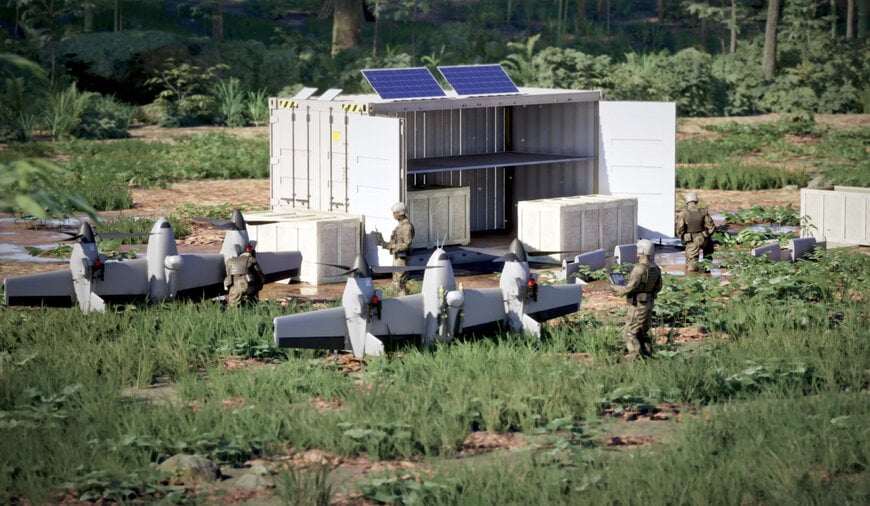
Modern defense and expeditionary forces face severe operational constraints when deploying uncrewed aerial platforms into infrastructure-denied, contested environments where traditional runways are unavailable. To resolve these forward-basing and logistics challenges, Sikorsky, a Lockheed Martin company, developed the Nomad 100 fast pack, a containerized vertical takeoff and landing uncrewed aerial system package engineered for immediate autonomous air operations with minimal footprint.
Forward Operational Constraints and Mobile Autonomous Systems
Deploying persistent aerial assets in modern tactical theaters frequently exposes support infrastructure to disruption. Conventional fixed-wing uncrewed aircraft require cleared landing strips, specialized arresting gear, or fixed mechanical launchers that tether tactical units to vulnerable geographic footprints. Conversely, standard rotary platforms demand dedicated logistical chains for maintenance, fueling, and communication support. The requirement for runway-independent aerial systems has shifted engineering priorities toward modular, self-contained packages that combine aircraft storage, ground control interfaces, auxiliary power, and maintenance equipment within standardized logistical shipping standards.
Containerized Architecture and Modular Deployment Strategy
The Nomad 100 fast pack integrates four vertical takeoff and landing aircraft within a single standard 20-foot ISO intermodal shipping container. The structural enclosure doubles as a transport housing and an operational ground station, incorporating mission command software, primary communication links, onboard power generation, and field-level sustainment tooling.
By utilizing standard intermodal container dimensions, the entire kit interfaces directly with standard civilian and military freight transport, including commercial container chassis, tactical transport trucks, cargo aircraft, and naval decks. Once situated at a tactical site, two Nomad 100 aircraft reach operational mission readiness in under 15 minutes. The remaining two platforms within the packaging can be brought to mission readiness within four to six hours, establishing a rotational sortie schedule without requiring external staging facilities.
Flight Mechanics and Autonomy Architecture
The aerial platform integrates vertical lift and hover capability with the horizontal cruise efficiency, airspeed, and extended range typical of fixed-wing airframes. This hybrid flight profile permits vertical ascent from unprepared terrain, tactical vehicle staging zones, and non-aviation ship decks without auxiliary arrestment gear.
Autonomous flight management is governed by the proprietary MATRIX architecture developed by Lockheed Martin. Rather than relying on rigid waypoint navigation or direct manual piloting, the software layer executes command-directed mission autonomy. The system processes flight parameters, dynamic routing changes, and environmental variables locally, allowing the vehicle to execute operational profiles, monitor internal component health, and navigate complex operational environments with reduced reliance on high-bandwidth, jam-vulnerable communication channels.
Expeditionary Mission Roles and Tactical Resupply
The platform configuration supports multirole operations across diverse expeditionary missions:
- Intelligence, surveillance, reconnaissance, and targeting operations across land and maritime sectors.
- Light tactical strike and precision engagement in infrastructure-limited operating areas.
- Contested logistics and rapid delivery of critical components to isolated personnel.
Once field objectives are met or the operational perimeter is compromised, the systems repack into the ISO housing. The unit can be secured, loaded onto tactical ground transport or maritime assets, and relocated to secondary staging sites, reducing the likelihood of targeting during extended forward deployment.
According to Rich Benton, vice president and general manager at Sikorsky, packaging aircraft, mission command systems, data communications, power, and maintenance equipment into a standardized containerized architecture enables operators to deploy, operate, and displace vertical takeoff uncrewed capability across dispersed theaters.
Additional Context:
This section details technical specifications and competitive benchmarking not included in the original product announcement.
Expeditionary military doctrine has driven broader procurement shifts toward modular, runway-independent Group 3 and Group 4 autonomous systems. Historically, forward-operating units relied on trailer-mounted catapult launch systems and skyhook recovery apparatus, as seen in platforms like the Boeing Insitu ScanEagle and RQ-21A Blackjack. While these pneumatic and mechanical architectures removed runway dependencies, they introduced bulky ground support footprints and high personnel demands during mechanical retrieval.
In contrast, modern tactical architectures increasingly adopt hybrid vertical takeoff and landing profiles, matching designs evaluated across United States Department of Defense initiatives such as the Future Tactical Unmanned Aircraft System program. By standardizing the logistical package to 20-foot ISO shipping enclosures, systems align with ISO 668 dimensional and handling standards, ensuring compatibility with standard military logistics vehicles like the Heavy Expanded Mobility Tactical Truck and Palletized Load System without custom flatbed configurations. The combination of local autonomous flight management, containerized power, and short setup intervals reflects a broader engineering shift toward dispersed, low-signature tactical mobility.
Edited by Natania Lyngdoh, Induportals editor, with AI assistance.
www.lockheedmartin.com
According to Rich Benton, vice president and general manager at Sikorsky, packaging aircraft, mission command systems, data communications, power, and maintenance equipment into a standardized containerized architecture enables operators to deploy, operate, and displace vertical takeoff uncrewed capability across dispersed theaters.
Additional Context:
This section details technical specifications and competitive benchmarking not included in the original product announcement.
Expeditionary military doctrine has driven broader procurement shifts toward modular, runway-independent Group 3 and Group 4 autonomous systems. Historically, forward-operating units relied on trailer-mounted catapult launch systems and skyhook recovery apparatus, as seen in platforms like the Boeing Insitu ScanEagle and RQ-21A Blackjack. While these pneumatic and mechanical architectures removed runway dependencies, they introduced bulky ground support footprints and high personnel demands during mechanical retrieval.
In contrast, modern tactical architectures increasingly adopt hybrid vertical takeoff and landing profiles, matching designs evaluated across United States Department of Defense initiatives such as the Future Tactical Unmanned Aircraft System program. By standardizing the logistical package to 20-foot ISO shipping enclosures, systems align with ISO 668 dimensional and handling standards, ensuring compatibility with standard military logistics vehicles like the Heavy Expanded Mobility Tactical Truck and Palletized Load System without custom flatbed configurations. The combination of local autonomous flight management, containerized power, and short setup intervals reflects a broader engineering shift toward dispersed, low-signature tactical mobility.
Edited by Natania Lyngdoh, Induportals editor, with AI assistance.
www.lockheedmartin.com
