
Electric Aircraft Propulsion Architectures
GE Aerospace, Safran, and magniX are developing distinct electric propulsion technologies addressing battery limitations, power generation, and aircraft efficiency.
induportals-media-publishing.com
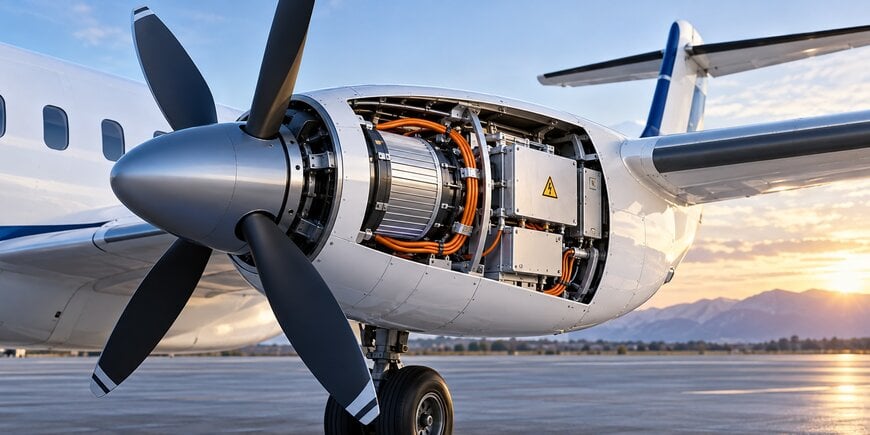
Aircraft electrification is not a single propulsion technology but a range of architectures with different energy sources, operating principles, and performance constraints. Battery-electric aircraft use stored electrical energy to drive motors without combustion engines. Hybrid-electric aircraft combine electric propulsion with conventional turbines, while turboelectric architectures use gas turbines to generate electricity for electric motors. These distinctions determine aircraft range, payload, fuel consumption, and integration complexity. Although electric motors can achieve efficiencies exceeding 90%, practical aircraft performance depends on the complete powertrain, including energy storage, generators, power electronics, cooling systems, and propulsors.
Current Technology Market Landscape
The principal engineering constraint is battery specific energy, measured in watt-hours per kilogram (Wh/kg). Jet fuel stores substantially more usable energy per unit of mass than current aviation batteries. Batteries also retain their mass throughout flight, whereas fuel consumption progressively reduces aircraft weight. Consequently, battery-electric propulsion is most practical for smaller aircraft and shorter missions, while hybrid-electric architectures offer a potential route toward regional and larger aircraft. High-power motors remain essential, but their kilowatt ratings describe output rather than the energy available to sustain flight. NASA's High-Efficiency Megawatt Motor program targets a 1.4 MW electric machine, illustrating the power levels required for future electrified aircraft.
Core Market Challenge
Integrating electric propulsion requires more than replacing a turbine with a motor. Engineers must manage battery mass, high-voltage distribution, thermal loads, electromagnetic interference, redundancy, and fault containment. Batteries must deliver sufficient power during take-off while retaining enough energy for cruise, reserves, and diversions. Hybrid systems introduce additional complexity through coordination between turbines, generators, motors, and energy-management controls. Certification must address electrical arcing, thermal events, and safe operation following component failures.
Existing Technology Solutions
GE Aerospace is developing a megawatt-class hybrid-electric powertrain with NASA, Boeing, and Aurora Flight Sciences. Installed alongside conventional CT7 turboprop engines on a modified Saab 340B test aircraft, the system integrates motor-generators, power converters, and energy-management technology. In 2026, the demonstrator completed flights above 30,000 feet, advancing evaluation of hybrid-electric propulsion for future commercial aircraft.
Safran supplies electric motors rather than a complete aircraft energy source. Its ENGINeUS range covers approximately 50 kW to 1 MW, with operation at voltages up to 850 VDC. The ENGINeUS 100 received European Union Aviation Safety Agency certification in 2025 after a programme involving 1,500 hours of motor certification testing and more than 100 flight hours. Its integrated power electronics support installation in all-electric and hybrid-electric aircraft.
magniX develops direct-drive electric propulsion units for aircraft applications. Its magni650 is rated at 700 kW peak power, with 515 kW continuous output, a dry mass of 144 kg, and a 500–850 VDC operating range. Under NASA's Electrified Powertrain Flight Demonstration programme, two magni650 units are planned for the outer engine positions of a Dash 7, while its inner turbine engines remain. Batteries supply electrical energy to the motors, making the demonstrator a hybrid-electric configuration.
Actual Implementation on the Ground
GE's Saab 340B programme demonstrates hybrid-electric powertrain operation in flight. Safran's certification establishes a regulatory milestone for an electric motor, not certification of every aircraft using it. magniX's Dash 7 programme evaluates the integration of battery-powered electric motors with retained turbine propulsion.
Summary and Strategic Future Outlook
The industry's progress depends on matching propulsion architecture to mission requirements. Battery-electric systems suit shorter-range applications, while hybrid-electric and turbine-generated electrical power offer alternatives where greater energy capacity is necessary. Improvements in battery specific energy, motor power density, power electronics, and certification will determine how far electrification can extend into regional and commercial aviation.
Edited by Lekshman Ramdas, Induportals editor – adapted by AI.
