
www.aero-defence.tech
01
'26
Written on Modified on
Military Helicopter Procurement and Modular Avionics Architecture
Lockheed Martin and the U.S. Army established an agile acquisition framework for UH-60 Black Hawk manufacturing to stabilize defense industrial base production.
www.lockheedmartin.com
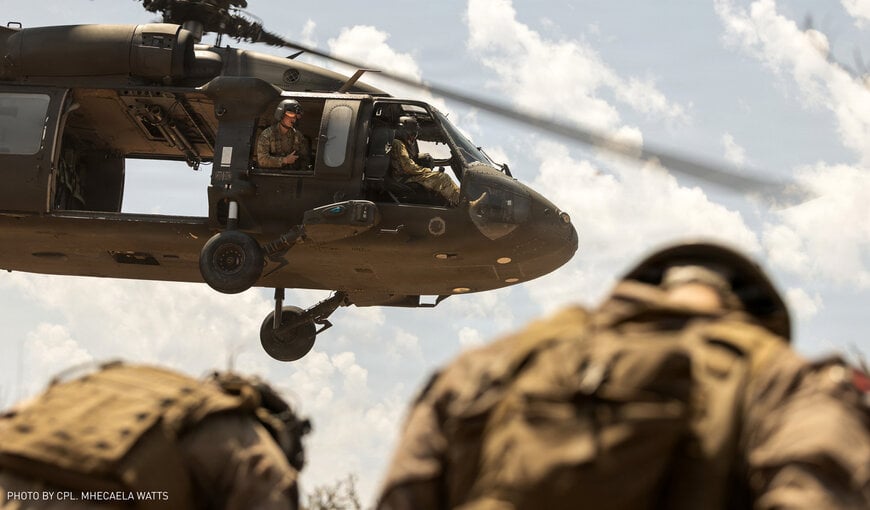
The U.S. Army and Sikorsky, a Lockheed Martin company, established a flexible production framework to manufacture UH-60 Black Hawk utility helicopters for domestic operations and foreign military sales. This industrial agreement integrates iterative fleet modernization, procurement agility, and multi-tier supply chain continuity across defense aerospace programs.
Industrial Structure and Procurement Framework
Conventional multi-year military procurement cycles often present lead-time friction when operational requirements or allied fleet needs shift. The framework enables the U.S. Army to incrementally procure airframes as funding and requirements emerge, beginning with an initial baseline of 16 aircraft funded through fiscal years 2025 and 2026 appropriations alongside Black Hawk Exchange and Sales Transaction divestment revenue. Projections anticipate scaling by more than 100 additional aircraft.
By structuring the acquisition mechanism around dynamic capacity, the procurement model eliminates production pauses across Sikorsky facilities and an industrial network spanning 230 suppliers across 43 states.
Technical Upgrades and Avionics Modernization
Modernization efforts center on increasing payload margins, operational range, and avionics interoperability across tactical transport, air assault, and medical evacuation profiles:
- Propulsion and Airframe: Integration of high-shaft-horsepower turboshaft engines combined with structural airframe reinforcements raises payload capacity and operational range under high-altitude, hot-day conditions.
- Open Architecture: Integration of a digital backbone compliant with the Modular Open Systems Approach standardizes electrical, communication, and software interfaces to reduce the integration cycle time of third-party hardware.
- Mission Systems: Incorporation of autonomous flight subsystems and air-launched effects directly into the tactical bus architecture.
Rich Benton, Sikorsky vice president and general manager, noted: "We’ve come to this structure to give the Army flexibility as their needs and budget change year-to-year, while maintaining a vehicle that can support FMS demand. This agreement turns a partner-nation decision into aircraft on the ramp faster than conventional procurement allows."
Lifecycle Sustainment and Fleet Interoperability
The utility fleet exceeds 5,000 delivered units across 36 allied nations, representing over 15 million cumulative flight hours. Retrofitting existing airframes with open systems hardware addresses lifecycle obsolescence while maintaining mechanical commonality with current maintenance logistics pipelines.
Col. Ryan Nesrsta, Project Manager for the Utility Helicopters Project Office, stated: "This contract ensures we maintain a ready, modern and survivable rotary-wing capability for the Army and our allies."
Integrating a Modular Open Systems Approach allows iterative subsystem updates without requiring full airframe recertification, sustaining operational viability through anticipated service lifecycles extending into the 2070s.
Edited by Evgeny Churilov, Induportals Media - Adapted by AI.
www.lockheedmartin.com
Lifecycle Sustainment and Fleet Interoperability
The utility fleet exceeds 5,000 delivered units across 36 allied nations, representing over 15 million cumulative flight hours. Retrofitting existing airframes with open systems hardware addresses lifecycle obsolescence while maintaining mechanical commonality with current maintenance logistics pipelines.
Col. Ryan Nesrsta, Project Manager for the Utility Helicopters Project Office, stated: "This contract ensures we maintain a ready, modern and survivable rotary-wing capability for the Army and our allies."
Integrating a Modular Open Systems Approach allows iterative subsystem updates without requiring full airframe recertification, sustaining operational viability through anticipated service lifecycles extending into the 2070s.
Edited by Evgeny Churilov, Induportals Media - Adapted by AI.
www.lockheedmartin.com
