
www.aero-defence.tech
17
'26
Written on Modified on
Lockheed Martin Demonstrates Legion Sensor System with Pod-to-Pod Data Link
This advancement enables pilots to establish near-instantaneous engagement solutions for multiple airborne targets, providing faster, more accurate situational awareness in radar-denied and contested environments.
www.lockheedmartin.com
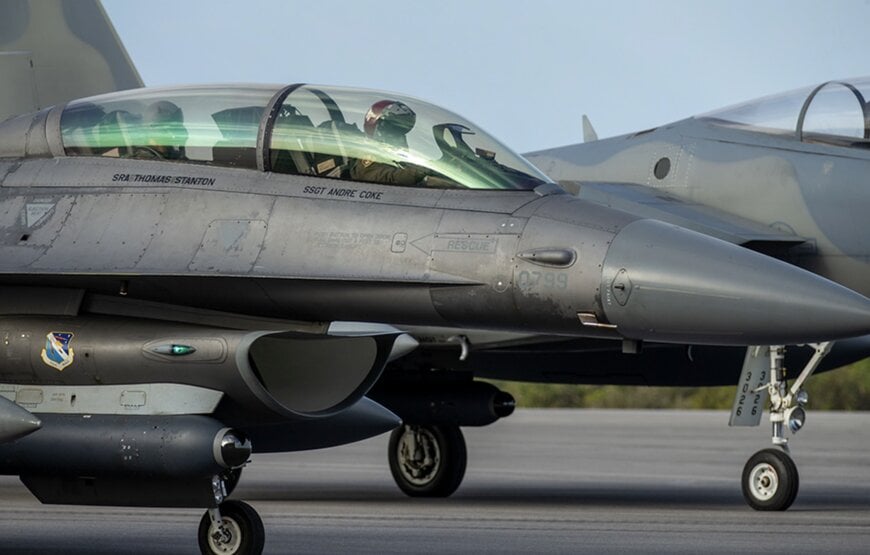
Lockheed Martin has completed flight evaluations of its Legion sensor system in Tucson, Arizona, demonstrating a dedicated inter-pod data link that provides pilots with near-instantaneous engagement solutions against multiple airborne threats. Operating in radar-denied and contested airspace, the networked configuration allows passive sensor pods to exchange targeting data directly, improving situational awareness without activating radio-frequency radar emissions.
Flight Test Integration and HiveLink Networking
Conducted in collaboration with the Air National Guard and the Air Force Reserve Test Center (AATC), the flight trials evaluated two F-16 aircraft operating from Morris Air National Guard Base. Both aircraft carried Legion sensor pods integrated with a pre-production variant of HiveLink, a tactical data link developed by L3Harris. In flight, the pods established direct connectivity to fuse tracking data, increasing target track accuracy and multi-target tracking stability.
Targeting Capabilities and Cockpit Workload Reduction
Formerly designated as IRST21, the Legion platform functions as a passive infrared search-and-track (IRST) sensor built on a modular open systems approach (MOSA). Equipping the pod with dedicated inter-pod communication establishes instantaneous range solutions across multiple aerial targets, providing aircrews with passive spatial depth perception to prioritize tactical engagements. Direct pod communication offloads computational and datalink processing from core aircraft systems, preserving onboard mission bus bandwidth and reducing pilot workload during intercept sequences.
Platform Roadmap and Fleet Interoperability
Lockheed Martin is executing the flight test series under an Air National Guard contract to demonstrate system transportability, processing performance, and joint interoperability. Future integration plans encompass software-defined radios, multi-waveform communication gateways, and operational connectivity for manned-unmanned teaming (MUM-T). Fielded and in active production for U.S. Air Force F-15 and F-16 aircraft, the podded architecture incorporates standardized mechanical and electrical interfaces, permitting cross-deck transportability to additional combat aircraft, support platforms, and uncrewed systems.
Additional Context
This section details technical specifications not included in the original news release.
Passive long-wave infrared (LWIR) search-and-track systems utilize stabilized optical scanning assemblies and cryogenically cooled focal plane arrays to detect aerodynamic skin friction heating and turbine exhaust plumes at beyond-visual-range distances. While isolated optical sensors provide precise angular line-of-sight tracking, determining target distance passively without laser rangefinders typically requires ownship kinematic s-turns that delay fire-control solutions. Dedicated pod-to-pod directional tactical datalinks resolve this limitation by correlating angular bearing lines from separated aircraft through continuous triangulation filters, calculating real-time three-dimensional target position vectors and closure rates. Tactical mesh radios operate using low-probability-of-intercept (LPI) and low-probability-of-detection (LPD) dynamic frequency-hopping waveforms compliant with Common Data Link standards, maintaining resilient peer-to-peer data distribution across electronic warfare environments without relying on satellite links.
Edited by Romila DSilva, Induportals Editor, with AI assistance.
www.lockheedmartin.com
