
www.aero-defence.tech
20
'26
Written on Modified on
L3Harris Demonstrates Interoperable Multi-Domain Defense Systems at Project Convergence
Capabilities include assured communications, Link 16 integration, electronic warfare and counter-UAS technologies for contested environments.
www.l3harris.com
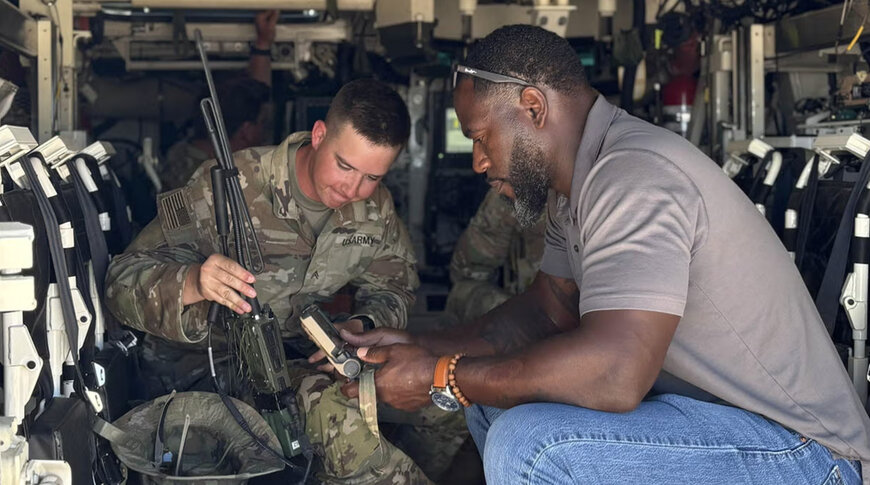
L3Harris Technologies showcased its next-generation command and control transport layer, modular electronic warfare payloads, and assured communications systems during recent United States Army exercises. The technology provides the military defense sector with a unified tactical communications ecosystem designed to link multi-domain sensors and effectors for rapid threat interdiction in highly contested operational environments.
Assured Communications and Tactical Data Link Integration
During the Army’s Project Convergence-Capstone 6 exercise at Fort Irwin, California, L3Harris established unified data networks bridging decision-makers with field-level sensors. The technical framework relied on interoperable multi-domain assured communications, establishing data-rich transmission paths resistant to intercept and active electronic jamming attempts. The architecture featured the physical integration of the Link 16 tactical data link standard onto UH-60 Black Hawk helicopters, enabling secure, encrypted exchange of situational awareness data between airborne assets and ground command units.
Modular Electronic Warfare and Counter-Unmanned Aerial Systems
The deployment utilized the Deceptor modular electronic warfare payload, a software-defined radio system built on commercial off-the-shelf hardware to provide electronic support and electronic attack capabilities. By leveraging adaptable digital radio frequency mechanisms, the payload enables automated signal detection, geolocation, and active suppression of hostile emitters.
In collaboration with ARX Robotics, L3Harris integrated an operational counter-unmanned aerial system utilizing the CORVUS-RAVEN node. The system functions as a multirole transceiver to detect, locate, and classify hostile signals in tactical environments without relying on active radar emissions.
Christopher Aebli, President of Communications and Spectrum Dominance at L3Harris, noted the structural readiness of the hardware: "Our wide range of open system defense technologies have modern, high-volume manufacturing and resilient supply chains to support their rapid delivery into the hands of soldiers, providing additional value to the U.S. government’s investments into software-defined and open-systems solutions."
Next-Generation Command and Control Validation
L3Harris is actively developing infrastructure for new military requirements following its selection as a transport layer provider for the Next Generation Command and Control architecture. The system establishes a resilient transmission layer to handle high-bandwidth data routing across disaggregated forces, ensuring uninterrupted command functionality.
The underlying technology underwent further validation at the Ivy Mass, Lightning Surge, and Operation Jailbreak field events. During these exercises, the proprietary Wraith waveform and the WESCAM MX-Series of electro-optical and infrared sensor systems successfully operated as "jailbroken" integrations, proving their ability to function seamlessly within open-architecture, third-party software environments.
Additional Context:
This section details technical specifications and competitive benchmarking not included in the original product announcement
The L3Harris Deceptor payload utilizes a multi-core digital radio frequency memory architecture to achieve strict size, weight, and power specifications suitable for autonomous platforms. The associated CORVUS-RAVEN system provides passive signal detection of hostile drone telemetry operating within the 2.4 and 5 GHz frequency bands, at confirmed field detection ranges exceeding three kilometers. In the tactical communications and electronic warfare sector, L3Harris competes directly with defense contractors such as Collins Aerospace and Northrop Grumman. Collins Aerospace provides the ARC-210 airborne communication system, while Northrop Grumman develops Freedom multi-domain radios. Competitive benchmarking within this field evaluates objective metrics including frequency hopping speeds, cryptographic modernization compliance, signal attenuation resistance, and integration compatibility with existing multi-national military data architectures.
Edited by Natania Lyngdoh, Induportals editor, assisted by AI.
www.l3harris.com
