
www.aero-defence.tech
07
'26
Written on Modified on
GaN Drone Drive Targets Professional UAV Propulsion
Allient Inc. has introduced a GaN-based electronic speed controller combining field-oriented motor control, configurable operation and diagnostics for professional unmanned aircraft propulsion.
allient.com
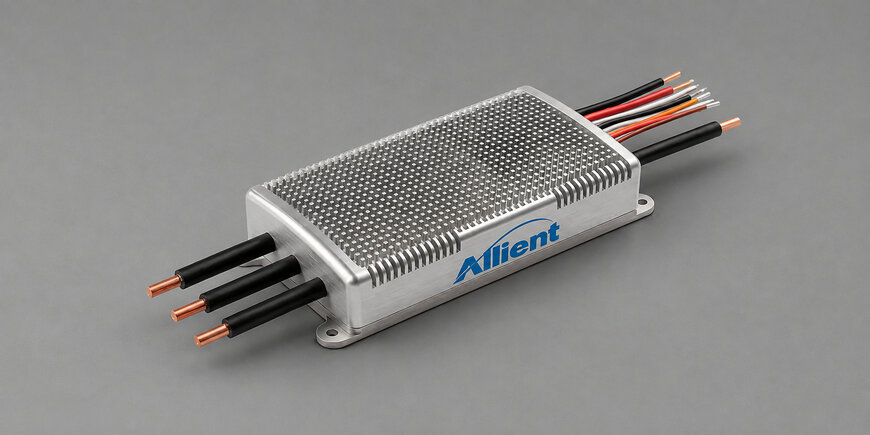
Allient Inc. has expanded its Intelligent Controls platform with an electronic speed controller (ESC) developed for professional unmanned aerial vehicle (UAV) propulsion. The controller combines gallium nitride (GaN) power electronics with high-speed field-oriented control (FOC) for defense, industrial, robotics and agricultural drone platforms.
GaN Power Electronics for UAV Propulsion
An ESC regulates electrical power delivered from a drone's battery system to its propulsion motors. Its switching behavior, motor-control algorithms and thermal characteristics therefore influence propulsion efficiency, motor response and heat generation within the aircraft.
The new controller uses GaN power technology rather than relying solely on conventional silicon-based power switching. GaN devices can support high switching speeds and low switching losses when implemented appropriately, characteristics that are relevant to compact power converters where thermal management and power density are important design constraints.
Allient has not disclosed the controller's input-voltage range, continuous or peak current rating, maximum electrical RPM, switching frequency, power density or measured conversion efficiency. As a result, the efficiency and thermal-performance improvements claimed in the announcement cannot yet be quantified against other UAV ESC architectures.
Field-Oriented Control Supports Different Motor Feedback Modes
The controller combines high-speed sensorless operation with encoder-based FOC. Field-oriented control regulates motor currents relative to the rotor's magnetic field, allowing torque-producing and magnetic-flux components to be controlled separately.
Sensorless operation eliminates the requirement for a physical rotor-position sensor in applications where the control system can estimate rotor position from electrical measurements. Encoder-based operation provides direct position feedback where the propulsion architecture requires measured rotor-position information.
Supporting both approaches gives UAV designers options when balancing system complexity, feedback requirements and motor-control performance.
The drive is also field programmable, allowing control parameters to be adjusted for different propulsion configurations and mission requirements. This can be relevant when an ESC must operate with different combinations of motors, propellers, payloads or aircraft configurations.
Thermal Management, Diagnostics and Communications
Allient states that the controller incorporates protection and diagnostic functions together with multiple communication interfaces. These functions are particularly relevant to professional UAV propulsion because motor-drive faults, excessive current or thermal conditions can directly affect propulsion availability.
The company also specifies low-noise and low-vibration operation as design objectives. In an FOC-based propulsion system, precise phase-current regulation can produce smoother motor torque than less sophisticated commutation methods, although the announcement provides no acoustic, vibration or torque-ripple measurements for the new controller.
Compact electronics are intended to support integration into UAV platforms where propulsion electronics compete with batteries, payloads, sensors and communications equipment for available mass and installation volume.
Defense and Industrial Drone Integration
The controller is intended for unmanned systems operating in defense, industrial inspection, robotics and agriculture.
Allient states that the product will meet National Defense Authorization Act (NDAA) supply-chain requirements and is planned for inclusion in the Defense Contract Management Agency (DCMA) Blue UAS Framework / Catalog. This positioning addresses procurement and supply-chain requirements associated with U.S. government unmanned aircraft programs.
According to Jesse Dowd, General Manager of Allient Rochester, the development focuses on increasing efficiency, power density and reliability for mission-critical unmanned systems.
Additional Context:
This section details technical specifications and competitive benchmarking not included in the original product announcement
Published specifications for other professional UAV electronic speed controllers illustrate the measurable parameters normally used to evaluate this class of propulsion hardware.
Advanced Power Drives' F-Series provides one reference point. Its ESC family spans continuous-current ratings from 40 A to 200 A, with burst ratings reaching 300 A depending on model. The manufacturer specifies operation up to 14S for parts of the range and maximum motor speeds of up to 750,000 electrical RPM. The controllers support DShot communication, telemetry, current sensing and over-temperature protection.
For example, the APD 120F3[X]v2 is specified for up to 12S, corresponding to 50.4 V, with 120 A continuous current and 200 A burst current. Its peak output is specified at up to 9 kW, while the controller measures 70 × 30 × 20 mm and weighs approximately 20 g without cabling. APD defines its continuous-current rating at 100% throttle for 60 seconds with airflow of 33 m/s.
MGM COMPRO provides another professional propulsion reference, with electronic motor controllers and propulsion systems spanning approximately 3 kW to 400 kW for UAV, eVTOL, unmanned ground vehicle, marine and defense applications.
The main architectural distinction disclosed by Allient is therefore its combination of GaN power electronics, sensorless and encoder-based FOC, field-programmable tuning, diagnostics and planned defense supply-chain compliance. A direct numerical comparison with competing UAV ESCs is not yet possible because Allient has not published equivalent electrical and physical specifications such as voltage range, continuous and peak current, maximum motor speed, controller mass, dimensions or measured efficiency.
Edited by Sucithra Mani, Induportals editor – adapted by AI.
www.allient.com
