
www.aero-defence.tech
04
'26
Written on Modified on
Archer’s Midnight Completes California City-to-City eVTOL Flights
Piloted Midnight flights between Salinas and Monterey demonstrate fast intercity air taxi operations ahead of the White House’s eVTOL Integration Pilot Program.
www.archer.com
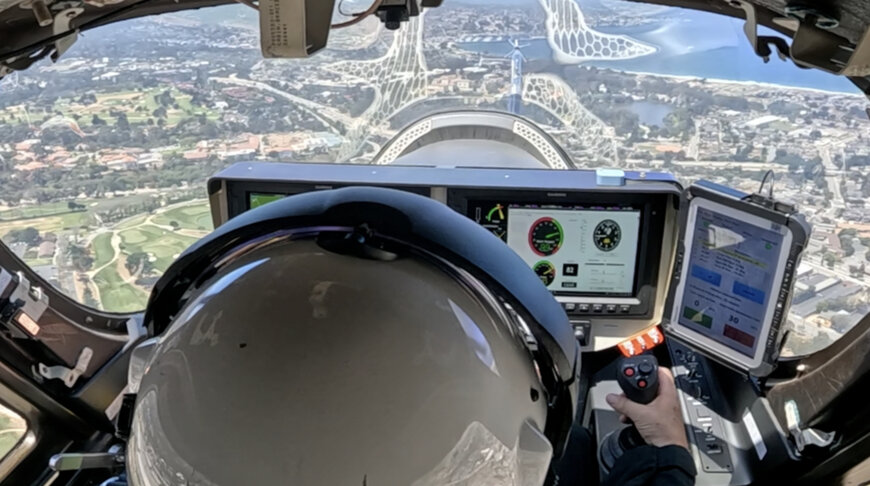
A view from Midnight’s cockpit during Archer’s round trip journey between Salinas and Monterey
Archer Aviation executed piloted, roundtrip flights utilizing an all-electric vertical takeoff and landing aircraft between Salinas Municipal Airport and Monterey Regional Airport. This flight testing validates the operational capabilities of electric air taxis within the regional air mobility ecosystem, supporting imminent deployments under the White House’s eVTOL Integration Pilot Program.
Operational Validation and Flight Metrics
On July 30, the all-electric Midnight aircraft completed successive intercity flight legs, covering the distance in approximately nine minutes per segment. This airborne transit offers a measurable reduction in travel time compared to traditional automotive transport, which requires 35 minutes or more for the equivalent route. By coordinating the flight profile with the Federal Aviation Administration, the company established baseline operational procedures required for integrating electric vertical takeoff and landing vehicles into controlled airspace. The aircraft is engineered to replace 60-to-90-minute ground commutes with rapid, battery-powered flights, utilizing electric propulsion to minimize acoustic signatures and eliminate direct emissions.
Infrastructure and Regional Air Mobility Expansion
The successful intercity transit functions as a proving ground for the operational infrastructure necessary to support high-frequency commercial air taxi services. Under the framework of the White House’s eVTOL Integration Pilot Program, the company collaborates with federal, state, and municipal entities to standardize airspace integration, charging protocols, and vertiport capabilities. Adam Goldstein, founder and CEO of Archer Aviation, stated that the completed route provides a scalable template designed for replication across partner states, including Texas, Florida, and New York. Furthermore, this regulatory and operational groundwork directly supports the company's contracted role as the designated air mobility provider for the upcoming LA28 Games in Los Angeles.
Additional Context:
This section details technical specifications and competitive benchmarking not included in the original product announcement
Within the electric vertical takeoff and landing sector, aircraft configurations are benchmarked on range, cruise speed, and payload capacity. The Midnight aircraft utilizes 12 electric motors and is designed to transport one pilot and four passengers with a maximum range of 100 miles and a cruise speed of 150 mph. In comparison, the Joby S4 aircraft, developed by Joby Aviation, employs a six-rotor tilt-propeller design, achieving a cruise speed of up to 200 mph and a maximum range of 150 miles with the same passenger capacity. Both platforms aim for an acoustic signature of approximately 45 dBA during cruise flight, representing a substantial reduction in noise emissions relative to conventional rotorcraft.
Edited by Natania Lyngdoh, Induportals editor, assisted by AI.
www.archer.com
Archer Aviation executed piloted, roundtrip flights utilizing an all-electric vertical takeoff and landing aircraft between Salinas Municipal Airport and Monterey Regional Airport. This flight testing validates the operational capabilities of electric air taxis within the regional air mobility ecosystem, supporting imminent deployments under the White House’s eVTOL Integration Pilot Program.
Operational Validation and Flight Metrics
On July 30, the all-electric Midnight aircraft completed successive intercity flight legs, covering the distance in approximately nine minutes per segment. This airborne transit offers a measurable reduction in travel time compared to traditional automotive transport, which requires 35 minutes or more for the equivalent route. By coordinating the flight profile with the Federal Aviation Administration, the company established baseline operational procedures required for integrating electric vertical takeoff and landing vehicles into controlled airspace. The aircraft is engineered to replace 60-to-90-minute ground commutes with rapid, battery-powered flights, utilizing electric propulsion to minimize acoustic signatures and eliminate direct emissions.
Infrastructure and Regional Air Mobility Expansion
The successful intercity transit functions as a proving ground for the operational infrastructure necessary to support high-frequency commercial air taxi services. Under the framework of the White House’s eVTOL Integration Pilot Program, the company collaborates with federal, state, and municipal entities to standardize airspace integration, charging protocols, and vertiport capabilities. Adam Goldstein, founder and CEO of Archer Aviation, stated that the completed route provides a scalable template designed for replication across partner states, including Texas, Florida, and New York. Furthermore, this regulatory and operational groundwork directly supports the company's contracted role as the designated air mobility provider for the upcoming LA28 Games in Los Angeles.
Additional Context:
This section details technical specifications and competitive benchmarking not included in the original product announcement
Within the electric vertical takeoff and landing sector, aircraft configurations are benchmarked on range, cruise speed, and payload capacity. The Midnight aircraft utilizes 12 electric motors and is designed to transport one pilot and four passengers with a maximum range of 100 miles and a cruise speed of 150 mph. In comparison, the Joby S4 aircraft, developed by Joby Aviation, employs a six-rotor tilt-propeller design, achieving a cruise speed of up to 200 mph and a maximum range of 150 miles with the same passenger capacity. Both platforms aim for an acoustic signature of approximately 45 dBA during cruise flight, representing a substantial reduction in noise emissions relative to conventional rotorcraft.
Edited by Natania Lyngdoh, Induportals editor, assisted by AI.
www.archer.com
