
www.aero-defence.tech
23
'26
Written on Modified on
Northrop Grumman Launches Mission Robotic Vehicle
First-of-its-kind satellite servicing vehicle and three life extension “jetpack” spacecraft enhance resilience and sustainment of assets in space.
www.northropgrumman.com
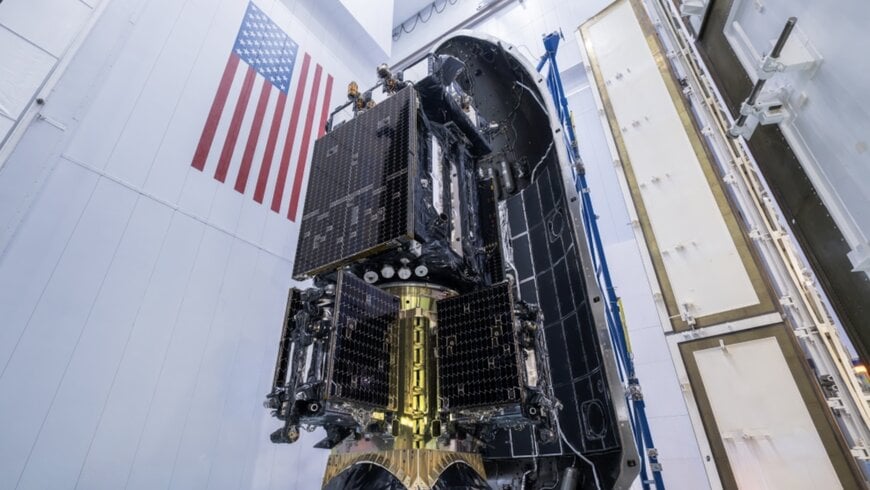
Northrop Grumman has launched its Mission Robotic Vehicle and three Mission Extension Pods to provide autonomous in-space robotic servicing and satellite life-extension capabilities. The system is engineered to perform orbital inspection, repairs, relocations, debris removal, equipment upgrades, and on-orbit maneuvering.
Space Robotics Platform and Payload Capabilities
Developed through an investment and partnership with the Defense Advanced Research Projects Agency (DARPA), the Mission Robotic Vehicle (MRV) operates as an autonomous, multi-function space robotics platform. The spacecraft expands options for satellite servicing by integrating a specialized robotics payload developed by the U.S. Naval Research Laboratory (NRL) under DARPA funding. This payload features two fully articulated robotic arms and specialized tools designed for complex in-space maneuvers, including satellite inspection, relocation, component repair, debris removal, payload upgrades, orbital experimentations, and structural assembly.
Satellite Life Extension and Refueling Interface
The three Mission Extension Pods (MEPs) function as supplemental propulsion units to extend operational lifespans and supply maneuvering capabilities for client satellites. Designed as a smaller-form-factor and more affordable alternative to first-generation servicing systems, MEPs can be rapidly deployed to a wide range of orbiting spacecraft.
To support sustained orbital maneuvering, the MRV incorporates the Passive Refueling Module (PRM). The PRM serves as the initial U.S. Space Force-approved docking and refueling interface standard, enabling the MRV to undergo on-orbit refueling for long-term space operations.
Autonomous Processing, AI Integration, and Space Hardware
The MRV incorporates advanced onboard processing hardware engineered to run future artificial intelligence-driven operational software. The integration of AI algorithms is designed to increase system reliability, lower operational expenditures, elevate mission assurance, and enable advanced in-space servicing tasks during future MRV deployments.
The mission relies on Northrop Grumman's established expertise in rendezvous and proximity operations (RPO) and docking. The company's first-generation servicing platform, the Mission Extension Vehicle (MEV), remains the only operational commercial spacecraft to extend the operational life of fuel-depleted satellites. To date, two on-orbit MEVs have docked with three commercial communications satellites in geosynchronous orbit (GEO), supplying over ten years of combined mission extension services.
The hardware architecture across the MRV, MEV, and MEP platforms utilizes domestic manufacturing processes. Onboard systems include company-built thermal control products and specialized flight electronics to protect and articulate the MRV's robotic arms, along with space-qualified drive electronics that operate the vehicle's electric propulsion thruster units.
Additional Context
This section details technical specifications not included in the original news release.
In-space servicing in geosynchronous orbit requires autonomous guidance, navigation, and control (GNC) algorithms paired with multi-sensor perception suites, including optical cameras, infrared sensors, and 3D flash LiDAR, to execute relative navigation and target tracking.
The Naval Research Laboratory robotic arm architecture features multi-axis articulated manipulators fitted with wrist-mounted force-torque sensors. These sensors provide closed-loop feedback to limit mechanical loads when grappling a target satellite's launch adapter ring or apogee engine nozzle. Concurrently, life extension via the Mission Extension Pods relies on high-efficiency electric propulsion, such as Hall-effect thrusters. Once docked, the pod takes over station-keeping duties—controlling inclination, eccentricity, and orbital drift—allowing the client satellite to conserve remaining onboard fuel while continuing primary payload operations.
Edited by Romila DSilva, Induportals Editor, with AI assistance.
www.northropgrumman.com
