
www.aero-defence.tech
14
'26
Written on Modified on
Dassault Aviation & Harmattan AI Validate NAMIB Electronic Warfare Payload in Rafale Flight Trial
Collaborative flight demonstrated autonomous electronic warfare payload detecting, geolocating and transmitting radar targets to a Rafale F4 for simulated engagement.
www.dassault-aviation.com
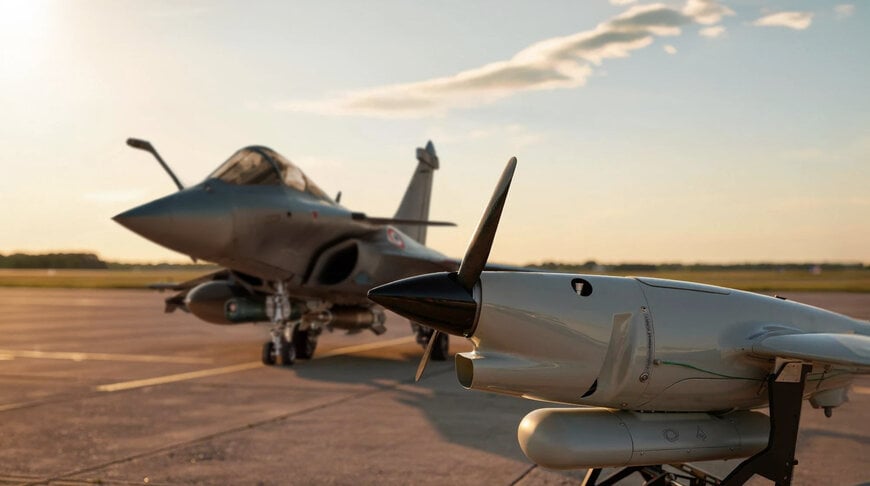
Dassault Aviation and Harmattan AI have executed a collaborative in-flight engagement to validate the NAMIB electronic warfare payload. The technical solution networks autonomous sensor platforms with centralized command architectures for military aviation and defense applications.
Application and Operational Use Cases
The system is designed for the aerospace defense industry, targeting advanced air combat architectures. A technical use case involves deploying the NAMIB payload on lightweight tactical drones to operate in close proximity to contested airspace. This configuration allows the system to detect and geolocate ground-based air defense radars. The resulting operational benefits include expanded sensor ranges for manned aircraft, improved target acquisition metrics, and enhanced process stability within multi-domain combat networks.
Cooperative Architecture and Roles
Addressing the challenge of integrating autonomous effectors with legacy combat networks required specific engineering expertise from both manufacturers. Dassault Aviation manages the overall combat system architecture and manned aircraft integration. Harmattan AI supplies the embedded intelligence and autonomous payload functionality. This cooperation establishes a network that links highly sophisticated manned systems with expendable, lightweight unmanned assets to scale electromagnetic detection capabilities across a wider operational area.
Technical Solution and System Integration
The NAMIB payload functions as an electronic warfare device engineered to identify and triangulate electromagnetic emissions. Harmattan AI designed the payload for compatibility with various unmanned platforms, including short-range quadcopters and long-endurance fixed-wing drones. Dassault Aviation adapted the communications architecture of its combat aircraft to receive data feeds from these autonomous nodes. The system operates by processing signal intelligence at the tactical edge and utilizing data links to transmit exact geolocation parameters to a central processing node.
Flight Testing and System Deployment
The technical approach was validated during a flight test involving a manned combat aircraft and a drone equipped with the NAMIB device. During the deployment, the unmanned system detected radar emissions from a distance of several dozen kilometers. The payload processed the signal, geolocated the source, and transmitted the spatial coordinates to the networked aircraft. The aircraft subsequently utilized the received data to execute a simulated strike sequence on the target coordinates.
Expected Impact
By distributing electronic warfare sensors to autonomous systems, the integrated architecture geographically extends the detection radius of manned platforms. The mechanism of separating the sensing payload from the primary strike platform reduces the probability of interception for high-value assets while establishing a measurable framework for decentralized combat networks.
Edited by Natania Lyngdoh, Induportals editor, assisted by AI.
www.dassault-aviation.com
