
www.aero-defence.tech
03
'26
Written on Modified on
Sensor Integration on Autonomous Ground Vehicles
Milrem Robotics and Hanwha Systems collaborate to engineer unmanned ground platforms equipped with specialized electronic warfare technologies for defense applications.
milremrobotics.com
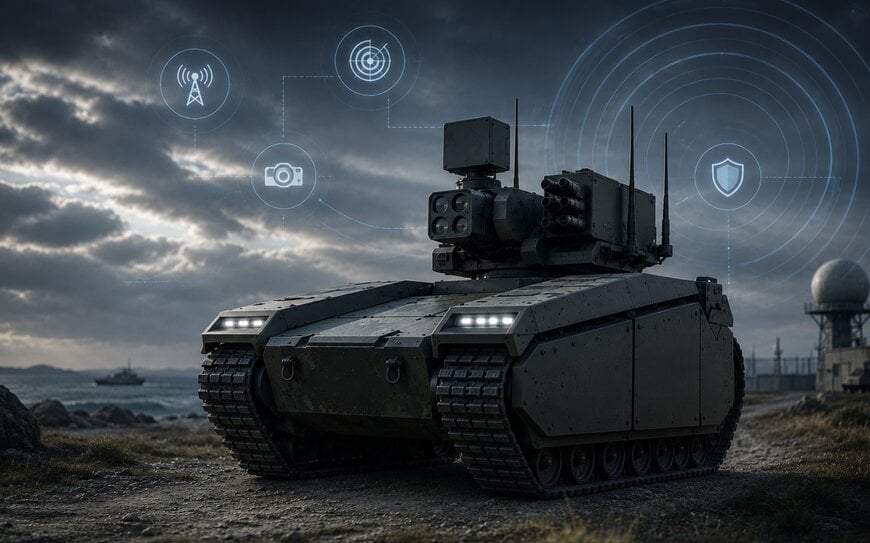
Milrem Robotics and Hanwha Systems have established a technical cooperation to integrate advanced sensor payloads and effector systems onto autonomous ground vehicles. This partnership targets the defense sector, specifically addressing the technical requirements for unmanned force protection and area security.
Applications and Use Cases
The primary application area is military defense, extending to the protection of critical infrastructure. Technical use cases include deploying unmanned platforms for perimeter surveillance, target identification, and electronic signal jamming. By removing human operators from direct line-of-sight exposure, these systems improve operational safety and enhance process stability during extended security and surveillance missions.
Roles and Industry Challenges
Military organizations require adaptable unmanned solutions capable of processing complex environmental data. Developing these systems presents significant integration challenges, requiring both robust robotic mobility and precise electronic payload management. The cooperation leverages Milrem Robotics' expertise in manufacturing ruggedized autonomous ground vehicle platforms and Hanwha Systems' specialization in military-grade sensor suites and integrated weapon systems.
System Architecture and Responsibilities
The technical architecture involves mounting Hanwha Systems' payload modules onto Milrem Robotics' existing unmanned chassis. Milrem Robotics provides the autonomous mobility platform, drive mechanisms, and navigation algorithms, while Hanwha Systems supplies the modular hardware payloads. Evaluated hardware components include electro-optical and infrared (EO/IR) imaging systems, radar arrays, electronic warfare and signal jamming systems, and laser or kinetic weapon integrations. The combined system is designed to process sensor inputs, detect environmental anomalies, and deploy appropriate technical countermeasures within standard operational parameters.
Deployment and Engineering Implementation
The initial framework for this integration phase was formalized at the Eurosatory defense exhibition in Paris, France, in June 2026. The respective engineering teams are conducting technical assessments to evaluate compatibility. Successful implementation requires cross-functional coordination to ensure the power distribution architecture and data interfaces of the autonomous chassis can adequately support the high-bandwidth data transmission and power-intensive requirements of active electronic warfare and radar payloads.
Operational Impact
The integration of these complementary technologies yields highly capable unmanned systems that systematically reduce personnel risk in hazardous environments. The modular hardware architecture enables rapid physical reconfiguration of the autonomous platforms based on specific mission profiles, increasing deployment flexibility and maintaining consistent hardware reliability across varying operational domains.
Strategic Perspectives
Peter BAE, Senior Vice President at Hanwha Systems, indicated that combining advanced sensors, electronic warfare systems, and autonomous ground platforms generates new methods for protecting military forces and critical infrastructure. He noted that the cooperation with Milrem Robotics aims to explore integrated capabilities to meet shifting operational requirements.
Kuldar Vaarsi, CEO of Milrem Robotics, explained that integrating advanced payload technologies with autonomous platforms enables the development of unmanned systems that increase operational effectiveness while removing personnel from hazardous situations.
Edited by Aishwarya Mambet, Induportals Editor, with AI assistance.
www.milremrobotics.com
