
www.aero-defence.tech
29
'26
Written on Modified on
Integrating dedicated small-satellite launch infrastructure with orbital science constellations
Rocket Lab is providing three dedicated launch vehicles to inject high-altitude instrumentation directly into specific, non-sun synchronous trajectories for NASA.
www.rocketlabusa.com
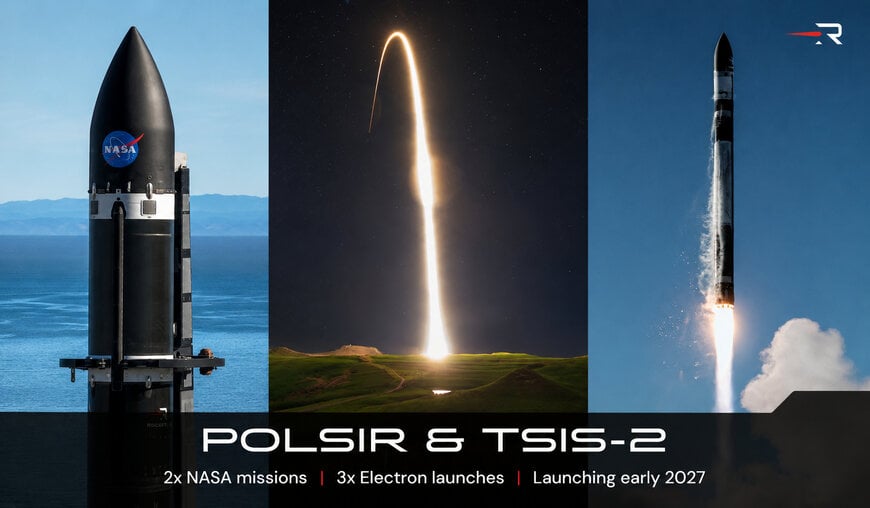
The technical cooperation integrates dedicated aerospace launch systems with high-altitude orbital instrumentation payloads. This framework establishes custom launch parameters to deploy environmental monitoring and solar irradiance sensors, targeting advanced digital infrastructure and public atmospheric forecasting networks.
Operational constraints in rideshare satellite deployment
Traditional space science missions frequently face deployment boundaries when relying on shared orbital transport models. Standard rideshare launches aggregate multiple corporate or institutional payloads onto a single secondary deployment ring, forcing individual satellites to accept compromise trajectories that deviate from their precise scientific baselines. For climate monitoring and atmospheric research constellations, variations in deployment parameters can cause orbital drift, which compromises cross-satellite daily comparison cycles and introduces telemetry lag.
Dedicated orbital injection and platform engineering
The joint operational framework resolves small-satellite deployment limits by using dedicated small-launch infrastructure tailored to specific instrumentation requirements. Under the technical agreement, NASA serves as the procuring agency specifying mission-critical payload parameters, while Rocket Lab provides the launch systems, vehicle engineering, and orbital delivery infrastructure.
The execution tasks are partitioned across specialized institutional capabilities:
- NASA components: Supply the instrumentation suites, including two polarized submillimeter ice-cloud radiometer CubeSats and a solar irradiance sensor satellite, and define precise timing windows.
- Rocket Lab components: Manufacture the dedicated launch vehicles, operate Launch Complex 1 in New Zealand, and execute the guidance control algorithms required for close-tolerance orbital injection.
The launch infrastructure uses custom flight software to target non-sun synchronous orbits at 52-degree inclinations. This allows the system to deliver the assets within meter-level accuracy thresholds, significantly reducing baseline alignment drift compared to traditional kilometer-level rideshare windows.
Phased deployment schedules and infrastructure testing
The system deployment protocol involves three independent launch phases scheduled to begin early next year. The initial phase utilizes a single launch system to place the solar energy science instrument into the top of the atmosphere to measure spectral solar irradiance.
The subsequent validation phase requires two consecutive launches from Launch Complex 1 to deploy the ice-cloud monitoring CubeSats into parallel free-flying orbits. This phased approach allows engineering teams to establish secure ground-station tracking connections sequentially, ensuring communication integrity across the newly established data network.
Expected technical benefits and atmospheric modeling impacts
Consolidating mission scheduling under a dedicated small-launch framework eliminates transit delays associated with secondary payload pools, accelerating deployment from contract signing to execution within a seven-month timeline. The high-precision orbital injection stabilizes daily, seasonal, and annual measurement cycles by minimizing corrective propulsion maneuvers by the satellites. This structural reliability ensures continuous data throughput for global Earth system models, improving long-term atmospheric and ozone layer forecasting predictability.
Edited by Sucithra Mani, Induportals editor – adapted by AI.
www.rocketlabcorp.com
Phased deployment schedules and infrastructure testing
The system deployment protocol involves three independent launch phases scheduled to begin early next year. The initial phase utilizes a single launch system to place the solar energy science instrument into the top of the atmosphere to measure spectral solar irradiance.
The subsequent validation phase requires two consecutive launches from Launch Complex 1 to deploy the ice-cloud monitoring CubeSats into parallel free-flying orbits. This phased approach allows engineering teams to establish secure ground-station tracking connections sequentially, ensuring communication integrity across the newly established data network.
Expected technical benefits and atmospheric modeling impacts
Consolidating mission scheduling under a dedicated small-launch framework eliminates transit delays associated with secondary payload pools, accelerating deployment from contract signing to execution within a seven-month timeline. The high-precision orbital injection stabilizes daily, seasonal, and annual measurement cycles by minimizing corrective propulsion maneuvers by the satellites. This structural reliability ensures continuous data throughput for global Earth system models, improving long-term atmospheric and ozone layer forecasting predictability.
Edited by Sucithra Mani, Induportals editor – adapted by AI.
www.rocketlabcorp.com
